You can make real, measurable progress with a scared bird in one day. But I want to be upfront with you: "taming" in 24 hours doesn't mean you'll have a bird stepping onto your hand by bedtime. What it does mean is that by the end of today, your bird should be noticeably calmer, less reactive to your presence, and starting to associate you with good things. That is genuine, meaningful progress, and it's absolutely achievable with the right approach. If you're in a hurry and want the fastest possible method for a pet bird, the quickest way to tame a bird still requires patience within each session, even if the overall timeline is compressed.
How to Tame a Scared Bird in 1 Day: Safe Plan
Clara Hayes
10 Apr 2026
Reality check: what you can actually achieve in 24 hours
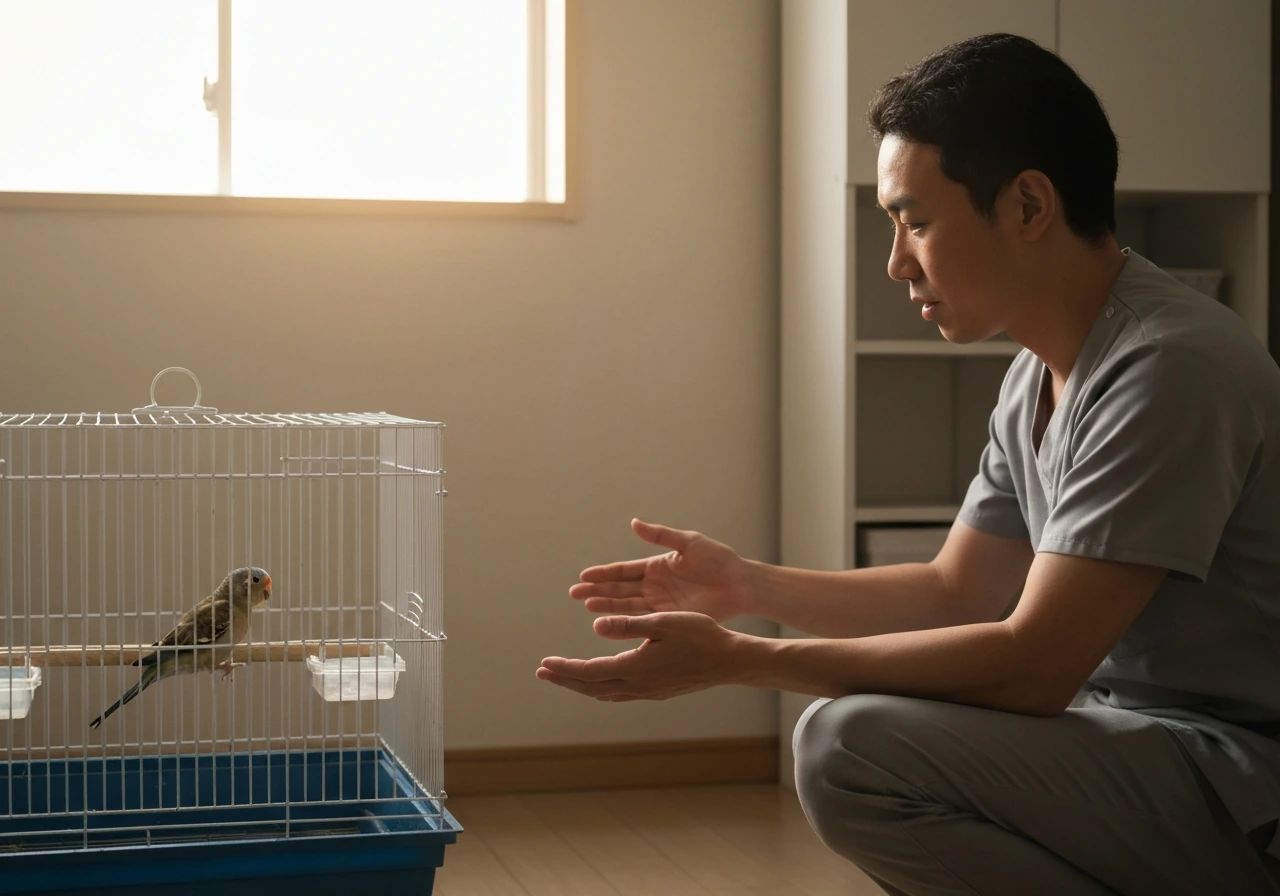
Let's set honest expectations first, because rushing this process is the single most common mistake people make. A scared bird is a bird running on adrenaline. Its nervous system is telling it that you are a predator. You can't override that in one afternoon by being persistent or forceful. What you can do, in a single day, is shift the bird from active panic to cautious tolerance, and in some cases to mild curiosity. That's the realistic goal.
Research consistently shows that short, repeated sessions work far better than long ones. Two to three sessions of 5 to 10 minutes each, spread across a day, will produce more trust than one 30-minute session. Each session ends on a calm note, which teaches the bird that your presence predicts safety and food rather than stress. By the end of day 1, a measurable win looks like: the bird doesn't bolt to the far side of the cage when you walk in, it eats or preens while you're nearby, or it takes a treat from near your hand. Those are real wins. Forced step-ups or restraint are not on today's agenda.
It's also worth knowing how long taming typically takes for different species and backgrounds, because a bird that was hand-raised but under-socialized will respond much faster than a wild-caught or parent-raised adult bird. Your day-1 results will vary by that history, and that's okay.
Quick safety triage before you do anything else
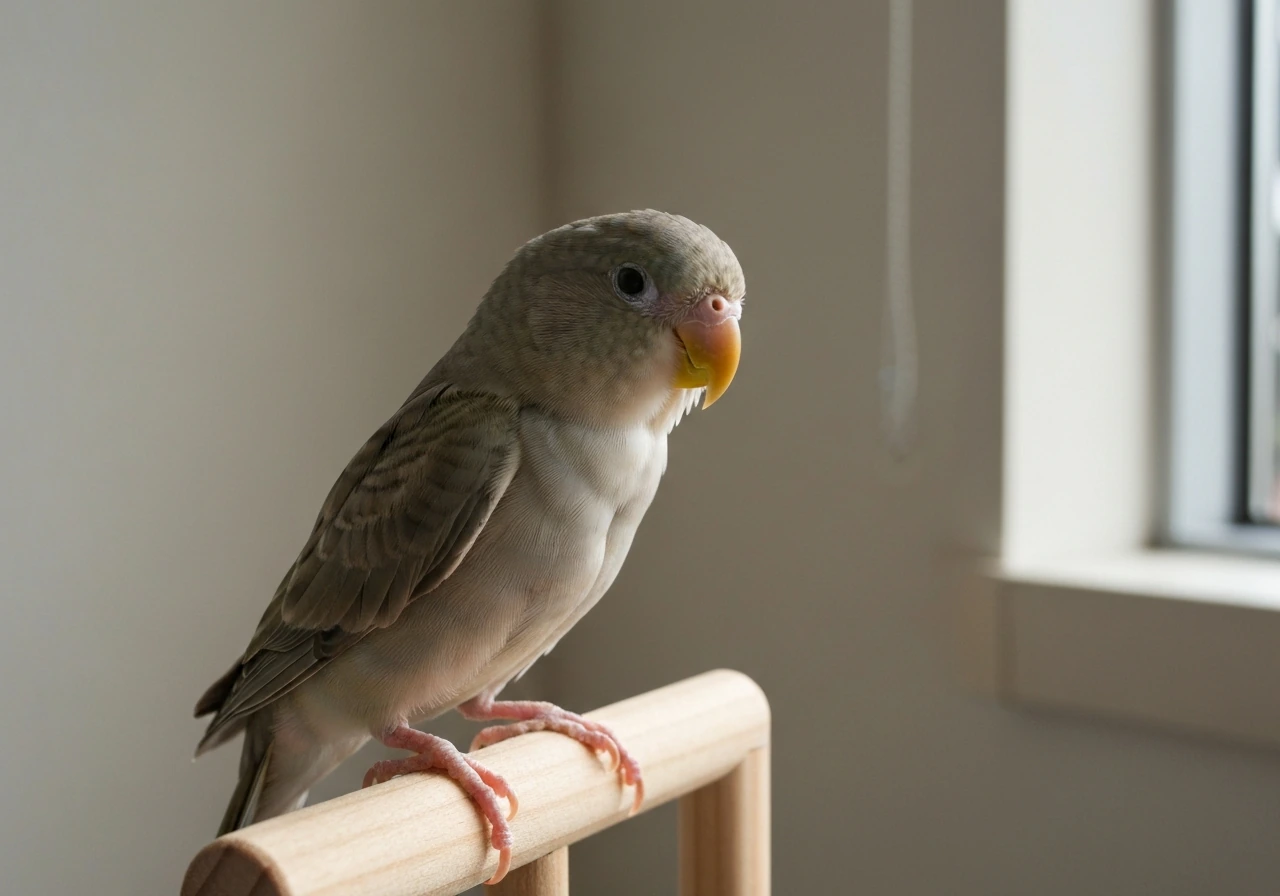
Before you attempt any taming or trust-building, you need to spend five minutes just watching your bird. Seriously, sit down, don't approach, and observe. A scared bird and a sick bird can look very similar, and the last thing you want to do is run a taming session on a bird that needs a vet. Training a sick bird can be dangerous for the bird.
Signs that mean stop and call a vet, not train
- Open-mouth breathing or panting at rest (not just after being chased)
- Tail bobbing in rhythm with each breath, which can signal respiratory distress
- Fluffed or ruffled feathers combined with lethargy or closed eyes
- Inability to grip the perch or stand upright
- Wings held away from the body in a hot room (heat stroke sign)
- Any blood in droppings or visible injury
- Prolonged panting that doesn't settle within two minutes of being left alone
Baseline respiratory rates give you a useful reference point: smaller birds under 300 grams (budgies, finches, cockatiels) breathe roughly 30 to 60 times per minute at rest, while larger birds in the 400 to 1,000 gram range (medium parrots) breathe closer to 15 to 30 times per minute. A bird breathing much faster than that, or visibly straining with each breath, is not a taming problem. It's a medical emergency.
If your bird passes the health check, you can move forward. Now set up the environment for success. Move the cage away from high-traffic areas, loud TVs, and windows where predators (cats, hawks) can be seen. Lower the cage or your seating position so you're not looming over the bird from above. Remove mirrors or toys that might be contributing to stress. Make sure the room temperature is comfortable and the cage has fresh water and food. A bird that isn't hungry won't be motivated by treats, so don't overfeed before training sessions.
The 1-day trust plan for pet birds
This plan is built around three short sessions spread across the day. Think of them as morning, midday, and late afternoon. Each session follows the same structure: approach slowly, stay at a non-threatening distance, offer a reward, and leave before the bird gets stressed. You're creating a pattern the bird can predict, and predictability is the foundation of trust.
How to approach without triggering panic
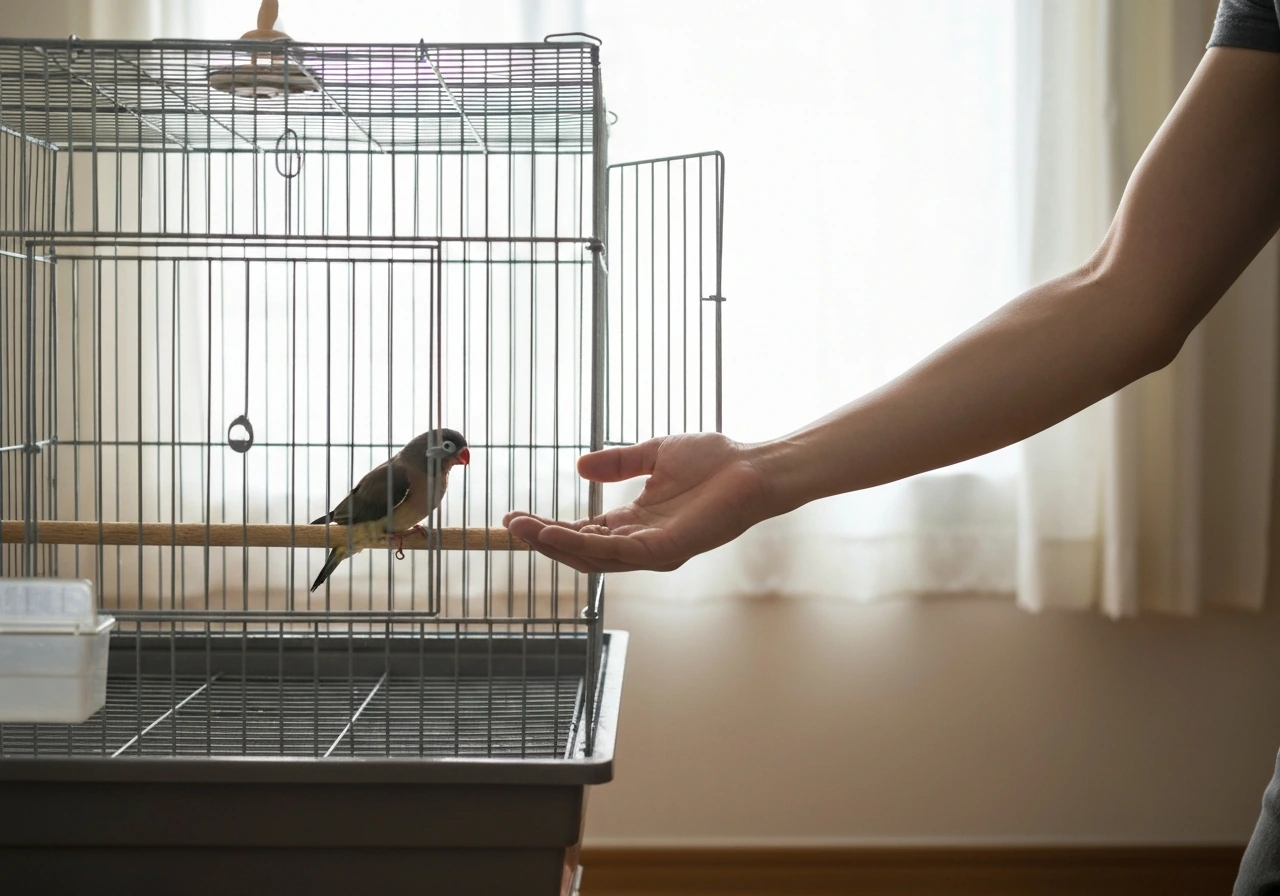
Never walk straight up to the cage and stick your hand in. That's the fastest way to undo any progress. Instead, approach from the side (not head-on), move slowly, and stop well before the bird reacts with alarm. Your goal is to find the bird's "comfort distance", the distance at which it notices you but doesn't immediately flee. Sit down at that distance. Look slightly away, not directly at the bird (direct eye contact reads as predatory). Stay there for two or three minutes, then get up and leave. That's it. That's session one.
If you want to use your voice, keep it low and even. Narrate softly what you're doing, use the bird's name, or simply hum. The content doesn't matter as much as the consistency and calm tone. A quiet voice combined with slow, predictable movement is genuinely calming to birds, and over multiple sessions it becomes a reliable signal that nothing bad is about to happen.
Using treats and marker cues to build the association
Find out what food your bird gets most excited about. For most species this is a small piece of millet, a sunflower seed, or a thin slice of fruit. Use treats that are small enough to eat in one second so the session keeps moving. In session two, sit at your comfort distance and offer the treat by placing it at the cage bars or on a flat hand held still near the cage. Don't push it through; let the bird come to it.
If you want to add a marker signal, a short word like "yes" or a gentle click works well. The idea is to say or click the marker at the exact moment the bird does something brave, like leaning toward the treat or staying calm as you approach, and then immediately deliver the reward. This precise timing helps the bird understand exactly which behavior is earning the treat. The marker becomes a kind of communication shortcut that speeds up learning considerably.
Keeping sessions short and reading the bird's signals
Each session should last no more than 5 to 10 minutes. Watch for signs that the bird is reaching its stress limit: feathers slicked tight against the body, rapid breathing, moving to the furthest corner, or crouching low. When you see those signs, end the session immediately by calmly moving away. Never end a session by trying to squeeze in "one more" interaction when the bird is already stressed. You want to end every session while the bird is still relaxed, or at worst mildly alert, so the last emotional memory from your visit is a neutral or positive one.
One practical note on hands: avoid reaching bare hands directly toward the bird, especially in early sessions. A stick perch, a wooden spoon, or even a long treat held at arm's length gives the bird something non-threatening to focus on and keeps the large human hand slightly less prominent. This is a classic approach used in hand taming pet birds and it genuinely reduces the fear response in those early stages.
Tactics by species: parrots, cockatiels, budgies, and finches
The same core principles apply across species, but the details matter. Here's how to adjust your approach depending on who you're working with.
| Species | Comfort distance to start | Best reward | Key tactic | Main caution |
|---|---|---|---|---|
| Parrot (medium to large) | 1 to 2 metres | Favoured nut or fruit piece | Desensitize to hand-held perch before attempting step-up; use shaping in small steps | Never use a towel for restraint during trust-building sessions |
| Cockatiel | 0.5 to 1 metre | Millet spray | Use a calm, sing-song voice; whistling can build rapport quickly | Very prone to night frights; cover cage at night to reduce startle responses |
| Budgie | 30 to 60 cm | Millet or small seed | Place hand flat inside cage without moving; let bird approach on its own timeline | Small size means they fatigue and overheat faster; keep sessions under 5 minutes |
| Finch | 30 to 60 cm | Live or dried insects, small seed | Focus on presence tolerance only; physical taming is rarely the goal for this species | Finches are generally not hand-tamed; chasing or catching causes extreme stress |
Parrots
Larger parrots are intelligent enough to learn quickly, but they're also intelligent enough to hold a grudge. If you've had a bad interaction recently, expect to spend most of day 1 just rebuilding neutral associations. Start by desensitizing to the sight of your hand near the cage, not inside it. Once the bird can watch your hand move near the cage without flinching, introduce a hand-held perch or dowel and let the bird investigate it at its own pace. The goal for day 1 with a very scared parrot is getting it to look at your hand without immediately retreating.
Cockatiels
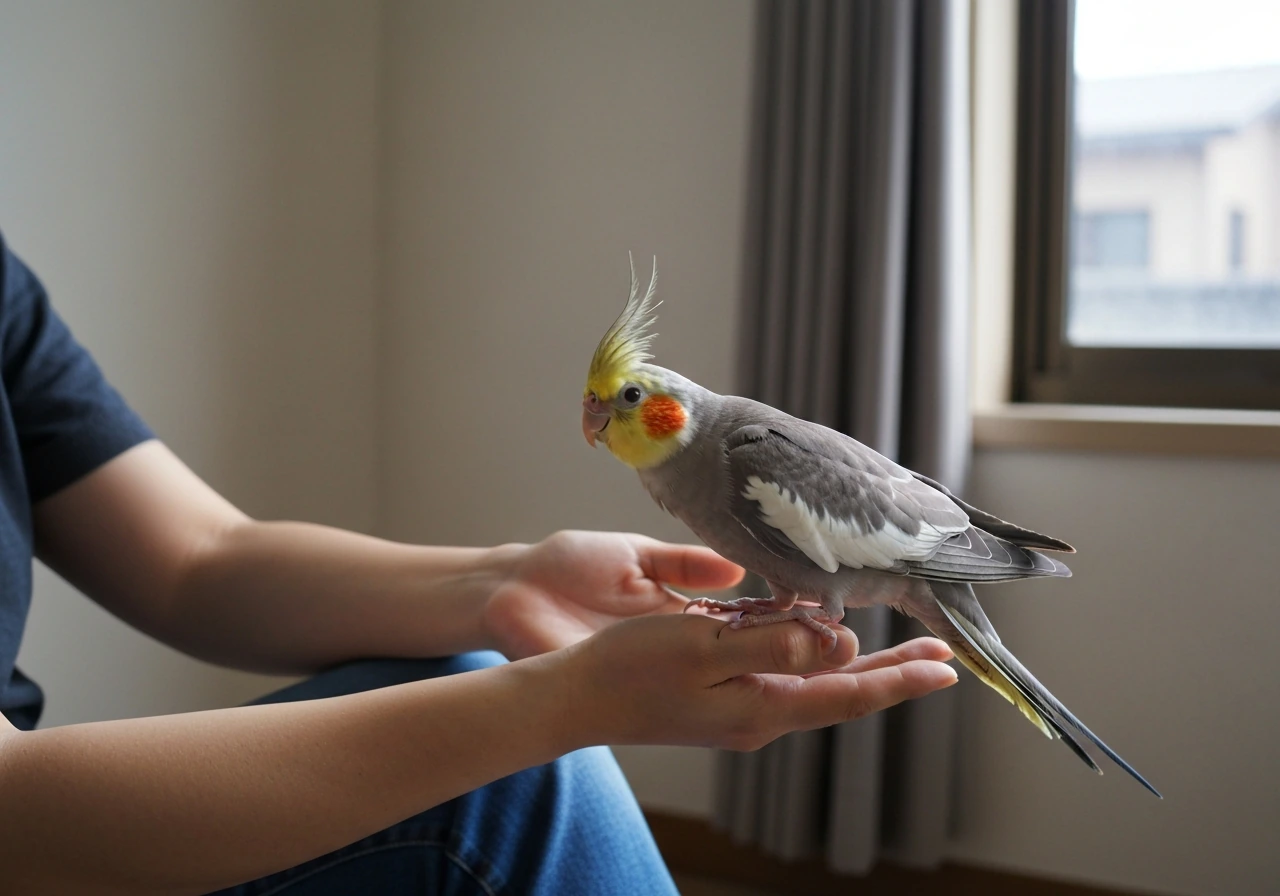
Cockatiels tend to warm up faster than larger parrots, especially to voice. Whistling a consistent short tune each time you approach can become a reliable "safe" signal very quickly. Millet is almost universally motivating for cockatiels and is a great tool for getting the bird to approach the cage bars from the inside. Sit quietly, hold the millet near the bars, and let the bird decide when to come get it. Most cockatiels will make at least one approach attempt within the first two or three sessions if you're patient and still.
Budgies
Budgies are small and easily overwhelmed by hands, but they're also naturally curious. A classic technique is to place your hand flat on the floor of the cage, fingers relaxed, and simply leave it there without moving. Ignore the bird completely. Most budgies will eventually creep close enough to investigate, especially if there's a little millet on your palm. This can take 10 minutes or more, so you need real patience. Don't curl your fingers or shift your hand when the bird gets close. Stillness is everything.
Finches
Finches are in a different category. Most finch keepers aren't aiming for a bird that perches on their hand, and that's fine. The realistic goal with finches is "presence tolerance": the bird keeps eating, singing, and moving normally while you're nearby. Sit near the cage daily, move slowly, and avoid sudden movements. Over time, finches habituate to your presence and become comfortable enough to feed and behave naturally while you watch. Chasing or attempting to catch a finch for any reason other than a vet visit causes extreme stress and will set you back significantly.
Helping scared wild yard birds (without touching them)
If the scared bird you're dealing with is a wild bird in your yard, the approach is fundamentally different. You are not taming a wild bird. You are reducing its fear response to your presence over time, which is a much slower and more limited process. More importantly, there are legal and ethical lines you must not cross.
In the United States, it is illegal to capture, keep, or transport most wild birds without the proper permits. In the U.S., Fish & Wildlife Service permit materials also explain that “take” can include trapping, capturing, or collecting, so unauthorized capturing or possessing wild birds can violate federal protections. The U.S. Fish and Wildlife Service is clear that well-intentioned capture attempts increase stress and fear and are not appropriate for untrained individuals. If you have found an injured wild bird, the right move is to contact a licensed wildlife rehabilitator, not to attempt to tame or handle it yourself. Do not offer food or water to an injured wild bird unless a rehabilitator has specifically told you to.
For healthy wild birds that are simply skittish in your yard, here's what actually works: reduce sudden movements near feeders and birdbaths, place yourself at a distance (10 to 15 metres) and stay still while they feed, and gradually reduce that distance over days and weeks. Human noise, direct eye contact, and unpredictable movement are the main things that keep wild birds alarmed. Minimize all three. Place feeders in a consistent spot so birds develop a regular, predictable routine at that location. Over time, many backyard species like sparrows, chickadees, and finches become remarkably comfortable with a quiet, still human presence.
The key difference from pet bird training is that you never reach toward a wild bird, never attempt to coax it onto your hand unless it has already habituated to your presence over many weeks, and you accept that the bird may never allow physical contact, and that's perfectly fine. Observing a wild bird feeding calmly while you're two metres away is a success worth celebrating.
Troubleshooting fear behaviors and when to pause training
Even with the best technique, you'll hit snags. Here's how to read the most common fear behaviors and what to do about each one.
The bird won't come anywhere near you
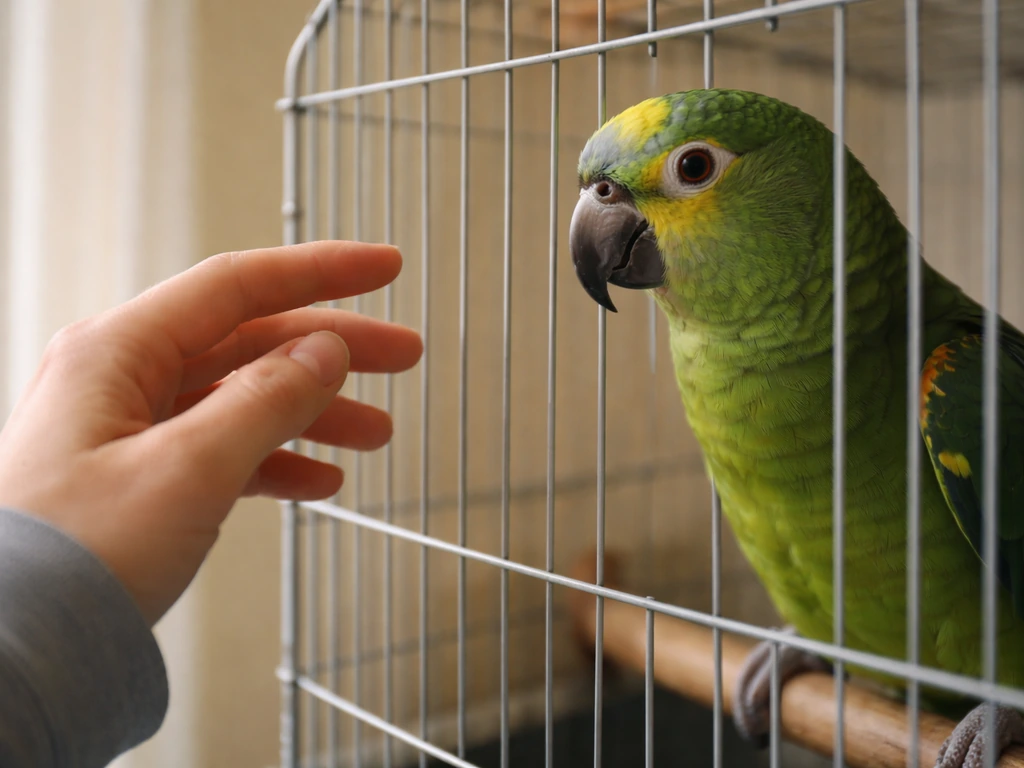
You're probably starting too close. Back up to a distance where the bird goes about its normal business (eating, preening, moving around the cage) while you're present. That's your real starting point, not where you wish it was. Spend today's sessions just sitting at that distance. Progress might look like nothing externally, but you're building a crucial foundation: the bird is learning that your presence reliably does not lead to anything bad.
The bird bites or lunges at the cage bars
Don't pull back sharply (that reinforces the behavior by showing it works) and don't push forward (that escalates the fear). Stay calm and still for a moment, then slowly increase your distance without making it look like a retreat. Biting at bars is usually a distance-regulation behavior: the bird is telling you it needs more space. Give it that space, and come back slightly further away next session.
The bird screams or vocalizes loudly
Loud alarm calls are a stress signal. Don't respond to them by talking louder or moving closer to reassure the bird. Simply wait quietly until the calling reduces, then leave. If the screaming starts immediately when you enter the room, your distance is still too small. Try approaching only to the doorway of the room for the first few sessions.
The bird freezes completely
Freezing (also called tonic immobility) is a fear response where the bird becomes completely still. It looks calm but it isn't. If your bird freezes when you approach, back off immediately. A frozen bird is a very frightened bird. This is especially common during any kind of restraint, which is one strong reason to avoid restraint-based handling during trust-building entirely.
When training genuinely won't work today
Some situations call for stopping the taming process and addressing a bigger issue first. If your bird just arrived in a new home today, give it 48 to 72 hours to just settle before you try any active taming work. If the bird has had a very traumatic handling experience recently (being caught, chased, restrained), its stress hormones are elevated and it needs a rest day, not more interaction. And if you're seeing any of the medical warning signs listed in the triage section above, please contact an avian vet before proceeding. A sick bird cannot consent to training, and you risk making its condition worse.
It's also worth remembering that a bird that won't cooperate with training isn't being stubborn or difficult. It's being a bird. Fear is a survival mechanism, and it takes time to override. If you're struggling with a bird that won't stay in the cage during free flight time, the challenge of getting an untamed bird back in its cage is a related problem that many owners face, and it's worth having a clear plan for that before you open the cage door.
Building on day 1: what to do next
At the end of today, sit down and honestly assess where you got to. Which of these milestones did you reach?
- Bird stays in the middle of the cage (doesn't flee to the far end) when you enter the room
- Bird eats or preens while you're seated nearby
- Bird looks at you without immediately becoming alarmed
- Bird moves toward the cage bars when you offer a treat nearby
- Bird takes a treat from near your hand, or from a stick you're holding
Wherever you landed on that list is your baseline for tomorrow. Start each day's first session at the level you ended the day before. Don't jump ahead just because it's a new day. Birds don't generalize trust the way humans do, so a bird that tolerated your hand near the cage yesterday might be more cautious tomorrow morning. That's normal. Keep sessions short, keep your approach consistent, and keep the rewards coming for any brave behavior.
Over the next week, you're aiming to gradually close the distance, introduce your hand inside the cage (flat and still, not reaching), and eventually work toward the bird stepping onto a perch you're holding. The full one-day taming method gives you a more detailed session-by-session breakdown if you want to follow a structured plan from start to finish. Progress will feel slow some days, but if you're consistent with your timing, your tone, and your rewards, trust will accumulate faster than you expect.
The most important mindset shift you can make right now is this: your job today is not to tame the bird. Your job is to become predictable, calm, and associated with good things. Do that repeatedly and reliably, and the bird will meet you halfway. That's how trust works with every species, and birds are no different.
FAQ
What if my bird seems no calmer at the end of day 1, is the plan failing?
If your bird does not show any improvement after 3 sessions, first re-check health and environment. Start each session where the bird can eat or preen normally, then reduce your distance further. Also confirm the bird has eaten recently, because an underfed bird may refuse treats even if it is less afraid.
How do I know I pushed too far during a session?
Your sessions are too long or the starting distance is too close. Cut each visit to 3 to 5 minutes, end while the bird is still mildly comfortable, and keep your position at the exact spot where it could watch you without bolting. Tomorrow, begin at that same distance again.
Do I put the treat inside the cage or only at the bars?
Use the “comfort distance” you observed. Place the treat at that distance first, then move the treat fractionally closer only if the bird takes it or leans in without alarm. If the bird panics at the bars, do not try to reach for it, focus on treating the bird for staying calm while you remain at that distance.
What should I do if my bird bites the cage bars?
Don’t. During day 1, the target is cautious tolerance, so avoid forcing contact, restraint, or repeated hand reaching. If your bird bites the bars, treat that as a signal to increase space and lower your intensity, then try again later using voice, stillness, and treat placement from the outside.
Is freezing or tonic immobility a sign the bird is calm?
When you see signs like rapid breathing, feathers tightly slicked, retreating to the furthest corner, crouching low, or freeze-like immobility, stop the interaction immediately. Remove yourself calmly and resume later only if the bird returns to normal behavior (eating or preening).
Can I use a clicker or a word marker on day 1, and what if it scares my bird?
Yes, but keep it tightly controlled. Use one consistent marker cue you can repeat reliably, only at the moment the brave behavior happens, and deliver the reward immediately. If your marker makes the bird more alert or moves away, pause it for the rest of day 1 and rely on treat timing and quiet body language instead.
How long should I wait for the bird to take a treat?
Follow the bird’s stress threshold, not the bird’s curiosity. If it takes a treat quickly, that is your green light to keep sessions short and end soon after. If it hesitates, do not chase, do not advance your hand quickly, simply wait longer at the same distance and leave before stress escalates.
What counts as a real win after one day, even if it will not step up yet?
If you want a “1-day win,” aim for predictable presence, treat association, or voluntary approach to the bars, not a step-up. Hand-step training often benefits from later stages, so day 1 should focus on desensitizing, predictable visits, and building positive associations.
My bird’s breathing seems faster than normal, is it always an emergency?
Breathing rates are helpful, but also watch for changes from the bird’s normal. If you notice open-mouth breathing, tail bobbing, persistent lethargy, or any respiratory distress that is not improving, pause training and contact an avian vet. A new or freshly acquired bird especially needs a health check before intensifying handling.
Can I tame a scared bird in 1 day if I also want free-flight bonding?
Don’t start with free-flight training. Keep the cage door closed or only allow brief, supervised movements if your bird already tolerates your presence. If you must work up to free-flight, do it after day 1 when the bird reliably stays calm at the comfort distance.
What if my bird refuses every treat on day 1?
If the bird won’t eat or take treats at all, try the bird’s strongest favorite food in a smaller, more appealing form (for example, millet for many small parrots) and offer it at the bars from your comfort distance. If it still refuses, you may be too close or the bird may be unwell, so revisit health and starting distance before continuing.
Can I tame a scared bird in 1 day if it is very far from the cage bars when I approach?
Yes, for some birds, especially very skittish ones. If the comfort distance is large, make progress by treating calm attention from farther away, and use voice consistently at a low volume. Later days can bring the distance down gradually, but day 1 should protect the bird from sudden changes.