
Yes, you can absolutely tame a cockatiel at home, even if your bird currently bolts to the far corner of the cage every time you walk by. Taming a cockatiel is really just a trust-building process, and with the right setup, a consistent daily routine, and positive reinforcement, most birds go from terrified to stepping onto your hand within three to four weeks. Some get there faster, a few take a little longer, but the method is the same either way.
How to Tame a Cockatiel Bird: Step-by-Step Training
Clara Hayes
2 Apr 2026
Understanding cockatiel temperament and trust basics
Cockatiels are prey animals. That single fact explains almost every behavior you'll encounter during taming. When your bird puffs up, screams, lunges, or frantically flaps away, it's not being mean or stubborn. It's doing exactly what evolution built it to do: survive. Your job as the owner is to prove, slowly and consistently, that you are not a threat.
Wild-caught cockatiels and poorly socialized hand-raised birds start at very different baselines, but both can be tamed. Hand-raised birds raised with human contact from a young age tend to be more naturally confident, while birds with little prior handling may take longer to settle. Older birds can absolutely be tamed too. Age is not a barrier; the key variable is trust, and trust is built the same way regardless of age.
Cockatiels are highly social, flock-oriented birds. They read body language constantly. Slow movements, a calm voice, and predictable behavior from you will register as safe signals far faster than you might expect. Avoid staring directly at the bird (side-glancing is less threatening), crouch or sit at cage level rather than towering above, and keep your energy calm. If you're tense, your bird will know. With patient, calm handling, you can make cockatiels bird friendly and help them feel safe with you.
One more thing to internalize before you start: force does not tame a bird. Grabbing, chasing, or cornering your cockatiel to force interaction will set you back days or weeks every time it happens. The goal is for the bird to choose to interact with you, not to be made to comply.
Preparing the home setup for safe, humane training
Before your first training session, get the environment right. A stressed or sleep-deprived bird cannot learn, and a poorly positioned cage can undermine everything else you do.
Cage placement and room setup
Place the cage at chest height, in a room where the family spends time, but away from direct drafts, air vents, and windows with unobstructed outdoor views (which can trigger alarm responses from wild birds passing by). A corner placement with two solid walls behind it helps the bird feel secure. Keep the cage away from the kitchen, where cooking fumes and Teflon-coated cookware off-gassing can be fatal to birds.
Cockatiels need 10 to 12 hours of quiet, dark sleep each night. Disrupted sleep, caused by late-night noise, TV light, or drafts, makes a bird irritable and much harder to work with during training. Whether you cover the cage at night or not depends on the individual bird; some find a cover reassuring, while others find it stressful. If your bird gets night frights (sudden panicked flapping in the dark), try a dim nightlight near the cage and consult your avian vet about the best routine.
What you need before you start training
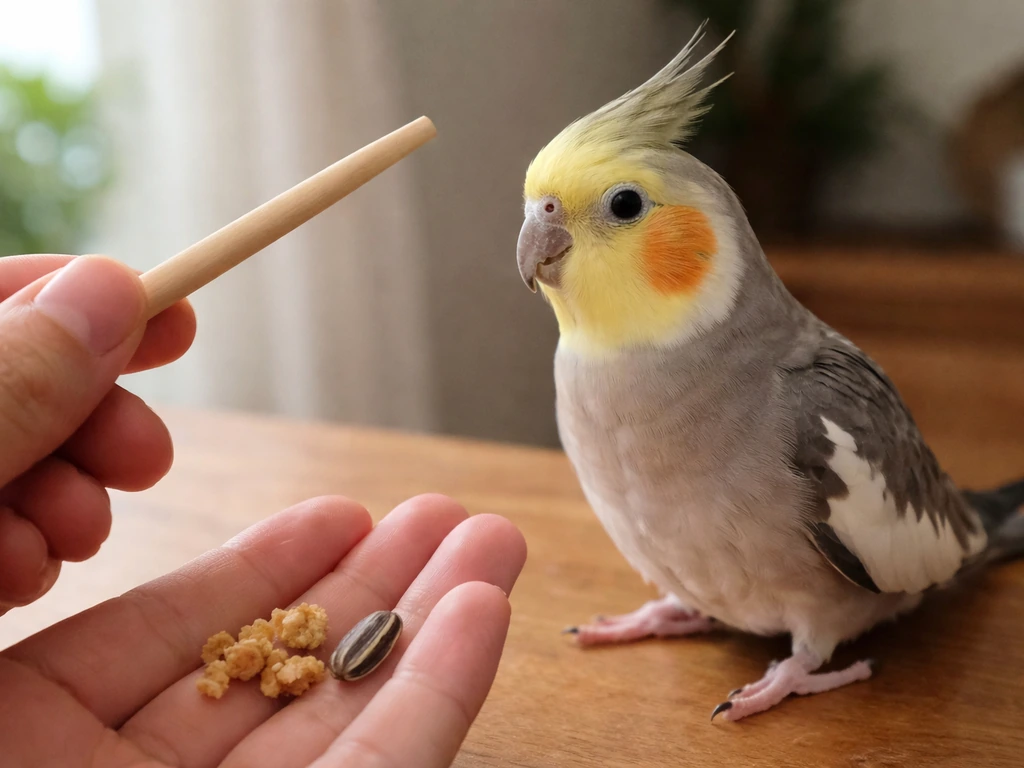
- A target stick (a chopstick, pencil, or purpose-made bird training stick works fine)
- High-value treats: small pieces of millet spray, a single sunflower seed, or a tiny bit of cooked sweet potato (figure out what your specific bird goes wild for)
- A clicker, or decide to use a consistent mouth click or a short word like 'yes' as your marker sound
- A quiet room for out-of-cage training sessions with no ceiling fans running and no other pets present
- A comfortable chair or floor cushion so you can sit at the bird's level
Do a basic hazard check before any out-of-cage session: close windows and doors, turn off ceiling fans, cover mirrors and large glass surfaces, remove toxic houseplants, and make sure other pets are secured in a different room. Keeping cats and birds safely separated is non-negotiable when training, and it also sets the stage for safe introductions, such as how to introduce a bird to a cat. Keeping cats and birds safely separated during training is non-negotiable.
Step-by-step taming plan: week one through month one
Here's how to move through the stages practically. Each phase builds on the last. Don't rush forward just because you're eager; let the bird's behavior tell you when it's ready.
Week 1: presence and acclimation
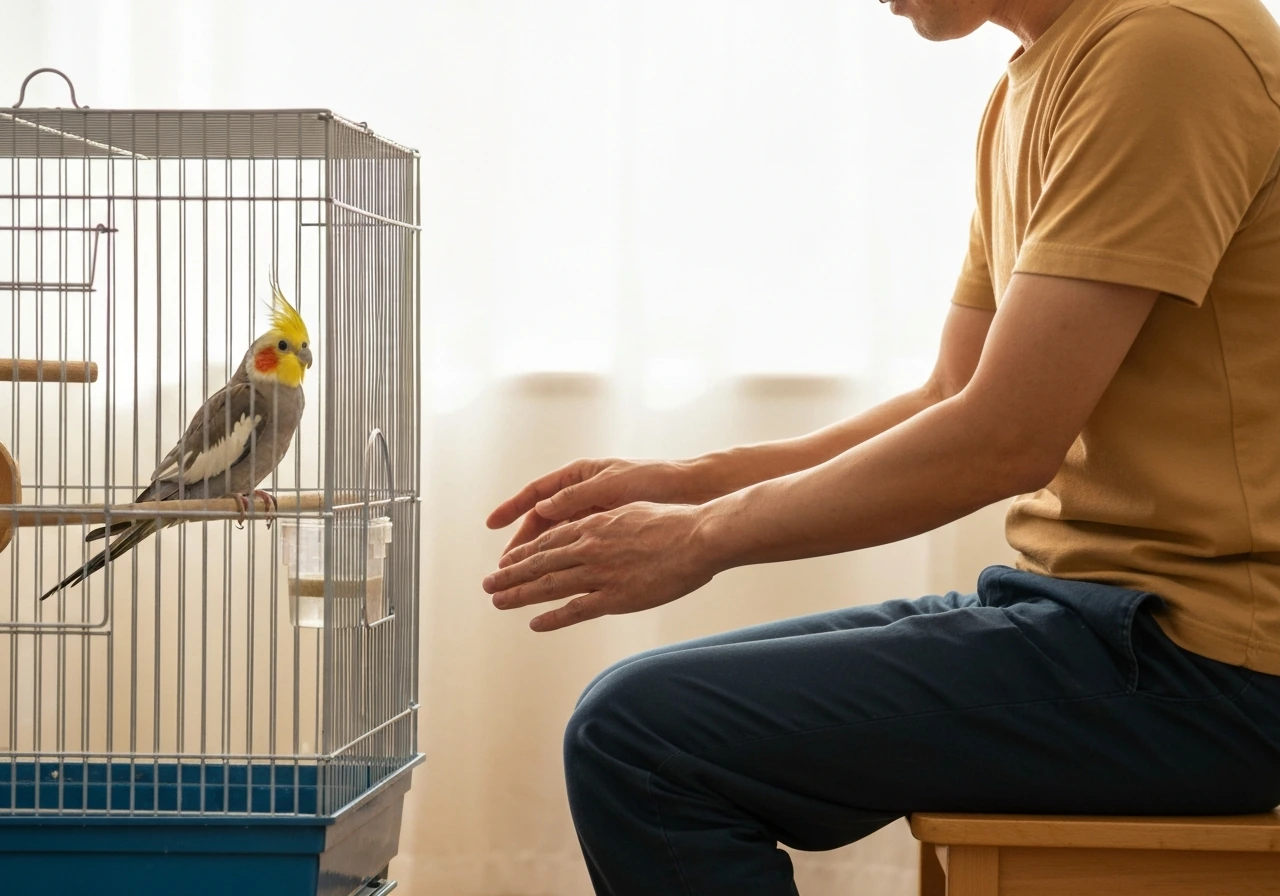
Your only goal this week is to become a non-threatening part of the bird's world. Sit near the cage for 15 to 20 minutes, once or twice a day, talking softly or reading aloud. Don't reach into the cage. Don't make sustained eye contact. Just be there. Offer a small treat through the bars if the bird approaches, but don't push it. Let the bird set the pace. By the end of week one, most cockatiels will stop alarm-calling every time you sit down, and some will start watching you with curiosity rather than panic.
Week 2: hand inside the cage
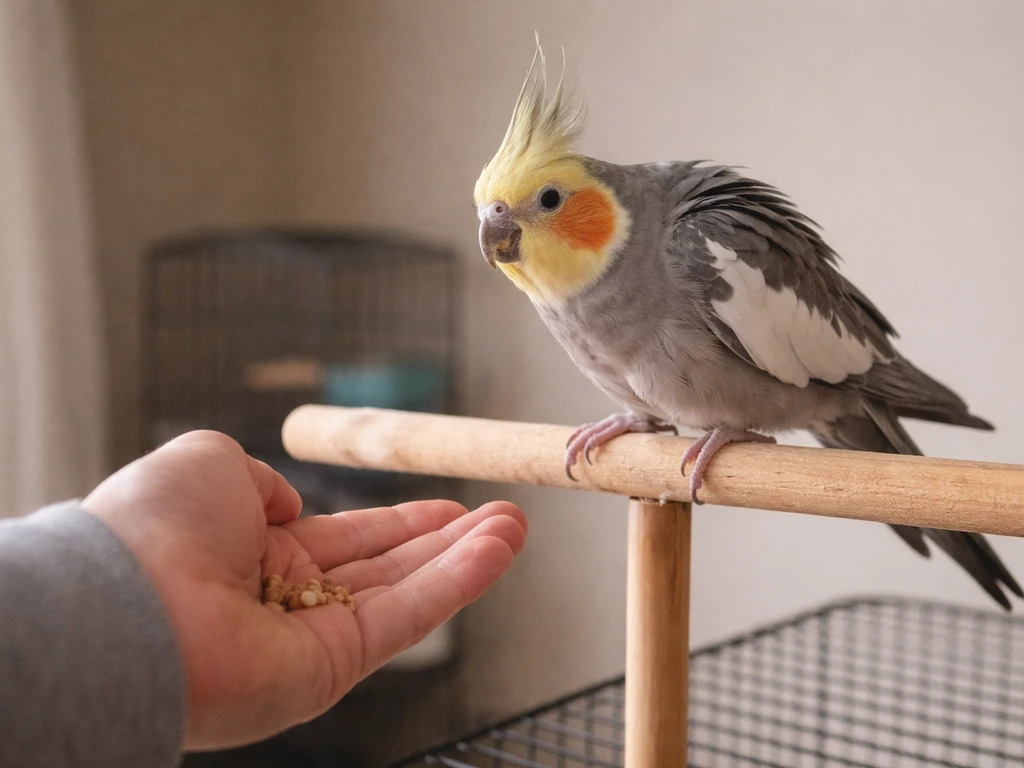
Once your bird is relaxed with you nearby, start placing your hand inside the cage, held still, palm up, at perch level. Don't move toward the bird. Just let your hand be there. Offer a high-value treat in your open palm. Some birds will approach within a few sessions; others take several days. When the bird eats from your hand without backing away, that's your green light to move to the next phase. Keep sessions to 5 to 10 minutes so you always end on a calm note.
Week 2 to 3: introducing the target stick
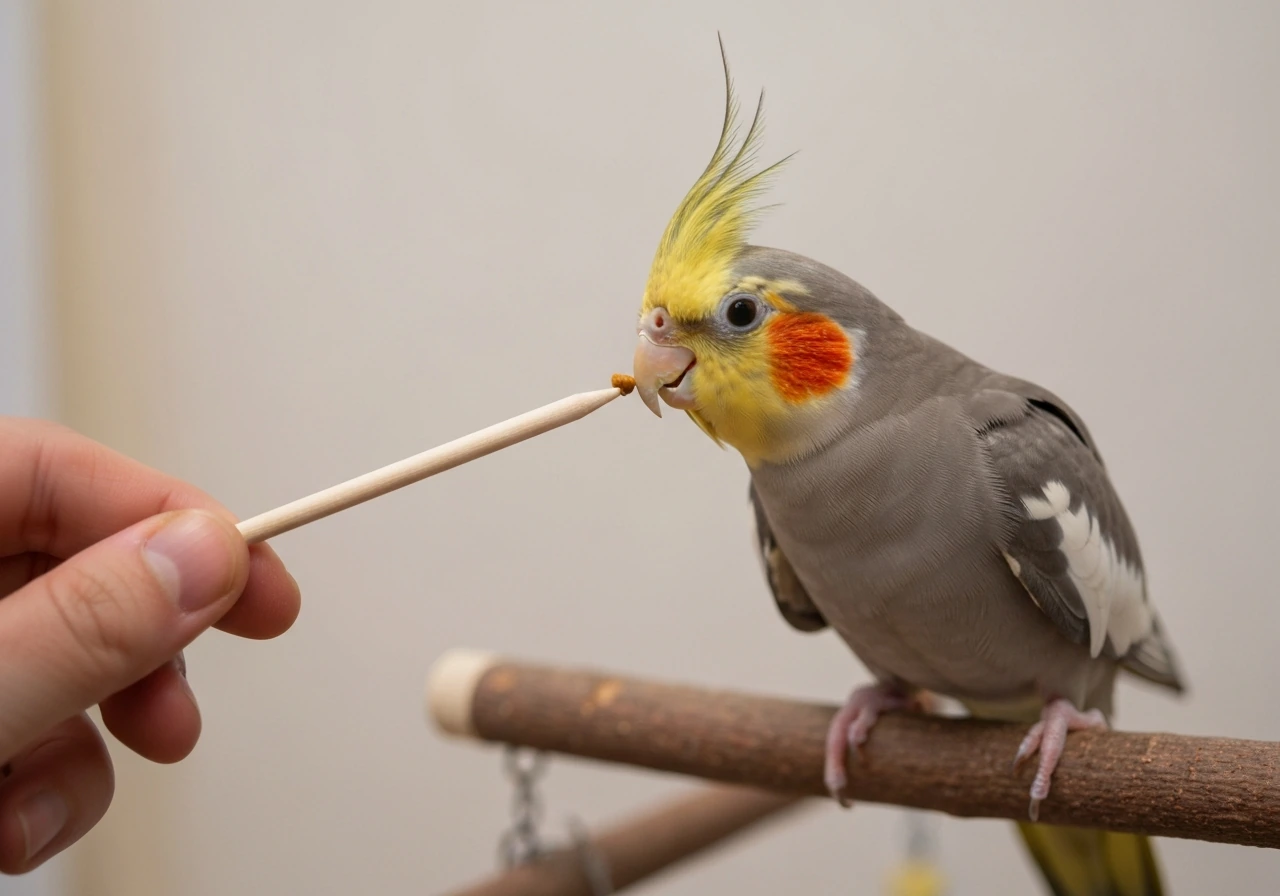
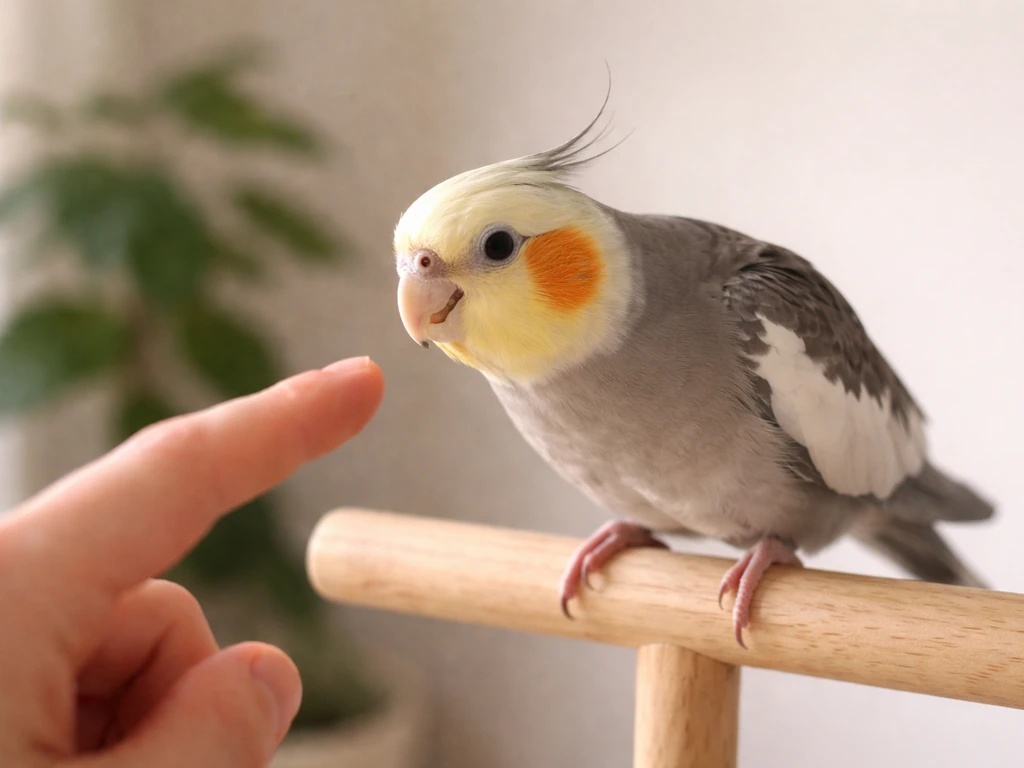
This is where target training starts. Present the tip of your target stick near the bird's beak. The moment the bird's beak touches the tip (even accidentally), immediately mark it with your clicker or your marker word, then offer a treat. The sequence is always: touch target, mark instantly, deliver treat. Repeat this 5 to 10 times per session. Most cockatiels pick up the touch-the-stick concept within two or three sessions because they're naturally curious and will investigate something new with their beak.
Target training is considered a foundational skill in companion parrot training because once the bird understands that touching the stick earns a reward, you can use it to guide movement, teach step-up, and eventually shape all sorts of new behaviors without ever physically manipulating the bird.
Week 3: stepping up from inside the cage
Hold your finger or a hand-held perch just below the bird's chest, slightly above where its feet are. Say 'step up' in a calm, even tone. You can use the target stick to encourage the bird to lean forward toward the treat, which naturally shifts its weight forward and onto your finger. The moment one foot lands on your finger, mark and reward. Don't pull your hand away immediately; hold steady, let the bird stand there, then reward again for staying. Practice this inside the cage first, where the bird feels more secure, before asking for it in open space.
Week 4 and beyond: out-of-cage sessions and bonding
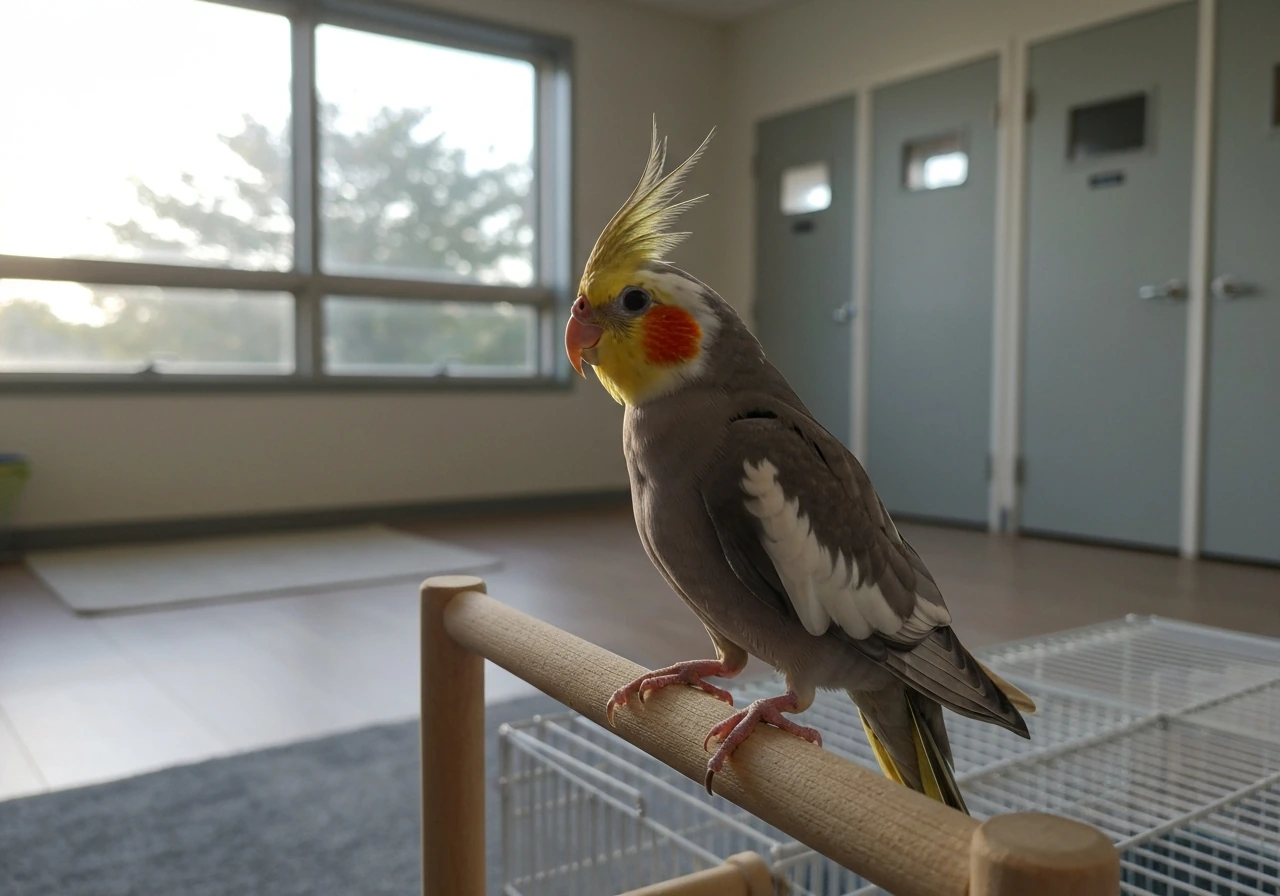
Once step-up is reliable inside the cage, begin short out-of-cage sessions in your designated safe room. Start with just 5 minutes and build up gradually. Let the bird explore, sit on your shoulder or arm, and return to the cage willingly (use a treat near the cage door to encourage this). A bird that willingly goes back into its cage at the end of a session is a bird that doesn't associate the cage with being trapped. That matters a lot for long-term bonding. Building a regular play routine at this stage deepens the bond quickly.
Positive reinforcement methods and useful commands
Positive reinforcement means you add something the bird values (a treat, praise, gentle head scratch) immediately after a desired behavior, making that behavior more likely to happen again. There is no punishment involved. No raised voice, no flicking, no covering the cage as a consequence. The Association of Veterinarians for Animal Behavior is explicit that mark-and-reward training should never involve fear, force, or coercion. This matters both ethically and practically: a frightened bird cannot learn.
Your event marker (clicker or word) is the bridge between the behavior and the treat. It has to happen at the exact moment the behavior occurs, not a second later. Timing is everything. AVSAB also emphasizes that timing is essential in training and that a clicker can mark a behavior more precisely than general praise or other cues Timing is everything.. Practice clicking and rewarding without the bird first if you need to build muscle memory.
Beyond step-up and target touching, here are behaviors worth teaching in roughly this order:
- Touch target (foundation for everything else)
- Step up on finger or hand perch
- Step down (onto a perch or cage door)
- Come to you from a short distance on a flat surface
- Turn around on cue (use the target to guide the bird's head in a circle)
- Wave or lift one foot (fun trick, great for bonding)
- Enter and exit cage on cue
Keep training sessions short: 5 to 10 minutes maximum, two to three times a day. End every session while the bird is still engaged, not after it's lost interest. Ending on a success, even a small one, keeps motivation high for the next session.
Handling and bonding routines
Daily handling builds the bond faster than weekly sessions ever will. Aim for at least two short daily interactions. Morning and evening tend to work well because cockatiels are most active and social at those times.
The step-up routine
Always use the same verbal cue before asking for step-up: say 'step up' once, calmly, before you offer your finger. Present your finger horizontally, pressed gently against the lower chest just above the feet. If the bird steps up, mark and reward. If it doesn't, wait a moment, withdraw, and try again after a brief pause. Never chase or press harder. Practicing step-up from perch to hand and back again (called 'ladder stepping') several times in a row builds the behavior quickly and keeps sessions engaging.
Target training in practice
Once the bird reliably touches the target, start using it to move the bird around. Hold the target slightly to one side so the bird has to rotate its body to follow it. Hold it above so the bird stretches upward. Eventually you can use the target to guide the bird from one perch to another, into its cage, and onto a scale for weight checks. A bird that follows a target is a bird you can work with cooperatively for life.
Head scratches and contact bonding
Many cockatiels become deeply affectionate once trust is established. If your bird lowers its head and fluffs the feathers on the nape of its neck while near you, it's asking for a scratch. Use one finger to gently scratch the pin feathers on the head and behind the crest. This is a major bonding behavior and something the bird would normally do with a flock mate. Keeping your cockatiel mentally and emotionally happy day-to-day involves a lot of these small social moments, not just formal training sessions.
Troubleshooting fear, biting, screaming, and slow progress
Every bird hits a plateau at some point. Here's how to work through the most common sticking points.
When your bird bites
A bite is communication. It almost always means 'I'm scared' or 'I said no and you didn't listen.' Before assuming bad intent, ask yourself: was I moving too fast? Did I miss a warning signal? Cockatiels give clear warnings before biting: pin eyes (rapid pupil dilation and contraction), raised crest held flat and tight, hissing, lunging with beak open. If you see those signs, back off immediately and give the bird a moment. If a bite does happen, the worst thing you can do is yell or jerk your hand away dramatically. Pulling away fast actually reinforces the bite because the bird learns it works to remove you. Move slowly, stay calm, and end the session quietly.
When your bird screams
Contact calling (loud calling when you leave the room) is completely normal cockatiel behavior. The bird is keeping track of its flock. The solution is not to rush back every time it calls, and not to yell back (which can reinforce screaming by turning it into a call-and-response game). Instead, establish a routine: call back briefly to acknowledge you're there, then return only when the bird is quiet, even for a few seconds. Reward quiet with your attention consistently and the contact calling usually moderates within a few weeks. Excessive, frantic screaming combined with other behavioral changes can sometimes indicate illness, so rule that out with a vet visit if it's a sudden change.
When progress stalls
If training has plateaued for more than a week, run through this checklist before changing your approach:
- Is the bird getting 10 to 12 hours of sleep? Sleep deprivation kills learning capacity.
- Are your training sessions too long? Try cutting them to 3 to 5 minutes.
- Is the treat actually high-value to this bird? Try a different reward.
- Are you training at the right time of day? Avoid sessions right after the bird wakes up or just before bed.
- Have there been changes in the household (new pet, moved furniture, new sounds) that might have reset trust?
- Are you asking for too large a step too quickly? Break the behavior into smaller pieces and reward each one.
When your bird spooks badly
Night frights (sudden panicked flapping in the dark) can injure a bird and shake its trust. If your bird has a fright episode, speak to it calmly from outside the cage before turning on a dim light, so it can locate you by voice first. Check for obvious triggers: a shadow passing over the cage, a loud noise, a nearby pet. If night frights are recurring, a dim nightlight near the cage is often enough to prevent them.
Safety, ethics, and timelines: when to adjust and when to get help
Towel restraint (wrapping the bird in a towel to hold it still) should never be used as part of a taming or training program. It is a veterinary handling technique used when medically necessary, and even in that clinical context, avian professionals note it can provoke significant fear and anxiety and in some cases affect the human-bird bond. Using force or restraint to speed up taming reliably backfires. If someone suggests it as a training shortcut, ignore that advice.
Every bird has its own timeline. A rough general guide looks like this:
| Stage | Typical timeline | What it looks like |
|---|---|---|
| Acclimation | Days 1 to 7 | Bird stops alarm-calling when you're nearby, watches you calmly |
| Hand acceptance | Days 5 to 14 | Bird eats from your hand, tolerates hand inside cage without fleeing |
| Target training solid | Days 7 to 21 | Bird reliably touches stick on cue |
| Step-up reliable | Days 14 to 28 | Bird steps up on finger consistently inside cage |
| Out-of-cage sessions | Week 3 to 4+ | Bird explores outside cage, returns willingly |
| Strong bond/handling | Month 2 and beyond | Bird seeks contact, asks for head scratches, comes when called |
These are averages, not rules. Some birds move through all stages in two weeks. Others, especially adult birds with a difficult history, may take two to three months to reach reliable step-up. That's fine. As long as you're seeing incremental progress, you're on the right track.
Know when to bring in professional help. If your bird's behavior is escalating rather than improving after six to eight weeks of consistent positive-reinforcement work, consult a certified parrot behavior consultant or an avian veterinarian with a behavior specialty. A sudden dramatic shift in behavior (especially paired with changes in droppings, posture, or appetite) is a medical signal, not a training problem, and warrants a vet visit promptly. The Association of Avian Veterinarians recommends routine wellness exams for pet birds regardless of behavior issues, and a baseline vet visit when you first get your cockatiel is a good habit to establish.
Stick with positive reinforcement, respect the bird's pace, and keep sessions short and consistent. If you are also working with a cat around birds, use a gradual introduction and reward calm behavior to help the cat learn to ignore prey. That combination is far more powerful than any shortcut, and the trust you build this way genuinely lasts.
FAQ
What treats should I use for training a cockatiel, and how do I avoid overfeeding?
Use small, high-value bites your bird reliably likes (many people start with millet or tiny seed portions). Keep treats tiny and count them as part of the daily diet, since frequent handouts during 5 to 10 minute sessions can add up quickly. If your bird gets full or becomes selective, reduce the treat size and swap to a more preferred option rather than increasing volume.
How do I tell the difference between fear and something like pain or illness during taming?
Fear usually comes with classic threat signals such as pinned eyes, crest held flat, hissing, and frantic backing away when you approach. If you notice changes that seem out of character for your bird, like lethargy, fluffed posture that lasts, reduced appetite, labored breathing, abnormal droppings, or repeated night frights without any trigger, treat it as a possible medical issue and contact an avian vet rather than pushing training forward.
Is it okay to skip target training and go straight to step-up?
Target training is not required, but it often makes step-up faster because it teaches the bird that voluntary movement toward a cue earns rewards. If you skip it and go directly to step-up, some birds freeze or lunge because they do not understand what behavior you want. If step-up stalls, go back to target for a few short sessions to rebuild confidence and predictability.
My cockatiel won’t step up even after it eats from my hand. What should I try next?
If hand-feeding is safe but stepping remains hard, the bird may be cautious about weight transfer. Try offering the finger slightly closer to where the bird’s feet already are, keep the cue consistent (say the same 'step up' once), and pause briefly if it leans away. Many birds do better with ladder stepping, perch-to-hand and hand-to-perch, practicing back and forth rather than insisting on open-floor step-up immediately.
What if my bird bites during step-up but does not show the usual warning signs?
If a bite happens suddenly without clear threat cues, slow down and consider the context, timing, and possible discomfort. Check whether your hand position touches sensitive areas, whether the bird is tired or hungry, and whether the room is stressful (noise, drafts, other pets). For any repeated unexpected escalation or signs of pain, stop training and consult an avian vet, because discomfort can look like aggression.
How should I handle contact calling when I leave the room?
If the bird calls loudly, avoid turning it into a back-and-forth conversation. A good approach is to acknowledge briefly, then wait for a short window of quieter behavior before returning. Reward calmness with attention or a treat. If calling becomes frantic or is paired with other behavioral changes, rule out illness with a vet check.
Can I cover the cage at night, and what if my bird gets night frights?
Quiet, dark sleep (10 to 12 hours) is key. Whether to cover the cage depends on your bird’s preference, some find it reassuring and others get more startled. If night frights occur, try a dim nightlight near the cage and speak calmly from outside the cage first so the bird can locate you by voice, then address likely triggers like passing shadows, loud sounds, or nearby pets.
How do I reduce fear if my cockatiel panics when I walk by the cage?
Stop trying to 'introduce yourself' by approaching quickly. Instead, build predictable exposure at a distance, sit and talk softly for short periods, and let the bird watch without being engaged. Train on a schedule (same times daily) and keep your body movements slower than you think you need. If it improves, gradually shorten the distance over days rather than making bigger jumps in one session.
How long should a training session be, and what if the bird loses interest early?
Keep sessions short, typically 5 to 10 minutes, and end while the bird is still engaged. If it starts backing away, freezing, or becoming loud, treat that as the signal to stop, then resume later. Ending on a calm success helps prevent the bird from associating training with pressure.
Is towel restraint ever okay as a shortcut to speed up taming?
No. Towel restraint should not be used as a taming or training method. It can increase fear and anxiety and may harm the trust bond you are building. Use restraint only for medical needs under veterinary guidance, and if someone suggests it for training, ignore that advice.
When should I involve a professional behavior consultant or an avian vet?
If behavior worsens rather than improves after about 6 to 8 weeks of consistent positive-reinforcement work, or if you see a sudden major change alongside appetite, posture, droppings, or breathing changes, seek professional help promptly. A certified parrot behavior consultant can assess training and handling dynamics, and an avian vet can rule out medical causes.
What are common mistakes that make taming slower?
Pushing too fast (reaching in before the bird is ready), cornering or chasing, timing your marker incorrectly, and using fear-based consequences like yelling, flicking, or trapping are the big ones. Another frequent issue is inconsistent cues, like using different phrases for 'step up' or changing hand position each time, which makes the bird unsure what earns a reward.
Next Articles
How to Make a Cockatiel Bird Happy: Start Here Today
Humane step-by-step tips to make your cockatiel happy today: setup, diet, bonding, enrichment, and stress troubleshootin
How to Catch a Bird Without Killing It: Humane Steps
Humane, trap-free steps to catch a wild backyard bird safely, minimize stress, contain it calmly, then release or reloca
How to Catch a Bird With a Bottle Safely and Humanely
Humane, safety-first steps to catch a bird with a bottle or cover, plus safer alternatives and what to do after capture.