If your cat has a bird right now, stay calm and move quickly but quietly. Your goal is to get the bird away from the cat without triggering a tighter grip or a sprint to hide. The safest sequence is: distract the cat to break its focus, cover the bird gently with a towel, place the bird in a ventilated box, and separate the cat from the room before you do anything else. After you place the bird in a well-ventilated box, bring it to a nearby wildlife rehabilitation centre for proper care. Everything else in this guide builds on those four steps.
How to Get a Cat to Drop a Bird Safely Today
Clara Hayes
28 Apr 2026
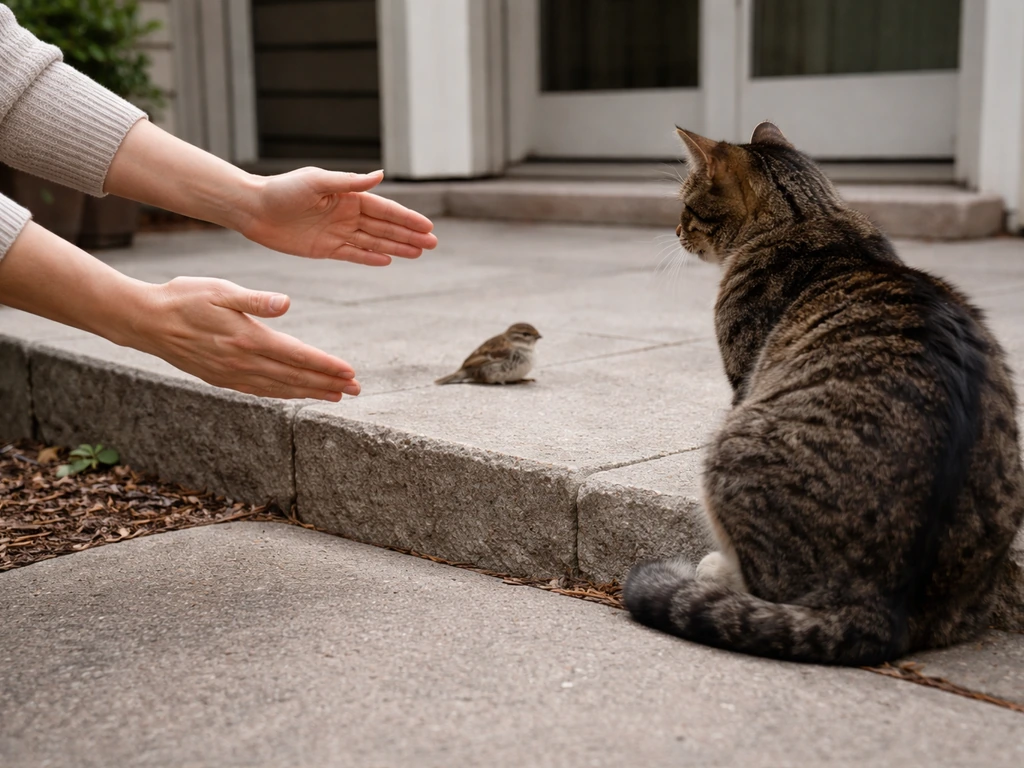
Immediate safety steps if your cat has a bird right now
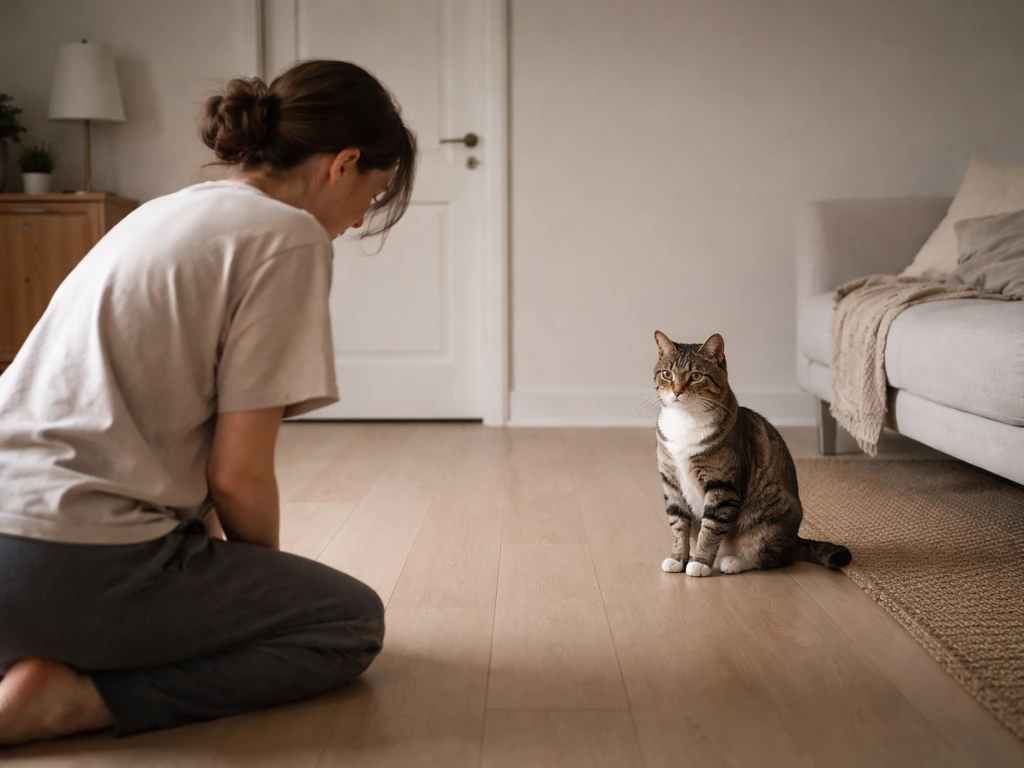
Speed matters here, but panicking makes things worse. A cat that feels threatened will clench its jaw tighter or bolt. Move toward the cat slowly and avoid direct eye contact, which reads as a challenge. Keep your body low and your voice quiet and neutral. Do not shout, clap loudly, or rush the cat from behind.
- Isolate the space. Close doors to other rooms so the cat cannot retreat with the bird to a hiding spot.
- Create a distraction. Shake a treat bag, open a can of food, or activate a crinkle toy nearby. You are trying to break the predatory focus, not punish the cat.
- The moment the cat loosens its grip or sets the bird down, use a towel or light cloth to gently scoop the bird up. Do not grab the bird with bare hands if you can help it, both to protect yourself from scratches and to reduce additional stress on the bird.
- Place the bird in a small cardboard box lined with a paper towel. Poke several air holes in the lid. Do not use a wire cage at this stage since the bird may thrash and injure itself further.
- Close the box and immediately move it to a warm, dark, quiet room away from the cat and any other pets. A temperature around 70 to 80 degrees Fahrenheit is ideal.
- Secure the cat in a separate room before you open the box to assess the bird.
Do not give the bird food or water at this point. Well-meaning hydration attempts often cause aspiration in an already-stressed bird. Darkness genuinely calms birds fast by mimicking night roosting conditions, and many birds that look stunned will stabilize within minutes once they are warm and dark. If the bird does not perk up in 15 to 20 minutes, treat it as injured and contact a wildlife rehabilitator immediately.
Why your cat won't just drop the bird
Understanding what is happening in your cat's brain makes the retrieval techniques below make a lot more sense. Cats follow a hard-wired predatory sequence: orient, stalk, chase, pounce, catch, deliver the killing bite, and carry. Once a cat is deep in that sequence, especially past the catch phase, it does not respond to commands the way a trained dog might. The 'carry' stage is a biological drive. Your cat is not being defiant. It is completing a program that evolved over millions of years.
Cats also clench harder when they feel the prey struggling, which is why a panicking bird actually worsens the grip. The same is true if you rush the cat or make sudden loud noises. Those inputs register as competition for the prey, and the cat's instinct is to hold on tighter or run. Knowing this, every retrieval technique below works by interrupting the sequence rather than fighting it directly.
For pet birds caught in the home, the dynamic is slightly different. If your cat has grabbed a budgie, cockatiel, or similarly sized pet bird, the injury risk from even a brief bite is extremely high because cat saliva contains bacteria like Pasteurella multocida that can cause fatal septicemia in birds within hours, even when the wound looks minor.
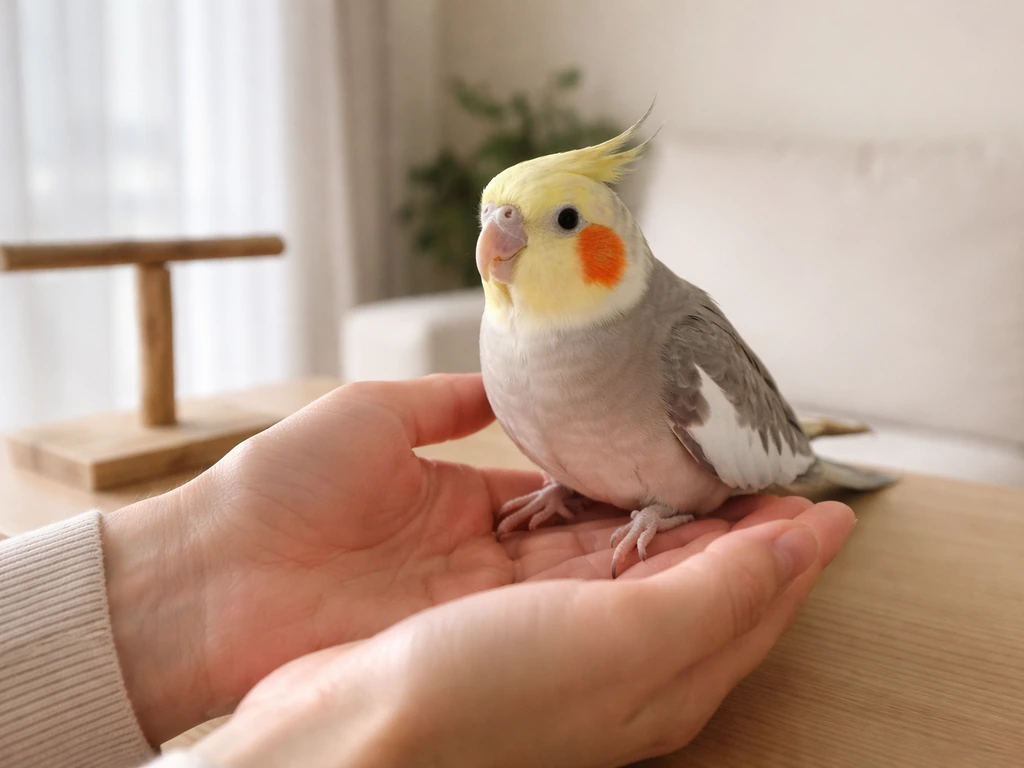
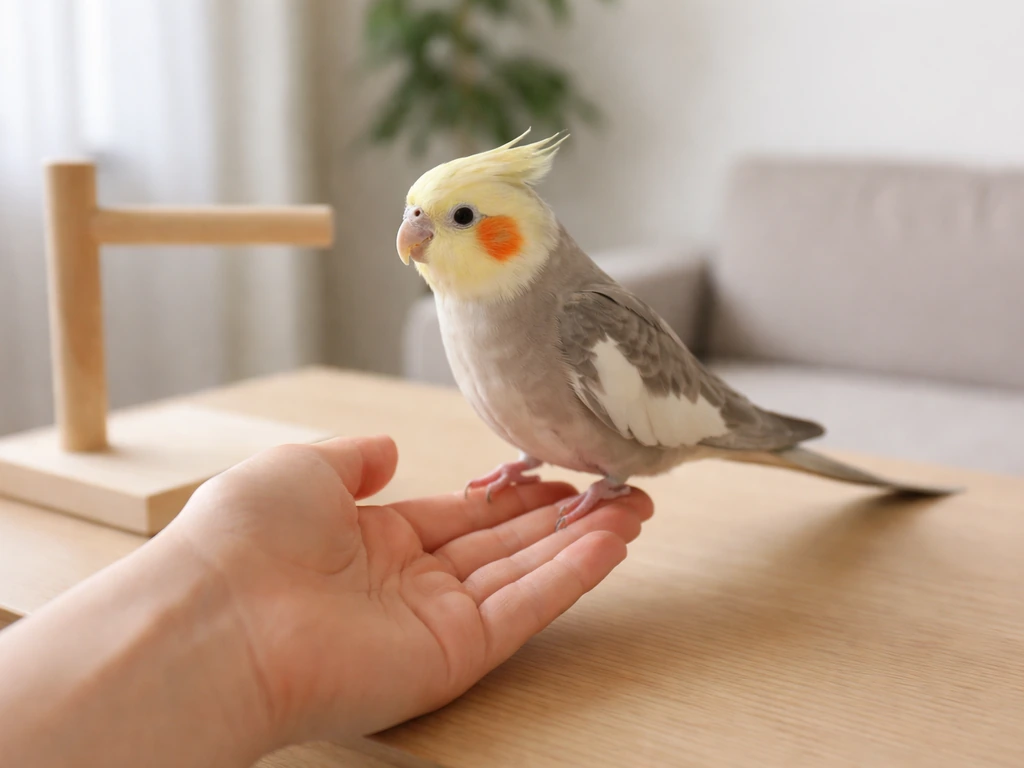
A cockatiel is a small, sensitive bird, so you should focus on quick safety steps and minimizing stress while you retrieve it. If you need breed-specific basics for a cockatiel in the long term, see how to breed cockatiel bird for an adjacent guide to responsible breeding considerations. If you are also looking for a daily bonding routine after the emergency, use this guide as a baseline before you follow how to play with cockatiel bird safely.
Treat any cat-caught pet bird as a veterinary emergency regardless of how the bird looks.
Step-by-step retrieval without hurting the bird
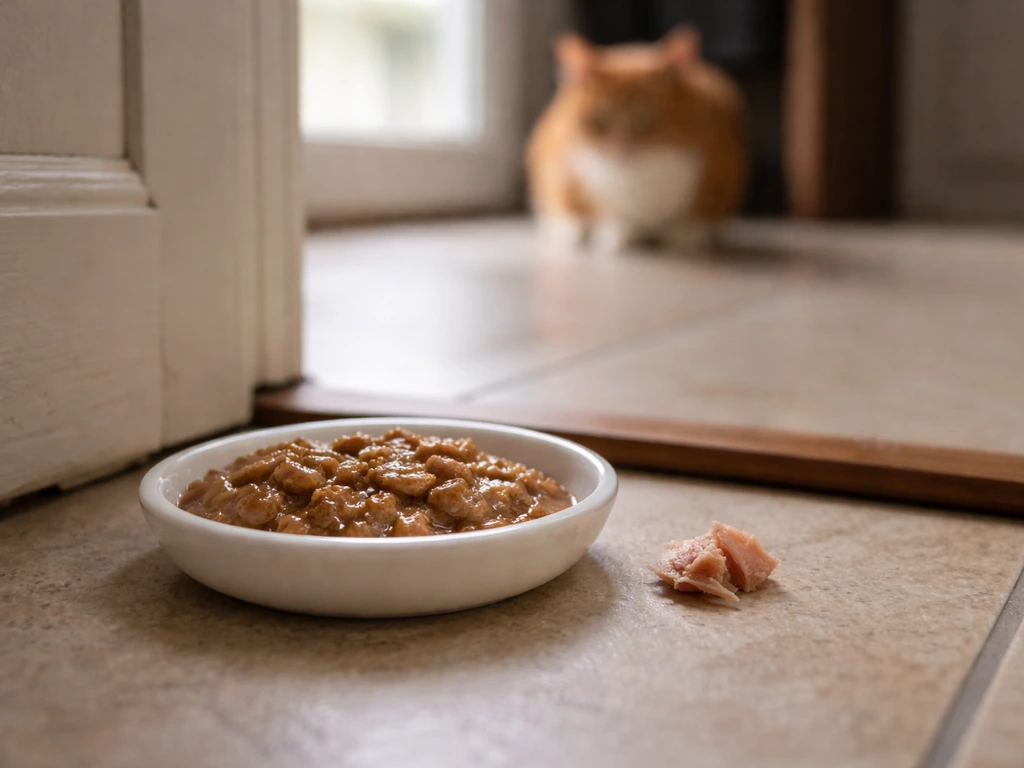
Work through these methods in order. Start with the least invasive and escalate only if needed.
Method 1: Food distraction (best first attempt)
Most cats will drop prey for a strong enough food reward, especially if they are food-motivated. Open a can of wet food or tuna nearby and let the smell do the work. Place the bowl on the floor a few feet away from the cat. Stay still and wait. Many cats will set the bird down to investigate the food. The moment the cat moves toward the bowl, step calmly between the cat and the bird, crouch down, and cover the bird with a towel in one smooth motion.
Method 2: Toy redirect (when food does not work)
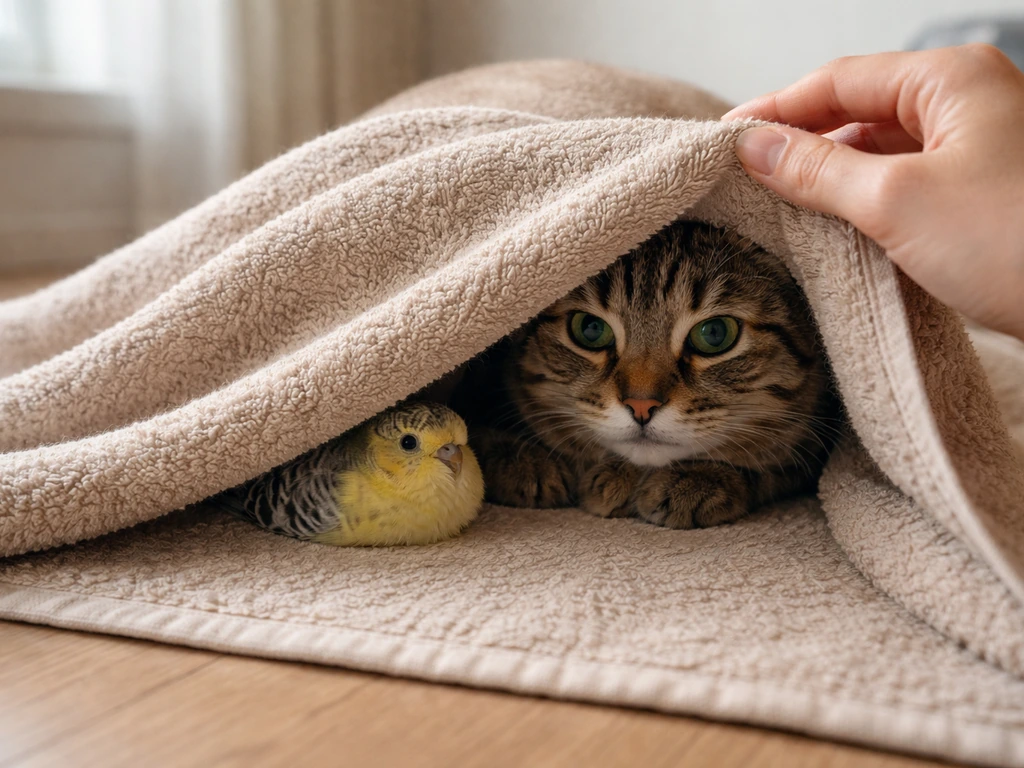
Drag a string toy or a crinkly foil ball across the cat's line of sight. Movement triggers a competing predatory response. Some cats will drop the bird to chase the new target. This works best with younger or highly play-motivated cats. Again, as soon as the cat disengages, move in calmly and cover the bird.
Method 3: Cover and scoop (when the cat is stationary)
If the cat is sitting still with the bird, drape a large towel over both the cat and bird simultaneously. This briefly disorients the cat and muffles the bird's movement. Reach under the towel and gather the bird firmly but gently in the cloth. Lift the bird out and transfer it directly to the box. The cat should back away from the towel as it sorts itself out.
Troubleshooting: when the cat will not release
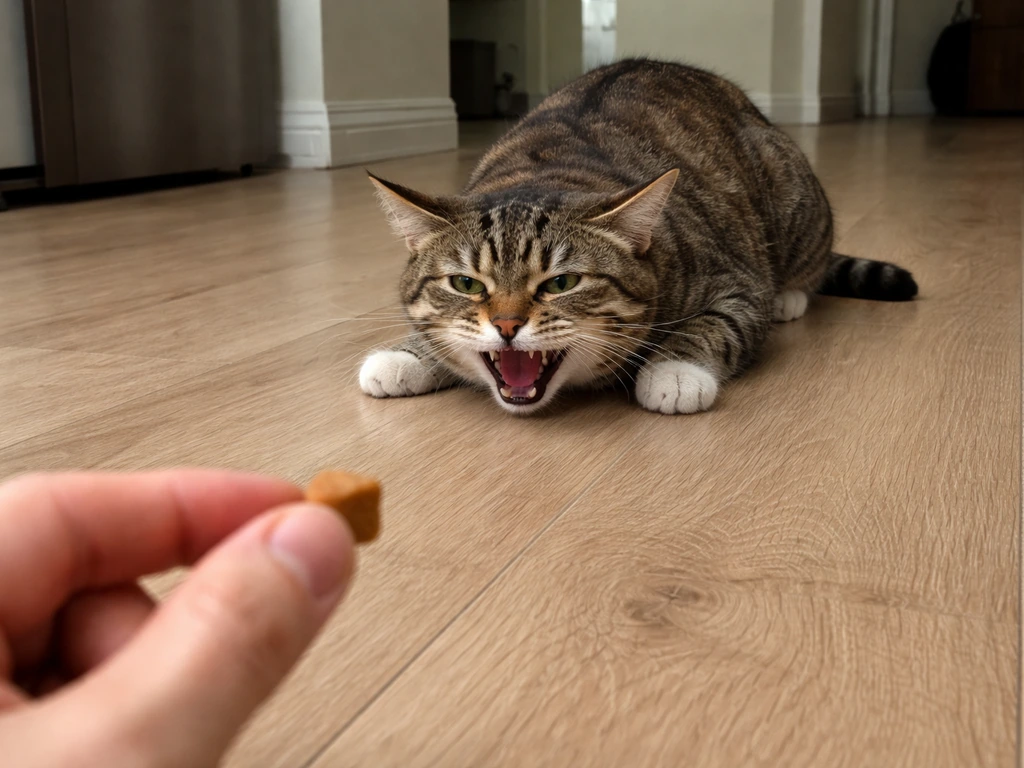
- Cat is crouching low and growling: Back off entirely, try food distraction from a greater distance, and wait. Forcing the interaction risks injury to the bird and a bite to you.
- Cat has retreated under furniture: Do not chase. Instead, block the area and leave the food distraction just outside the gap. Give the cat 2 to 3 minutes.
- Bird is struggling and cat is gripping tighter: Stop moving. Stand still until the bird goes quiet. Then use the food or toy method.
- Multiple cats involved: Remove additional cats first by herding them out of the room with food before attempting retrieval from the cat holding the bird.
- Cat is running between rooms: Close all doors before any retrieval attempt. Do not chase. Lure the cat into one room first.
Assessing the bird after retrieval
Once the bird is in the box, give it 15 to 20 minutes in a warm, dark, quiet place before you open the lid. If it is upright, alert, and trying to move away when you peek, that is a good sign. If you are also trying to support longer-term well-being, you can follow a separate guide on how to make cockatiel bird happy after the initial emergency care is sorted out.
After the emergency, you can also work on how to make cockatiel bird friendly with calm, consistent daily routines that reduce stress. If it is on its side, breathing rapidly with an open beak, unable to stand, or has visible wounds, it needs professional care today. Cat bites are deceptive. A bird can look completely uninjured and still have internal crushing injuries or a developing bacterial infection that will kill it within 24 to 48 hours without antibiotics.
Even if the bird looks fine after resting, contact a licensed wildlife rehabilitator or avian vet before releasing it. For a pet bird like a cockatiel or budgie, go to an avian vet immediately regardless of how the bird appears. Cat saliva in the wound is a medical emergency for small birds.
Preventing it from happening again
The indoor option
The single most effective thing you can do is keep your cat indoors. Cats kill an estimated 2.4 billion birds per year in the United States alone. Indoor cats live longer, healthier lives and pose no risk to birds. If your cat has been indoor-outdoor, the transition takes time and patience, but it is absolutely achievable. Start by restricting outdoor time to supervised sessions, then gradually shift activity to indoor enrichment.
Supervised and contained outdoor access
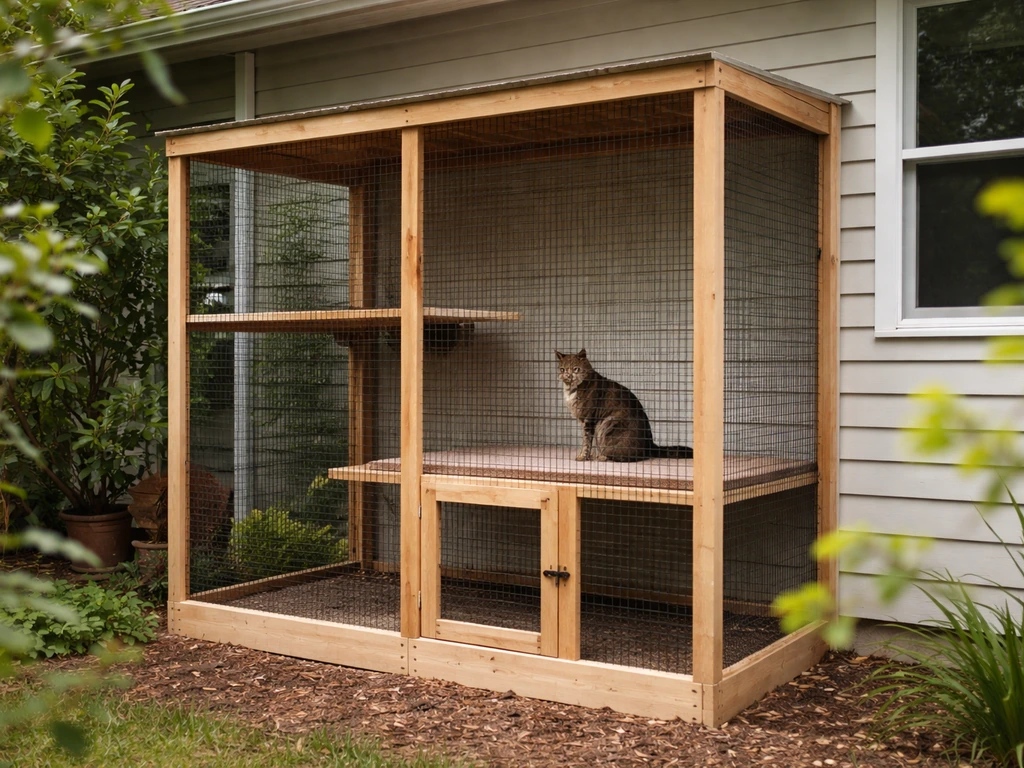
If your cat genuinely needs outdoor time, a catio (an enclosed outdoor cat enclosure) or a cat-proof garden run gives the cat fresh air and mental stimulation without access to birds. Leash training is another option for supervised outdoor sessions. These are practical middle-ground solutions recommended by organizations like the American Bird Conservancy for people who want to protect wildlife without completely restricting their cats.
Redirecting the predatory drive through play
A cat that gets regular, structured play sessions that run through the full predatory sequence is a cat with less drive to hunt outdoors. The key is to let the cat complete the sequence: stalk, chase, pounce, and 'catch' a toy. Sessions of 5 to 15 minutes, done two or three times a day, have a real impact on predatory motivation. End each session with a small food reward so the cat experiences the biological payoff of a successful hunt without involving any real birds. This is backed by behavioral science and it genuinely works over a few weeks of consistent practice.
Yard and garden management for backyard birders
If you feed wild birds and also have outdoor cats (yours or neighbors'), the setup of your feeding station matters. Place feeders at least 10 to 12 feet from any shrubs or structures a cat can use for cover. Use pole-mounted feeders with baffles. Ground feeders are the most dangerous option in a cat-present yard. A clear sightline around the feeder gives birds time to spot an approaching cat. Bell collars reduce hunt success by about 33 to 40 percent, but they are not a complete solution on their own. They work best as one layer in a broader management strategy.
Managing cats around pet birds in the home
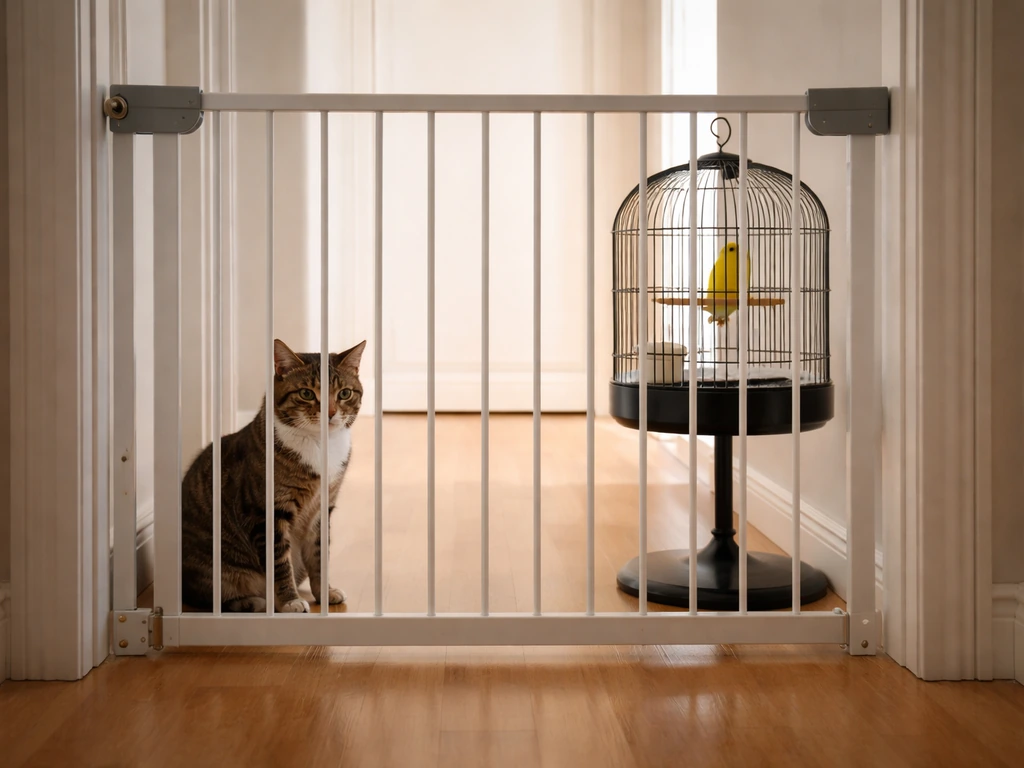
If you keep pet birds and cats in the same home, physical separation is non-negotiable when you cannot supervise directly. Cage doors that can be opened by a clever paw need secondary latches. Even a cat sitting on top of a cage causes chronic stress in birds that affects their immune function over time. The goal is to manage space so the cat cannot access the bird's area unsupervised.
If you are working on introducing your cat and bird more formally, that is a separate, gradual process that requires its own careful approach. If you are working on introducing a bird to a cat, plan slow, supervised sessions so both animals feel secure and you can stop before the predatory sequence escalates.
Safer bird options and alternatives for cat-focused households
If you want to enjoy birds but live with cats, the best approach is to create bird interest at a safe remove. Window feeders placed on second-floor windows or high-mounted outside feeders give indoor cats the visual stimulation of bird-watching without any predation risk. Bird-watching from a window has genuine enrichment value for cats and can partially satisfy the predatory drive through observation.
For people interested in keeping pet birds with cats in the home, larger bird species with more confident temperaments are not inherently safer just because they are bigger. The cat's predatory drive does not scale with bird size in a predictable way. What matters most is robust physical separation, consistent management, and a realistic assessment of your specific cat's prey drive. Some cats can coexist calmly with pet birds after careful, patient introductions. Others never can, and forcing the situation is not fair to either animal.
When to call a professional
Contact a licensed wildlife rehabilitator any time a wild bird has been in a cat's mouth, even briefly, even if there are no visible wounds. Most areas have a local rehab center or a state wildlife agency hotline. In the U.S., you can also call your state's Fish and Wildlife office. The NWRA (National Wildlife Rehabilitators Association) maintains a directory. Transport the bird in its dark, closed box and do not attempt to feed or water it on the way.
For a pet bird that has been caught by a cat, call an avian vet immediately. Do not wait to see if the bird seems okay. Pasteurella infection progresses fast in small birds and is treatable with prompt antibiotics but almost always fatal if treatment is delayed past 24 hours.
A quick note on the law
In the U. S. , most wild birds are protected under the Migratory Bird Treaty Act, a federal law that makes it illegal to take, possess, or transport migratory birds without a permit. This means that even well-intentioned extended home care of a cat-caught wild bird puts you in a legally gray area.
The practical takeaway is this: stabilize the bird, keep handling minimal, and get it to a licensed rehabilitator as quickly as possible. Licensed rehabilitators hold federal and state permits specifically authorizing them to hold and treat these birds legally. You are not in trouble for doing an emergency rescue and promptly handing the bird off. Holding it at home for days without professional guidance is where the legal and welfare problems compound.
Signs a bird needs emergency care now vs. can wait a short time
| Sign | What it likely means | Action |
|---|---|---|
| Upright, alert, moves away from hand | Shock or minor injury | Box, dark/warm, contact rehab within a few hours |
| On side, not moving | Serious injury or severe shock | Contact rehab immediately, keep warm |
| Visible blood, open wound | Puncture or laceration | Cover lightly with clean cloth, rehab or vet now |
| Open-beak breathing, gasping | Respiratory distress or internal injury | Emergency vet or rehab now |
| Wing hanging at odd angle | Possible fracture | Do not attempt to splint, rehab today |
| No visible injury but was in cat's mouth | Invisible bite wound, bacterial risk | Avian vet or rehab today regardless |
The most common mistake people make is releasing a bird too soon because it looks better. A bird that stands up, flutters, and seems to recover in an hour may still have a developing infection or internal injury. When in doubt, get a professional assessment before releasing. That one extra step can be the difference between survival and death for the bird.
FAQ
What should I do if my cat runs away with the bird and I cannot cover it right away?
Keep people and pets away and focus on preventing chase. Use the loudest, safest cue you can manage (a can opening or food smell) to lure the cat, then be ready with a towel and a ventilated box at the moment the cat drops or slows. If the cat stays hidden and you cannot safely retrieve the bird, contact a wildlife rehabilitator for guidance, especially for wild birds.
Is it safe to pry open my cat’s mouth or pull the bird out by force?
No. Pulling or forcing the beak can worsen crushing injury and increases the chance of deeper bites. Instead, interrupt the predatory sequence using distraction or towel coverage only once you can do it calmly and quickly.
Should I remove the bird from the towel or box immediately if it looks alert?
No, give it the full 15 to 20 minutes in the warm, dark, quiet box before you check again. Many birds stabilize on the surface while internal injury or infection begins to develop, so repeated early handling can increase stress and delay proper medical triage.
Can I offer water by dropping a few drops near the bird once it calms down?
Do not offer water or food during the immediate emergency phase. Even when a bird seems calmer, fluid and food can trigger aspiration, especially if it has been stressed or is breathing abnormally. For pet birds, follow an avian vet’s feeding instructions after assessment.
What are signs I should treat as an emergency even if there’s no visible blood?
Treat it as urgent if the bird has rapid breathing, an open beak with effort, inability to stand, obvious weakness, disorientation, or any puncture, even if tiny. Cat bite injuries can look mild externally while causing internal trauma or fast-moving bacterial infection.
If the bird is a wild bird, can I just release it once it flies normally in my yard?
Not automatically. A bird that looks recovered for an hour can still have developing infection or internal injury. If it was in a cat’s mouth, the safest step is to get it assessed by a licensed rehabilitator before release.
How should I transport the bird to a wildlife rehabilitator or avian vet?
Use the ventilated box immediately and keep it dark. Minimize handling, keep the box secure to prevent shifting, and avoid feeding or watering en route. If you have a second carrier, use it to separate the cat and reduce further stress during transport.
What if the cat won’t drop the bird even after food, toys, or towel methods?
Do not escalate to grabbing or pulling. Prioritize separating the cat from the room, then contact a wildlife rehabilitator or avian vet for practical instructions based on your situation and bird type. In the meantime, keep noise and movement low to avoid escalating the grip.
Should I clean the cat’s mouth or the cat cage area right after?
Yes, clean contaminated areas to reduce bacterial spread, but do it after the bird is secured and removed. Wear gloves, use a disinfectant appropriate for surfaces, and avoid splashing. Do not attempt to disinfect inside the cat’s mouth.
Will keeping my cat indoors completely solve the problem if I have neighborhood cats or outdoor birds?
It removes the main risk from your household cat, but wildlife exposure can still occur if neighbors’ cats enter your yard. Add layers such as cat-proof outdoor enclosures, supervised leash time, and secure, elevated bird feeding setups to reduce additional predation opportunities.
Is a bell collar enough protection for cats in bird-heavy areas?
Not by itself. Bells can reduce hunt success but they are not a complete solution, because cats can still stalk and pounce once close enough. Use bells as one layer, combined with baffles, safe placement of feeders, and preventing unsupervised roaming.
Can I keep my pet bird in a room the cat can see, even if the cat cannot physically reach the bird?
Visual access alone can still cause chronic stress for many birds, especially if the cat regularly perches near the barrier. Prefer strong physical separation with management that prevents any access, including the cat getting on top of cages or stands.