
You can introduce a bird to a cat safely, but it takes weeks of patient, barrier-based sessions rather than a single "let's see what happens" moment. The honest reality is that cats have a hardwired prey drive and birds have a hardwired panic response, and neither of those instincts disappears.
How to Introduce a Bird to a Cat Safely Step by Step
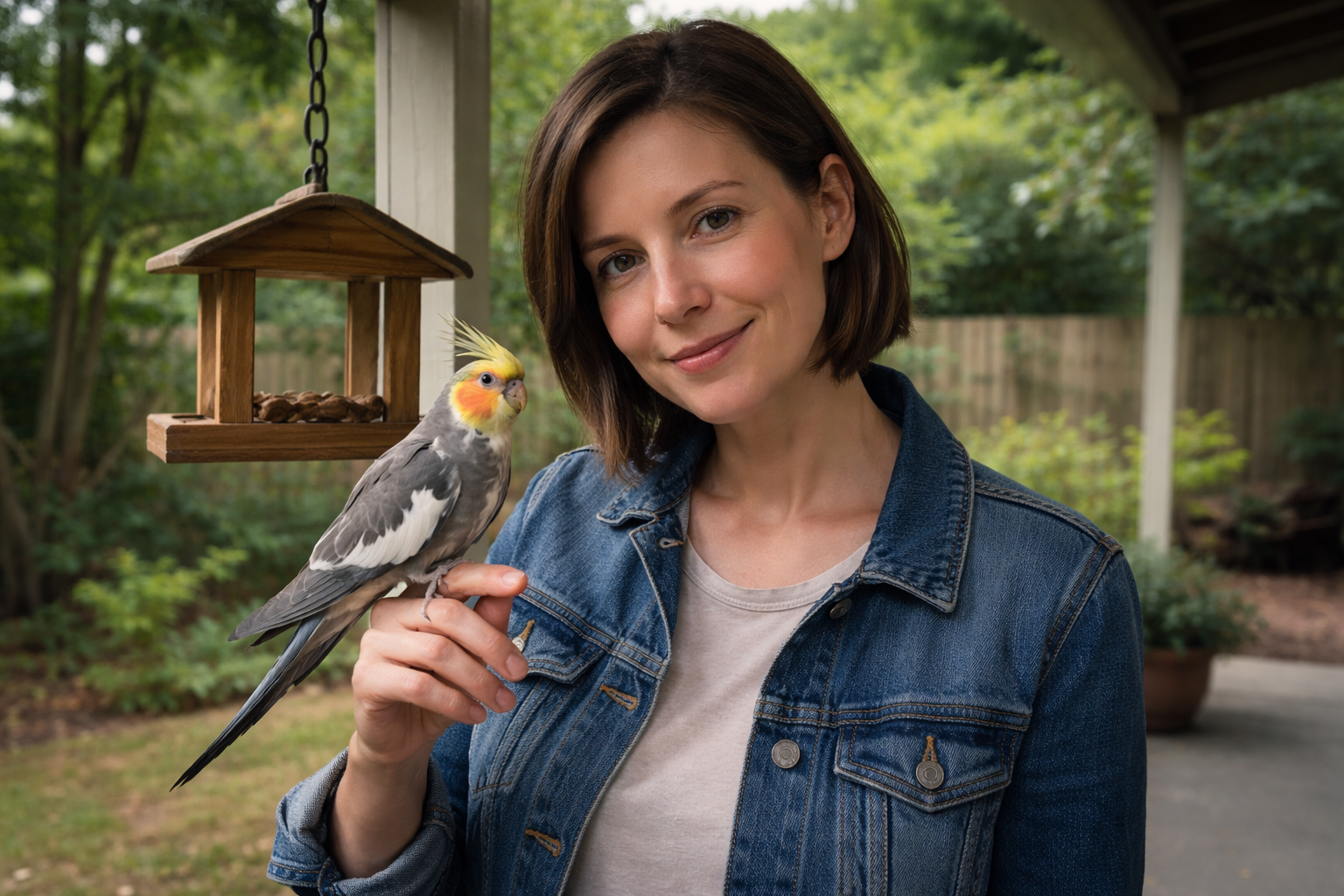
Clara Hayes
24 Apr 2026
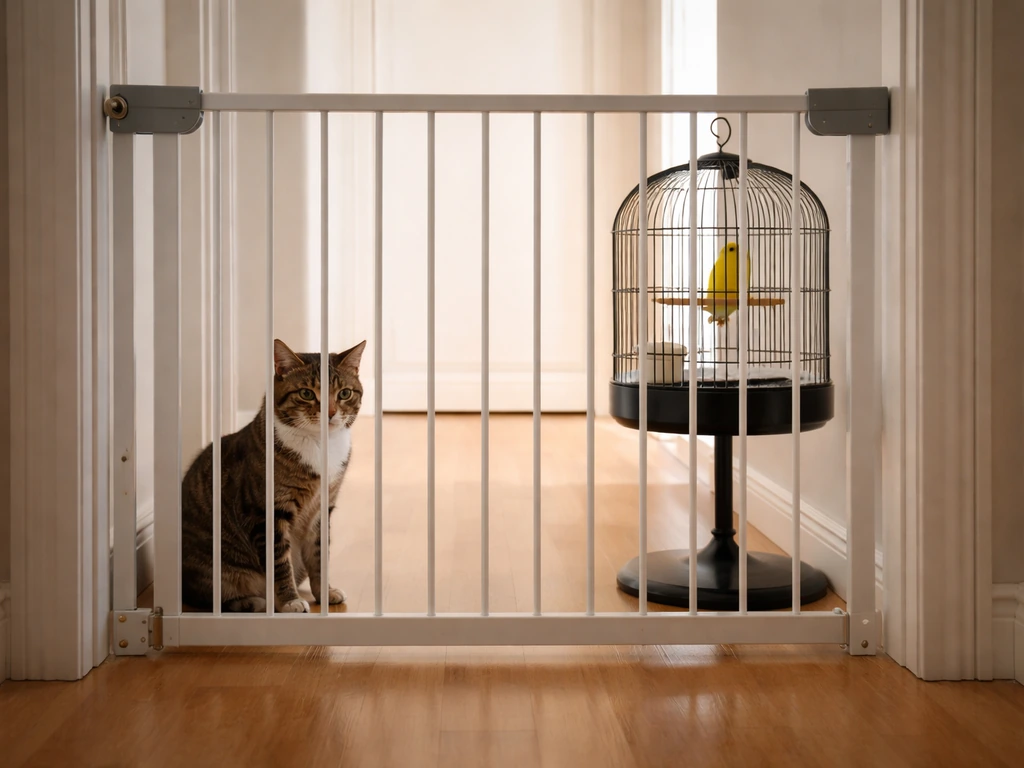
If your main concern is getting your cat to drop a bird, focus first on preventing the bird from being within reach and then work on calm, supervised training before anything is ever unsupervised get a cat to drop a bird. What you're actually training is self-control in the cat and confidence in the bird, one short, controlled session at a time. Done right, many cats and birds do reach a stable, low-stress coexistence.
Done wrong, it only takes a second for a serious injury to happen.
Set up for safety before the animals ever share a room

Before any introduction happens, your environment needs to be ready. This is the part most people skip, and it's the part that gets birds killed. Start here, and be honest with yourself about whether your setup is actually safe.
- The bird's cage or enclosure must be escape-proof. Check every latch, hinge, and gap. A stressed bird can squeeze through openings you'd swear were too small.
- The cage must be heavy enough that it cannot be knocked over. If a cat can topple it, it will eventually try.
- Place the cage on a solid surface well above floor level, ideally on a sturdy stand or table. Cats are far less likely to leap and swipe at eye-level or above than at a cage sitting on the floor.
- During any introduction session, the room must have only one exit and you must be inside it the whole time. Never leave these animals unsupervised together, ever.
- Remove clutter that gives the cat hiding spots to crouch and stalk from. You want clear sightlines so you can read both animals clearly.
- If you have an indoor/outdoor cat, keep them inside during all introduction phases. Outdoor exposure increases prey drive and keeps the cat in a more aroused baseline state.
- Have a towel or thick glove nearby in case you need to intervene quickly. You want to be able to act in one second, not ten.
A catio or dedicated bird room with a cat-proof door is the gold standard for long-term management, but for the introduction process itself, a single supervised room with a secure cage is your minimum requirement.
Understanding prey drive and stress signals in both animals
Cats don't chase birds out of malice. Prey drive is a motor pattern baked into feline neurology, and it's triggered by fast, erratic movement, high-pitched sounds, and small size. The intensity varies by individual: some cats are genuinely low-drive and barely register a bird after a few sessions, while others remain dangerously fixated no matter how much training you do. Knowing which cat you have is critical.
Cat body language to watch closely
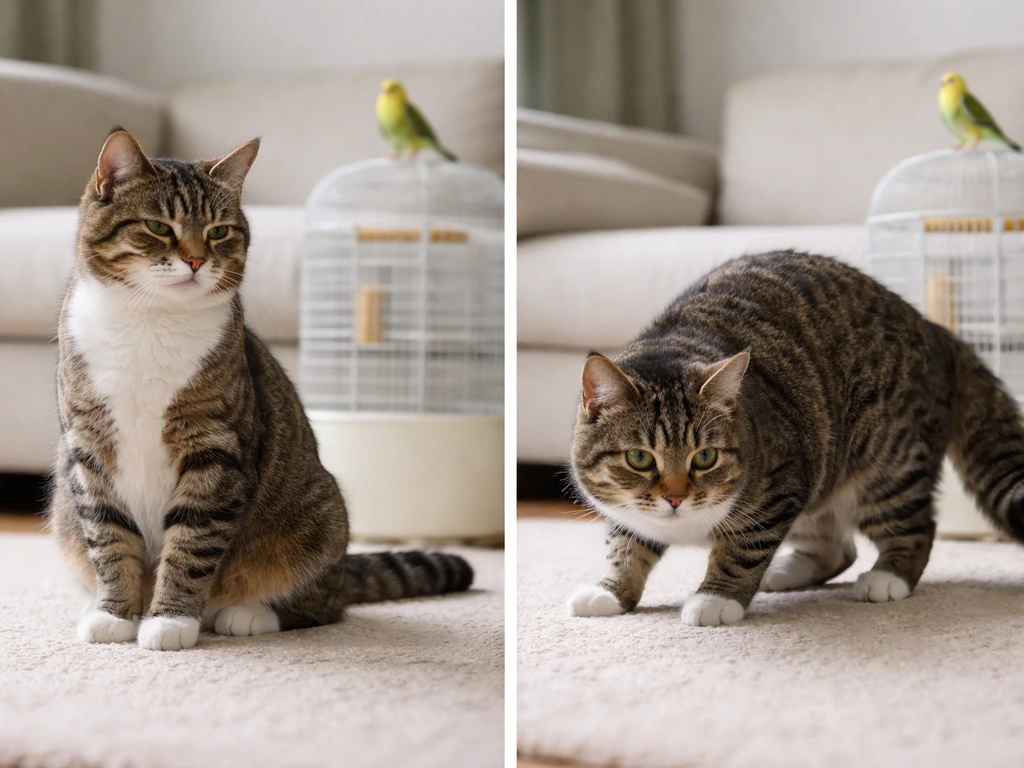
A relaxed cat around a bird will have a loose, neutral body posture, a gently swaying or still tail, and soft, half-closed eyes. A slow blink from a cat is a low-conflict signal, but only trust it when the rest of the body is loose and relaxed. If that same cat is crouched low with pupils blown wide and a tail lashing in short, tight flicks, the slow blink means nothing reassuring. Watch the whole body, not just the eyes. Ears pinned flat, a tucked or rapidly whipping tail, a low crouching body with weight shifted forward, and fixed, unblinking stare at the bird are all pre-attack signals. The moment you see any of these, the session ends.
Bird stress signals you must recognize
Birds mask stress and illness remarkably well until they can't anymore, so you need to know the early signs. A stressed bird will often alarm call repeatedly, hiss, pant, fan its tail, hold its wings slightly away from its body, or raise its head feathers. These are manageable stress signals that tell you the session is too intense. More serious is open-mouth breathing, visible tail bobbing with each breath, and increased sternal (chest) movement.
In a Reddit thread about a budgie with persistent tail bobbing, commenters emphasized considering the overall context, such as whether there is open-mouth breathing and other illness indicators, before assuming it is distress context matters when interpreting tail bobbing as respiratory distress. Those are not "just stress" signs.
Open-mouth breathing and tail bobbing with respiration indicate respiratory distress and require the session to stop immediately and, if they persist, a call to an avian vet. A bird frozen in place and puffed up is also a major warning sign: that's a bird in shutdown, not a calm bird.
The step-by-step introduction plan
This process runs in phases. Do not rush between them. Each phase should feel boring before you move on, meaning both animals are calm and not reacting strongly. That boredom is the goal.
Phase 1: Scent swapping (Days 1 to 7)
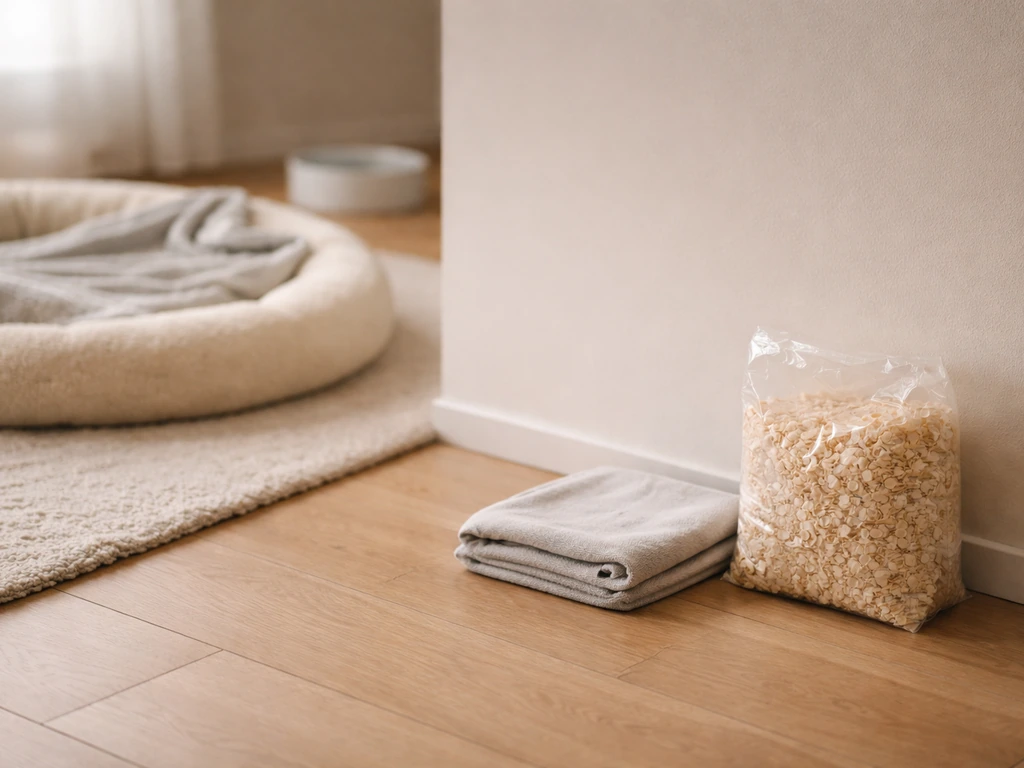
Start without either animal present in the same room. Take a small cloth or piece of bedding from the bird's cage and place it near the cat's resting area. Do the reverse: put something that smells like the cat near (but not inside) the bird's cage. Let both animals get used to the other's scent before they ever see each other. This phase builds familiarity at zero risk.
Phase 2: Visual contact through a barrier (Days 7 to 21)
Now you let them see each other, but through a solid barrier like a closed glass door, baby gate, or the cage itself. Keep sessions to 5 to 10 minutes. Have a second person present if possible: one person focuses on the cat, one on the bird. Reward the cat with high-value treats for any calm behavior: sitting still, looking away, sniffing the air without fixating. Watch the bird the whole time. If the bird is exploring, vocalizing normally, and eating, that's a good sign. If it's frozen, alarm calling, or showing any respiratory signs, end the session and give it a day before trying again at a greater distance.
Phase 3: Same-room sessions with cage barrier (Weeks 3 to 6+)
The cat enters the room where the bird's secure cage is. The cat is on a leash or harness for the first several sessions, period. This gives you physical control without having to grab or restrain the cat in a way that escalates the situation. Sessions stay at 10 to 15 minutes. Keep the cat at least six to eight feet from the cage initially, reward calm behavior continuously, and move closer only in small increments over multiple sessions, not within a single session. If the cat lunges, pulls toward the cage, or fixates, you've moved too fast. Go back a step.
Phase 4: Supervised proximity (Weeks 6 to 12+)
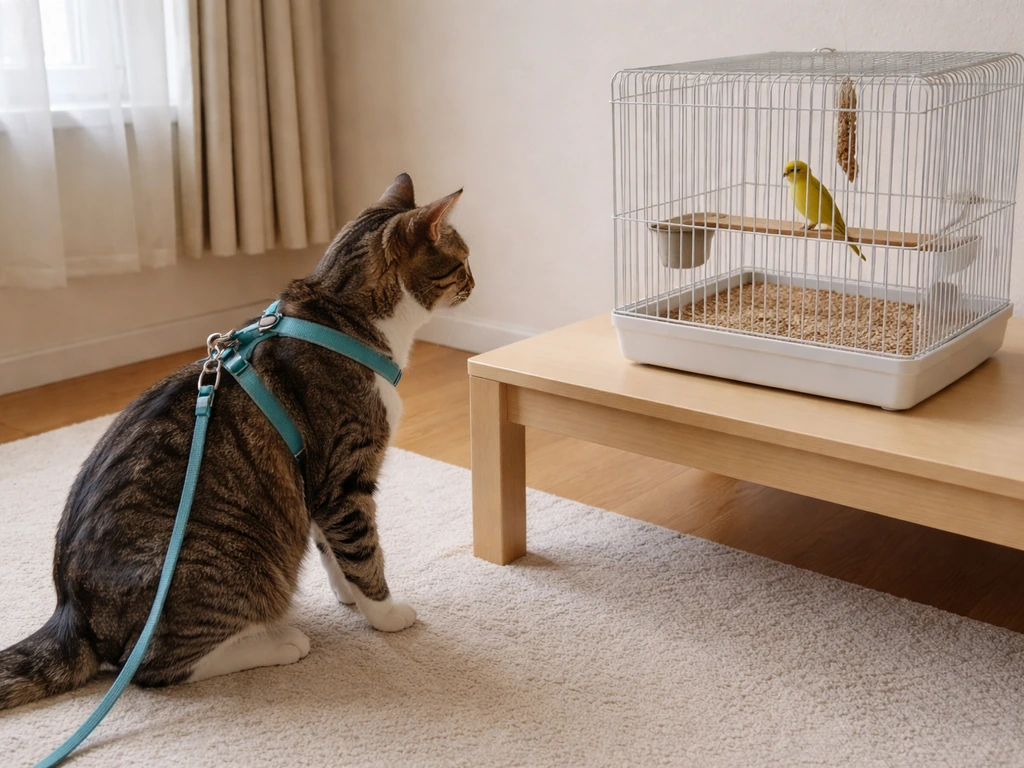
Only when the cat consistently ignores or shows mild, relaxed interest in the cage across multiple sessions do you allow freer movement in the room. The RSPCA recommends using a gradual, controlled approach to introductions, including a “cat-safe” room, to help animals acclimatise and manage introductions carefully. The bird remains in the cage. The cat is not leashed but you are actively watching both animals. Never, at any stage, allow the bird to be out of its cage with the cat free in the same room unless you have months of consistently calm behavior behind you and a very specific, known individual cat that has proven itself. Even then, the risk is never zero.
Species-specific strategies for pet birds and wild birds
Not all birds respond to this process the same way, and their size and temperament change both the risk level and the approach.
Cockatiels and budgies
Cockatiels and budgies are small, fast-moving, and vocal. If you're specifically trying to tame a cockatiel bird, focus on building a calm, predictable routine before any close interactions with other animals Cockatiels and budgies are small. Their movement patterns trigger prey drive easily. Cockatiels will often raise their crest feathers as a stress indicator: a fully flattened crest in a bird that's otherwise active is alertness, but a crest slicked flat combined with a frozen posture is fear.
Budgies tend to go very still when frightened, which can be misread as calm. During introduction sessions, keep these birds in a spacious cage with visual cover (a hanging toy or a corner they can retreat to) so they don't feel exposed. If you're working on taming or building trust with a cockatiel alongside this process, the confidence work you do during handling sessions carries over and makes cat introductions less frightening for the bird.
If your goal is to make a cockatiel bird friendly, this same kind of confidence and trust-building is what lets the bird handle the slower, step-by-step introductions more calmly how to make cockatiel bird friendly.
Parrots
Larger parrots like conures, African greys, or Amazon parrots can hold their own psychologically better than a budgie, but they're also capable of serious self-injury from panic (broken blood feathers, impact injuries). A stressed parrot may lunge, scream, or feather-destructively react over hours and days after a bad session. Give them more time between phases and prioritize their behavioral cues heavily. The advantage with parrots is that they often habituate well when introduced slowly because they're cognitively engaged by novelty rather than just frightened by it.
Finches and canaries
Finches and canaries are among the highest-risk species for this process. They are tiny, extremely fast, and highly reactive. Their stress response can escalate to open-mouth breathing and exhaustion very quickly. If you have finches, keep introduction sessions very short (5 minutes maximum), use maximum distance, and be prepared for this to take several months rather than weeks. If a finch shows any respiratory distress signs, that animal may simply not be a good candidate for cat coexistence in a shared space.
Wild birds in temporary care
If you're a rehabilitator or you've found an injured wild bird and are temporarily housing it, do not attempt any cat introduction process with that animal. Wild birds in care are already maximally stressed, immunocompromised, and need isolation from predators entirely. Keep the cat out of the room where the wild bird is housed, full stop. The ethical obligation to the bird's welfare and its release outcome means zero cat exposure. This is categorically different from working with a pet bird in a stable home environment.
Training routines for the cat and the bird
Training the cat: rewarding calm and desensitizing
The goal is to teach the cat that the bird's presence predicts good things for the cat, and that calm behavior around the bird earns rewards. Desensitization and counterconditioning are typically taught by rewarding appropriate behavior rather than punishing undesirable behavior, which helps reduce fear and anxiety calm behavior around the bird earns rewards. Use the highest-value treat your cat will work for: small pieces of cooked chicken, commercial meat-based treats, or whatever makes your cat visibly excited. The training sequence is simple but must be consistent.
- Bring the cat into the room. Immediately begin feeding treats at a steady pace as long as the cat is not fixating on or moving toward the cage.
- The moment the cat turns toward the cage with focused attention, treats stop. You don't punish: you simply remove the reward.
- When the cat looks away or sits calmly, treats resume.
- Repeat this across short sessions, gradually requiring longer periods of calm before the treat comes.
- As the cat consistently succeeds, you can begin adding a verbal marker (a short, consistent word like 'yes') the instant the cat looks away from the bird, then follow with the treat. This speeds up the learning.
Never use punishment, spray bottles, or loud sounds to correct the cat during these sessions. Aversive tools create negative associations with the entire situation and can increase anxiety and unpredictability in both animals.
Training the bird: building confidence and a calm baseline
A bird that is well-handled, step-up trained, and comfortable with its environment will manage cat introduction sessions far better than a bird that's already anxious about human contact. The step-up behavior (where the bird steps confidently onto your hand or a perch on request) is the foundation here: it gives you a reliable way to move the bird calmly and gives the bird a sense of agency and predictability.
If your cockatiel or budgie isn't reliably stepping up yet, prioritize that training before beginning cat introductions. For more step-by-step guidance on day-to-day enrichment and trust-building specifically for cockatiels, see how to play with cockatiel bird. If you are also planning for the future, learn the basics of how to breed cockatiel bird responsibly and safely before attempting pairings.
During cat introduction sessions, position the bird so it has a choice about where it sits in the cage. Perches at different heights, cover options, and familiar toys all reduce the bird's stress load. After each session, spend time with the bird independently: talking to it, offering treats, doing any regular handling routine you have. This helps the bird associate the post-cat-session period with positive social interaction rather than lingering stress.
When things go wrong: stop rules and troubleshooting
Things will go sideways sometimes. Having clear stopping rules before you start means you make the right call in the moment instead of second-guessing yourself while the situation escalates.
Stop the session immediately if:
- The cat lunges at, paws at, or circles the cage in a hunting pattern.
- The cat is crouched low, tail lashing, with fixed pupils and unbroken stare at the bird.
- The bird shows open-mouth breathing, tail bobbing with respiration, or hard panting.
- The bird has been frozen and silent for more than one to two minutes (shutdown, not calm).
- You feel like you can't safely control both animals simultaneously.
- Either animal begins vocalizing in a high-stress pattern that doesn't settle within 30 seconds.
How to reset after a bad session
Remove the cat from the room calmly and without drama. Check the bird: if it's showing any respiratory signs, watch it for 15 to 20 minutes in quiet and make sure it returns to normal breathing. If respiratory signs persist, contact an avian vet. Give both animals at least 24 to 48 hours before attempting another session. When you resume, go back two phases, not one. If you were doing same-room sessions, return to visual-through-barrier sessions. Regression is not failure: it's data telling you the introduction moved faster than both animals were ready for.
When to stop permanently and get help
Some cats are not safe around birds regardless of training effort. If after six to eight weeks of consistent, well-structured sessions the cat is still fixating intensely, lunging, or showing predatory stalking behavior, that animal may simply have a prey drive level that makes coexistence unsafe. This is not a failure of effort: it's a realistic assessment. At that point, the most humane and practical solution is permanent physical separation (dedicated rooms, never unsupervised), or consulting a certified applied animal behaviorist who can assess both animals in person. Do not let wishful thinking override safety.
Long-term coexistence, enrichment, and realistic timelines
Even when introductions go well, coexistence is an ongoing management situation, not a finished project. Here's what that looks like practically.
Realistic timelines
| Phase | Typical Timeline | What success looks like |
|---|---|---|
| Scent swapping | Days 1 to 7 | Cat sniffs item without strong reaction; bird ignores item |
| Visual barrier contact | Days 7 to 21 | Cat glances at bird and looks away; bird explores normally |
| Same-room on leash | Weeks 3 to 6 | Cat sits calmly near cage; bird is active and eating normally |
| Supervised free movement | Weeks 6 to 12+ | Cat ignores cage; bird shows no stress signals during sessions |
| Ongoing supervised coexistence | Months to indefinite | Both animals reliably calm; no fixation or stress signals |
These timelines assume consistent daily sessions and both animals being in a healthy, stable baseline. Younger, calmer cats often move faster. High-drive cats or very anxious birds may take significantly longer, or may not reach the later phases at all.
Enrichment for the bird during the long-term process
A bird that is bored, understimulated, or living in a barren cage will be more reactive and harder to settle during cat sessions. Prioritize foraging toys, varied perch textures and diameters, species-appropriate social interaction, and out-of-cage time in a fully cat-free space every single day. For cockatiels, budgies, and parrots, out-of-cage time is not optional for their wellbeing: it needs to happen in a room the cat cannot access, so the bird has a guaranteed safe zone where it can decompress. Making sure your bird feels happy and confident in its normal environment is directly connected to how well it handles the stress of cat sessions.
Supervision rules that never change
No matter how many months of calm sessions you have behind you, the supervision rules stay the same: the bird is never out of its cage with the cat in the same room unless you are physically present and actively watching. Not in the next room. Not checking your phone. Present and watching. Cat behavior can change suddenly due to illness, a new scent, an outside stimulus, or simply a moment of aroused predatory response that bypasses all previous conditioning. One unguarded moment is all it takes. Build your home management around this reality rather than optimism, and both animals stay safe long-term.
The goal of all of this isn't a picture-perfect cross-species friendship. It's two animals living in the same home with low stress, no injuries, and an owner who has genuinely reduced risk through structure and patience. That's a realistic, humane outcome worth working toward.
FAQ
Can I introduce my cat and bird if my cat is already obsessed with the bird’s cage or makes it hard to walk past?
Start by assuming the risk is high and do not attempt the same-room or “bird and cat together” phases. Go back to scent-only and visual-through-barrier sessions at maximum distance, and only progress when the cat can be rewarded for calm looking away. If the cat keeps fixating, lunging, or stalking even after several weeks of structured sessions, plan for permanent physical separation or a certified behaviorist evaluation instead of continuing to force progress.
What should I do if my bird seems calm during the session but I notice stress afterward?
Treat aftercare as part of the plan. If you see ongoing alarm calling, unusual breathing effort, reduced appetite, or persistent puffing after the session, consider the bird overstimulated and lengthen recovery time. Move back one phase (for example, from cat in room to barrier sessions) before trying again, and ensure the bird gets decompression in a cat-free space.
Is it ever safe to hold the bird while the cat is in the same room?
No, not as an introduction tool. Holding the bird removes its safety boundaries and eliminates your ability to instantly stop an unsafe chase or lunge. The bird should remain in a secure cage during any phase where the cat can access the room, even if the bird seems trusted with you.
How far apart should the cat and bird be during the “cat in the room with the cage” stage?
Use an initial gap that prevents reaching behavior, at least six to eight feet at first. Then only reduce distance in small increments across multiple sessions, never within a single session. If the cat fixates, pulls toward the cage, or attempts to lunge, increase the distance again and repeat the previous step until calm is consistent.
What are the most common mistakes that cause introductions to fail or become unsafe?
The biggest issues are skipping the environment setup, moving phases too quickly, and relying on eye behavior alone. Another common mistake is allowing any unsupervised moment, even briefly “just to check something,” because predatory arousal can change suddenly. Finally, avoid punishment or loud corrections, those can make both animals more unpredictable.
Can I use treats for the cat during every session, even if the cat is very aroused?
Use treats to reinforce calm, but only if the cat can still process them, meaning it is not locked into an intense stare or actively lunging. If the cat is too aroused to take treats, stop the session and return to the earlier phase at greater distance. Your goal is to pair bird presence with reward while the cat remains under threshold.
How do I tell the difference between fear and excitement in the bird during introductions?
Look at the full pattern, not one behavior. A bird that is actively exploring, vocalizing normally, and eating is generally not overwhelmed. If you see repeated alarm calls, hissing, panting, wing position away from the body, open-mouth breathing, or tail bobbing with respiration, treat that as too intense and end the session. A frozen, puffed shutdown posture is also a major warning sign.
My bird is a budgie or cockatiel. Are there species-specific red flags I should watch for?
Yes. Budgies may go very still when frightened, that can look like calm but may indicate fear. Cockatiels can show crest changes and posture shifts, a crest that is slicked flat with freezing can signal fear rather than relaxation. For either species, keep visual cover and retreat options in place, and end sessions at the first signs of respiratory distress or shutdown.
What if my cat is doing playful behaviors, like stalking or chasing, not serious hunting?
Playful chasing can still escalate into predatory contact, especially if the cat is fast and fixated on the bird’s movement. Treat stalking and crouched weight-forward behavior as a red flag regardless of your interpretation. If you see predatory body signals, end the session immediately and revert to a previous phase with more distance and barriers.
How long should I wait between sessions when things go well versus when things go poorly?
When things are going well and both animals are calm, sessions can stay short and consistent, then progress only when you see stable “boring” behavior. If you had to stop due to warning signs, give both animals at least 24 to 48 hours before trying again, and go back two phases rather than one when you resume.
What should I do if my bird has respiratory signs and I suspect something is wrong during an introduction?
Stop the session, remove the cat from the room calmly, and monitor the bird quietly for 15 to 20 minutes. If respiratory signs persist or worsen, contact an avian vet right away. Do not resume introductions until a professional confirms it is safe and the bird’s breathing is back to normal.
If my cat still can’t safely coexist after weeks, what’s the humane next step?
If after six to eight weeks of consistent, well-structured sessions the cat continues intense fixation, lunging, or predatory stalking, treat that as an unsafe mismatch. The humane solution is permanent physical separation with dedicated rooms, and continued management that never allows the bird out with the cat free. For a more individualized assessment, consult a certified applied animal behaviorist in person.
Next Articles
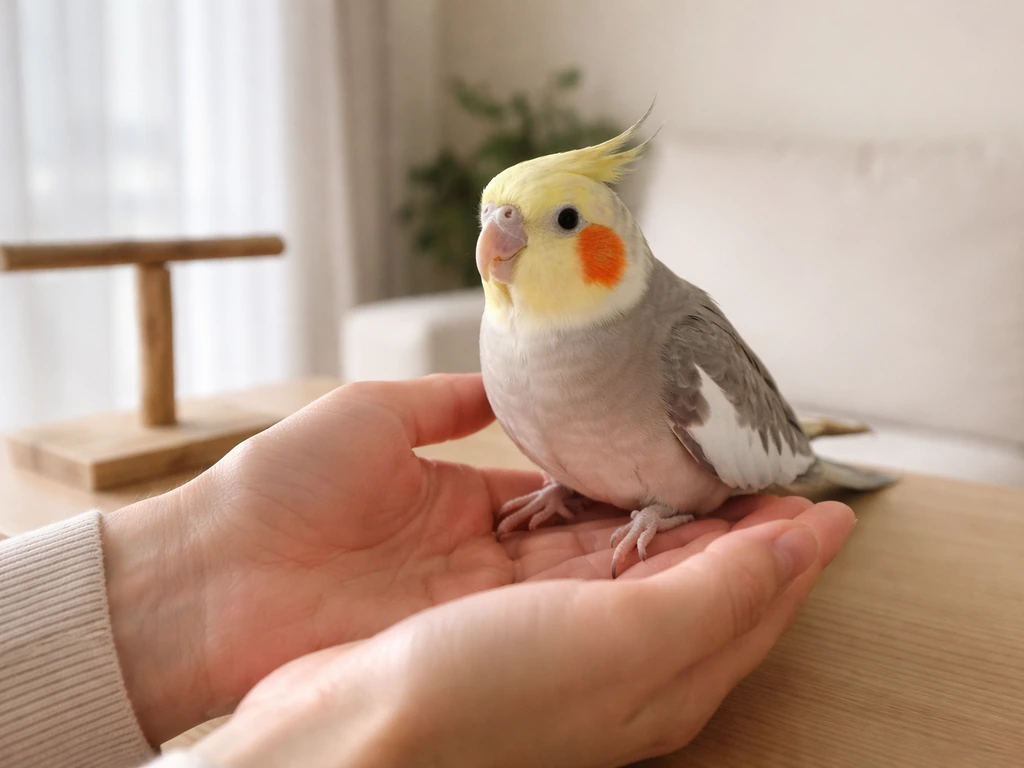
How to Play With a Cockatiel Bird Safely and Kindly
Safety-first guide to play with a cockatiel, read behavior, tame step-by-step, enrich, and troubleshoot biting or fear.
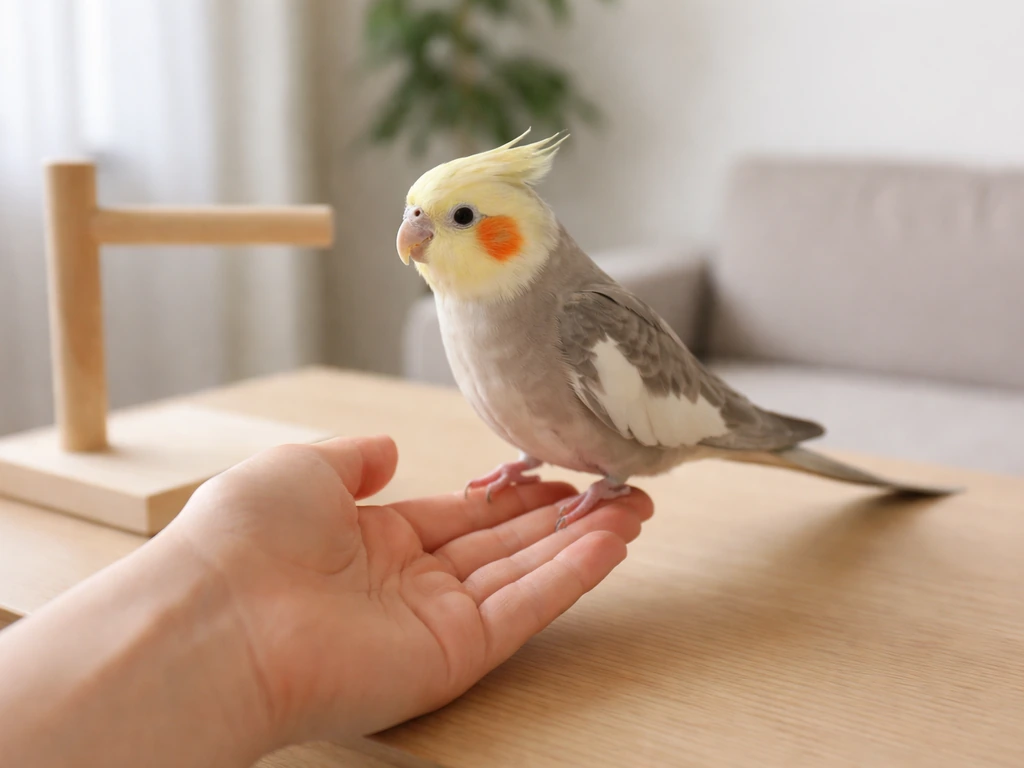
How to Make a Cockatiel Bird Friendly: Step-by-Step Guide
Step-by-step training and setup to make your cockatiel safe, calm, and trusting with people using gentle handling
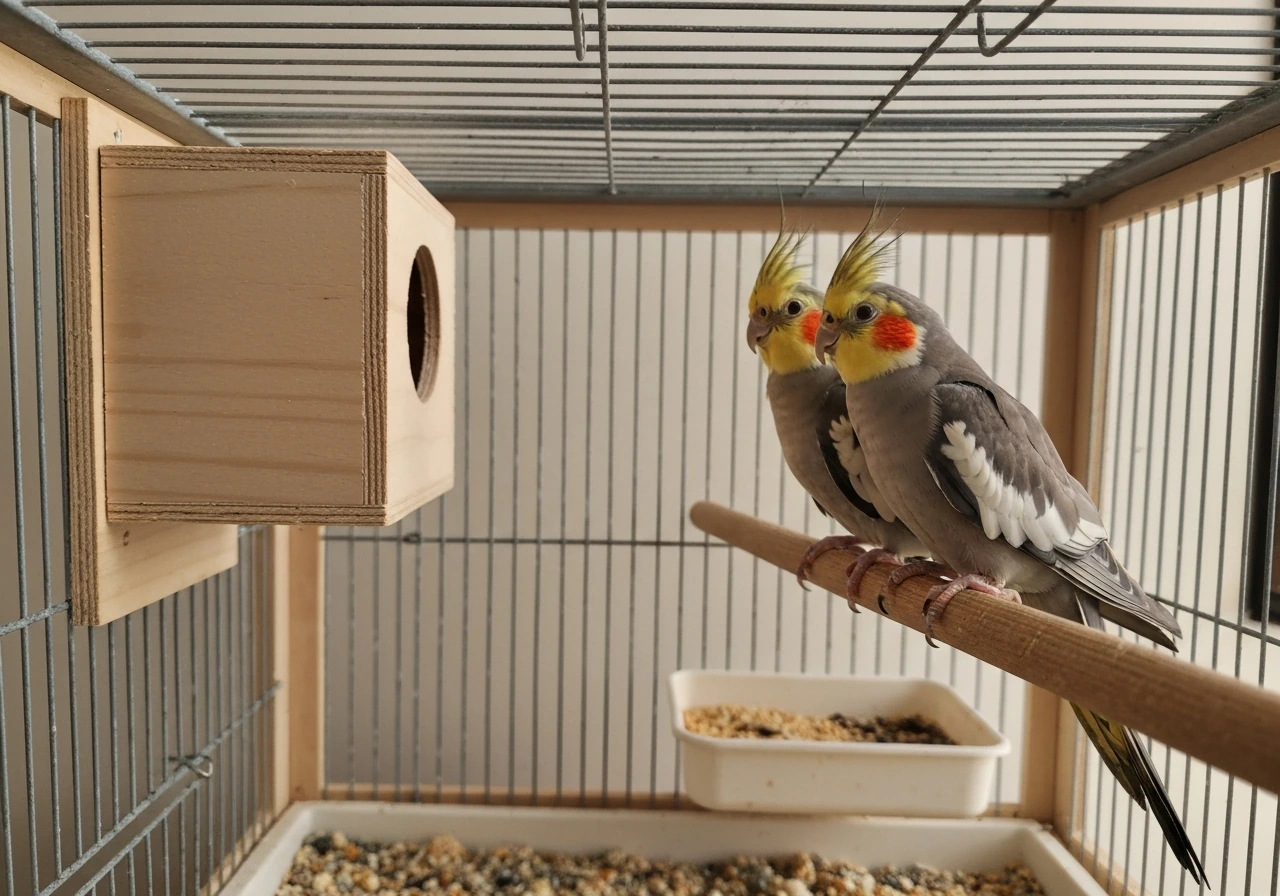
How to Breed Cockatiel Birds: A Step-by-Step Guide
Step-by-step, safety-first guide to breeding cockatiels: readiness, nesting, incubation, chick care, weaning, ethics, tr