You can build genuine trust with a wild bird in your yard, but it looks very different from taming a pet. In most cases, you are not training the bird to sit on your hand. You are teaching it that you are not a threat, so it chooses to come closer over time. That distinction matters a lot, both for the bird's wellbeing and for your safety. This guide walks you through the whole process: what to realistically expect, how to set up your space, how to build a daily routine, and exactly what to do when things go sideways.
How to Tame a Wild Bird Safely: Step-by-Step Trust Plan
Clara Hayes
6 Apr 2026
What taming a wild bird really means
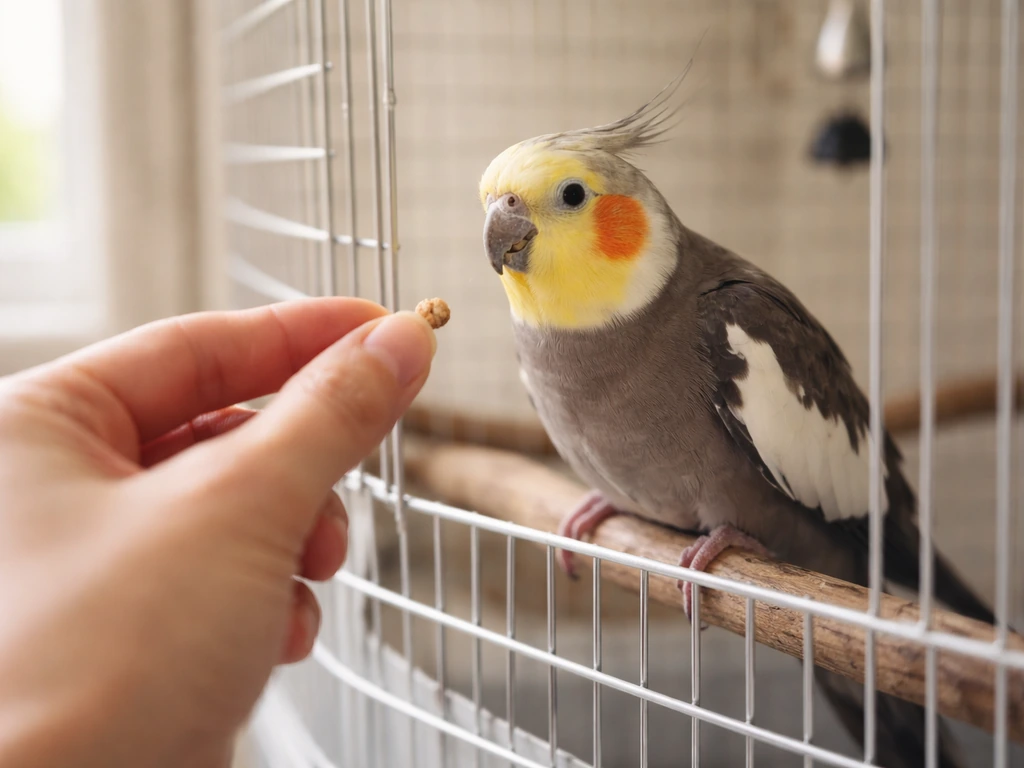
The word 'taming' means something very specific when you are dealing with a wild bird versus a pet. A hand-raised budgie or lovebird has been socialized to humans from the start. If you want to explore how to tame a bird that you already keep at home, the process involves hands-on contact from day one. Wild birds are different. They have a survival instinct that treats any large, fast-moving creature as a predator. You cannot override that through sheer persistence or by grabbing the bird.
What you can do is reduce fear over repeated, low-stress encounters until the bird chooses to stay near you. This is trust-building, not taming in the traditional sense. A truly 'tamed' wild bird that allows handling is almost always one that is ill, injured, or so young it has not yet developed its fear response. If a wild bird lets you pick it up easily, treat that as a red flag, not a success.
The realistic goal for a healthy wild bird is this: it stays within a comfortable distance while you are present, it returns to your yard reliably, and it may eventually feed or perch within a few feet of you without fleeing. That is a meaningful and worthwhile outcome. Handling is almost never part of the picture unless you are a licensed rehabilitator.
Before you start: safety, distance, and figuring out if the bird needs help
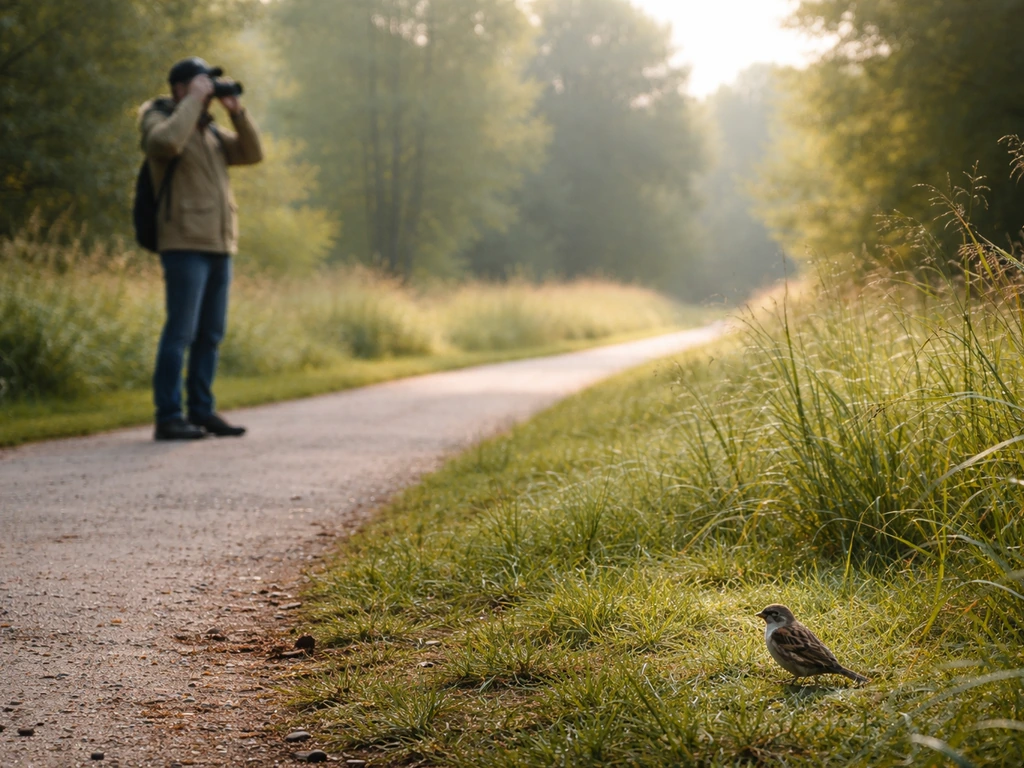
The very first thing to do before any trust-building attempt is to assess the bird's condition from a distance. Use binoculars if you have them. You want to know whether you are dealing with a healthy bird you can gradually habituate, or an injured or stunned bird that needs a different kind of help right now.
Signs that a bird is in distress and needs immediate attention, not a trust-building routine, include: sitting on the ground without moving for more than 20 to 30 minutes, visible drooping of one wing, a twisted or open beak, labored breathing with the beak open while at rest, or eyes that are closed or partially closed during daylight hours. A bird that flew into a window may also sit stunned for 15 to 30 minutes and then recover on its own. Give it quiet, shaded space during that window before assuming it is in serious trouble.
For your own safety, keep a respectful distance from any wild bird, especially larger species like crows, jays, mockingbirds, hawks, and waterfowl. Many birds will dive-bomb or strike if they feel cornered or if there is a nest nearby. Never reach into dense shrubs, tree cavities, or ground cover to pick up a bird unless you are wearing thick gloves and have a good reason. Even small birds can deliver a surprisingly sharp bite or scratch.
Also check whether any children or pets are in the area before you begin. Cats in particular can ruin weeks of trust-building in a single afternoon, and they pose a genuine risk to any bird you are trying to habituate. Keeping the yard cat-free, or at least creating a designated bird-safe zone, is a prerequisite before you invest serious time in this.
Identifying the bird and setting up the right food and water
You do not need to be a professional birder to give a wild bird what it needs, but you do need a rough identification so you can offer the right food and set up the space correctly. A misidentified bird fed the wrong food is a bird that will not come back, or worse, one that gets sick.
Start by looking at size, beak shape, and behavior. Small birds with conical beaks (sparrows, finches, cardinals, towhees) are seed eaters. Small birds with thin, pointed beaks (wrens, warblers, robins) are primarily insect and fruit eaters. Larger birds with hooked beaks (hawks, owls) are raptors and are almost always protected under stricter regulations. Hummingbirds are unmistakable and have their own feeding requirements entirely.
| Bird Group | Beak Shape | Best Food Offering | Special Notes |
|---|---|---|---|
| Sparrows, finches, cardinals | Short, conical | Black oil sunflower seeds, millet | Avoid flavored or salted seed mixes |
| Robins, thrushes, mockingbirds | Medium, straight | Mealworms, berries, fruit chunks | Avoid bread entirely |
| Jays, crows | Large, straight | Unsalted peanuts, suet, fruit | Very smart; learn routines fast |
| Doves, pigeons | Small, slender | Millet, cracked corn, safflower | Ground feeders; keep area clean |
| Hummingbirds | Long, needle-like | Plain nectar (4:1 water to sugar) | No red dye; clean feeder every 2 to 3 days |
| Woodpeckers | Long, chisel-like | Suet cakes, peanut butter mixes | Need a vertical surface feeder |
Water is just as important as food. A shallow dish (no more than 1 to 2 inches deep) with fresh water refreshed daily will attract birds faster than a feeder alone. Place it near but not directly under a feeder to avoid seed contamination. Add a small stone or two so tiny birds can perch without submerging. The U.S. Fish and Wildlife Service notes that backyard feeding is supplemental, and that native plants and habitat are the gold standard. Think of food and water as a trust-building tool, not a permanent replacement for natural resources.
On feeder hygiene: clean seed feeders at least once every two weeks with a mild bleach solution (1 part bleach to 9 parts water), rinse thoroughly, and let them dry completely before refilling. Hummingbird feeders need more frequent attention since nectar ferments quickly, especially in warm weather.
Audubon also emphasizes that feeder hygiene matters for disease control and that hummingbird feeders need more frequent maintenance because sugar solution can support bacterial growth Hummingbird feeders need more frequent attention because nectar can support bacterial growth. Aim to clean and refill hummingbird feeders every two to three days in temperatures above 70°F, and skip soap or detergent on those feeders since residue can harm the birds.
A hot water rinse is sufficient between deep cleans.
Building trust day by day: the routine and realistic timelines
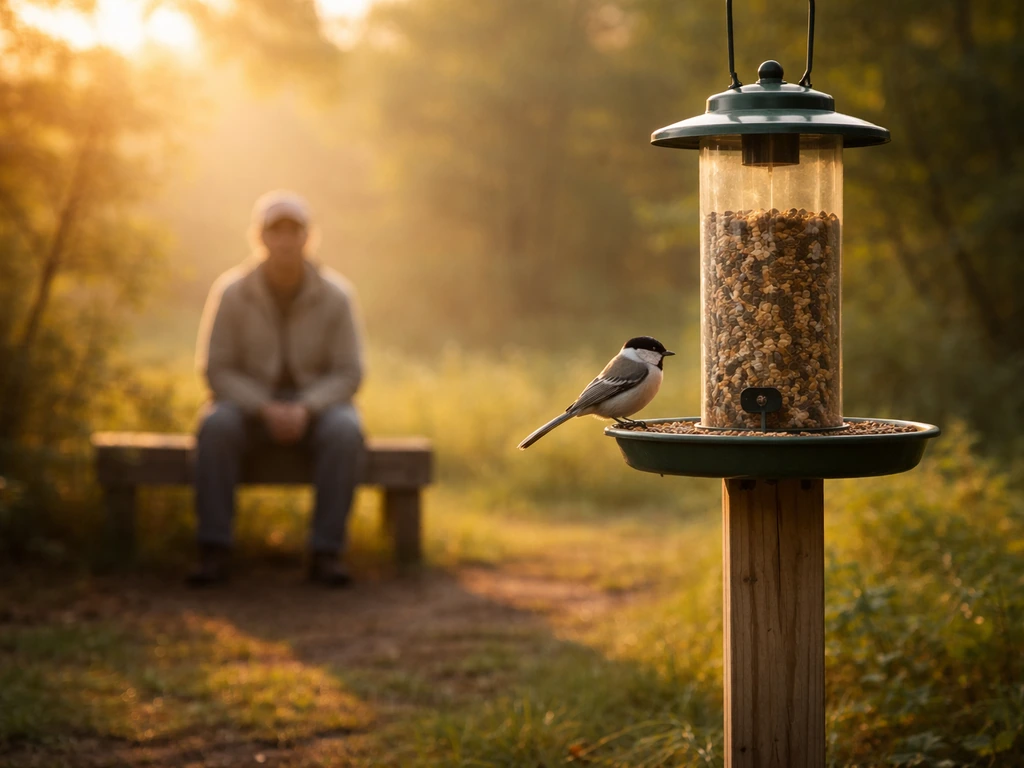
Consistency is everything. Wild birds are creatures of habit. If you show up at the same time each day, sit in the same spot, and move slowly and quietly, the bird begins to associate your presence with safety rather than danger. Erratic schedules, loud voices, or sudden movements reset the clock every time.
Here is a practical day-by-day framework for the first few weeks. The exact timeline varies by species and individual bird, but this gives you a realistic structure.
- Days 1 to 3: Set up your feeding station and water dish. Do not sit outside yet. Let the bird discover the space without any human presence. Check from a window to see if it is visiting.
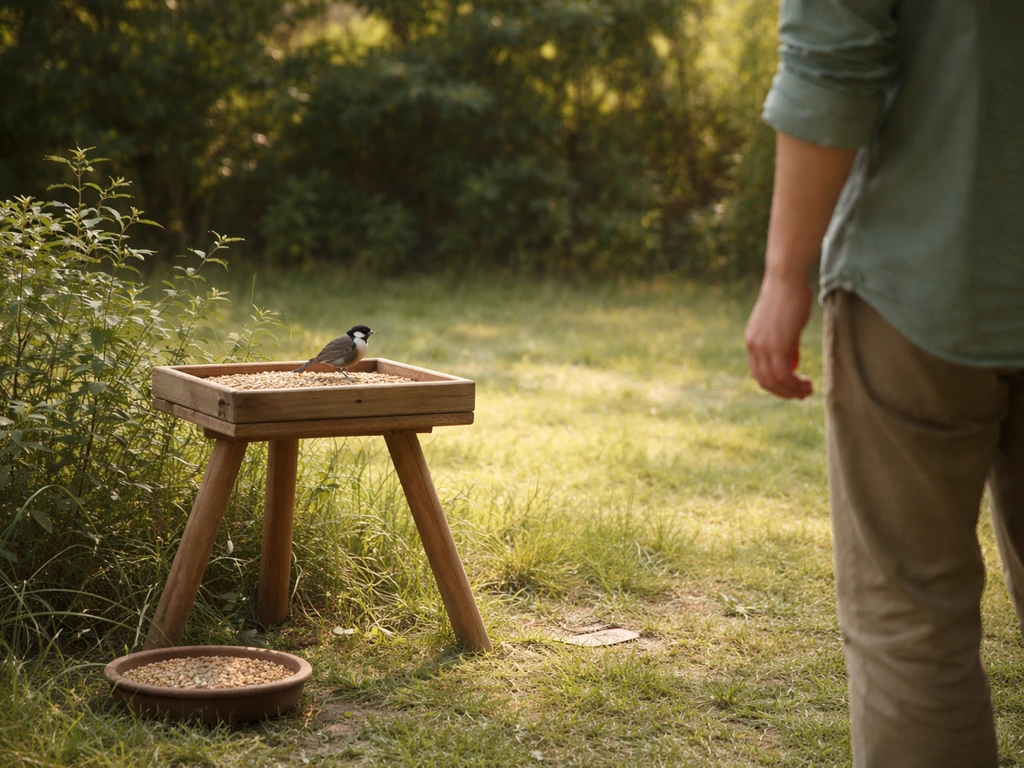
- Days 4 to 7: Begin sitting outside at a consistent time (morning is best, when birds are most active). Position yourself at least 15 to 20 feet from the feeder. Sit still, read a book, drink coffee. Do not make eye contact with the bird or face it directly.
- Days 8 to 14: If the bird is visiting while you are present, move your chair 2 to 3 feet closer every two to three days. Stop if the bird flushes (flies away). Back up and try again the next day.
- Weeks 3 to 4: You may be within 6 to 10 feet of the feeder by now. At this point, try placing a small handful of food on the ground or a low surface between you and the feeder. Sit still and wait.
- Weeks 5 and beyond: Some birds (especially jays, crows, and chickadees) may take food from your open palm at this stage. Hold your hand flat, perfectly still, and let the bird decide. Do not lift or close your hand.
Realistic timelines vary quite a bit. Chickadees and tufted titmice are among the fastest to habituate, sometimes taking food from a hand within two to four weeks of consistent effort. Cardinals and mourning doves take longer, often six to eight weeks or more. Robins and mockingbirds rarely take food directly from people but may tolerate close presence in four to six weeks. Do not rush the process. A bird that flushes every session is a bird you have pushed too fast.
Approach, perching, and the question of step-up training
Your body language during every session matters more than you might expect. Avoid direct eye contact, which many birds interpret as a predatory stare. Instead, look slightly to the side or down. Move only in slow, smooth arcs. Crouch or sit rather than standing tall, which reduces your silhouette. Speak quietly and at a low pitch if you speak at all. Some birds do seem to habituate to a calm, repeated voice over time.
If the bird is visiting a feeder or perch consistently and you are within a few feet, you can try offering a perch extension closer to you: a natural branch, a thick dowel, or even your forearm if you are at the hand-feeding stage with a very bold bird. Position your arm horizontally and keep it completely still. Do not attempt to guide or press the bird onto your arm. If it wants to perch, it will.
The 'step-up' cue familiar from pet bird training (pressing gently against the bird's chest to prompt it to step onto your finger) is appropriate for captive birds with human socialization. If you are curious how that process works for a domestic species, check out how to tame a dove bird, since doves are one of the gentler species where patient step-up work can succeed even in semi-wild individuals. For fully wild birds, skip the step-up entirely unless the bird is already perching on you of its own accord. Forced physical contact destroys trust and can injure the bird.
If you are housing a temporarily grounded bird (a fledgling, a window-strike casualty that has not recovered in 30 minutes, or a bird kept briefly while arranging transport to a rehabilitator), keep it in a cardboard box with air holes in a warm, dark, quiet space. Do not offer food or water until a professional advises you to. A dark environment reduces panic and metabolic stress. Do not handle it more than necessary.
When things go wrong: troubleshooting common problems
The bird won't come close
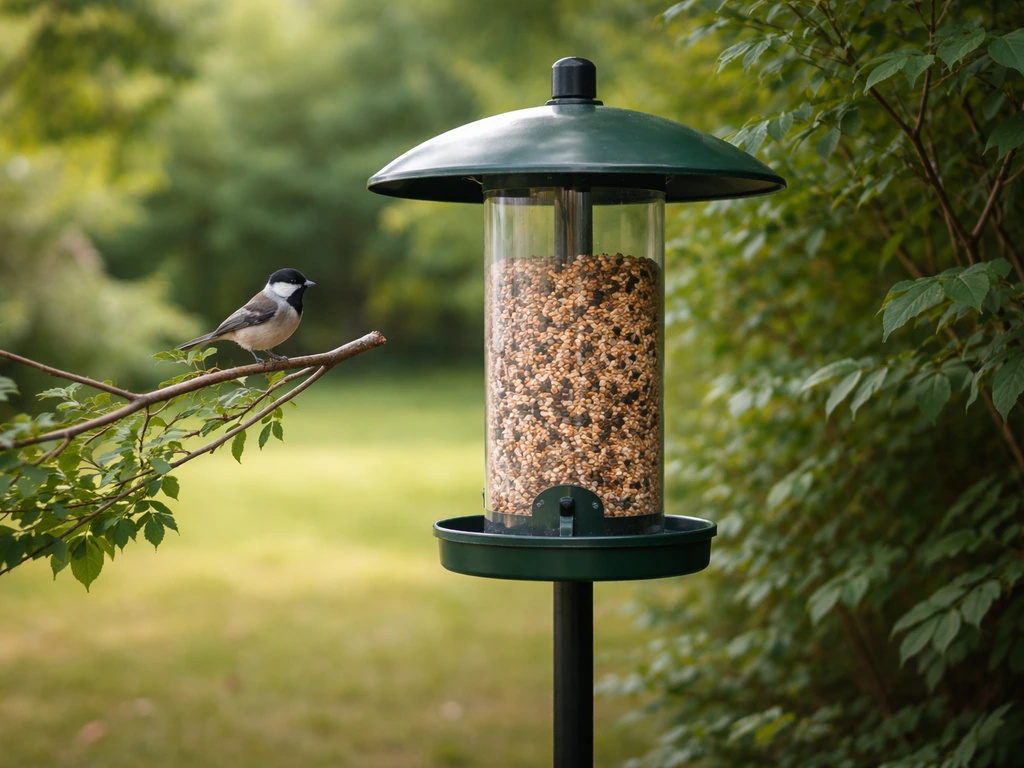
If the bird visits the feeder when you are not there but flees the moment you step outside, you are moving too fast. Go back to the beginning: sit at maximum distance (20 feet or more) and stay there for a full week before inching closer again. Also check for predator pressure. A neighborhood cat, a hawk territory, or even a reflective surface near the feeder can cause persistent avoidance that has nothing to do with you.
The bird won't eat
First, confirm you are offering the right food for the species. Then check feeder placement: feeders that are too exposed (no nearby shrubs or trees for a quick escape perch) make birds nervous about committing to a landing. Adding a brush pile or planting native shrubs within 6 to 10 feet of the feeder gives birds a staging area and dramatically increases visits. Also check feeder hygiene. Stale, wet, or moldy seed is refused immediately and can signal danger to other birds in the area.
The bird panics every time
Persistent panic (flushing, alarm calls, puffed feathers, or windows striking in an attempt to escape if temporarily housed) is a sign to back way off. You may be dealing with a species that simply does not habituate well to close human presence, or an individual bird that has had a bad prior experience. Some birds are just not good candidates for trust-building at close range, and that is fine. Enjoying them from 15 feet away is still a genuine connection.
The bird seems aggressive
If a bird is dive-bombing you, vocalizing loudly, or striking at you, there is almost certainly a nest nearby. Back off entirely and give the area wide clearance until nesting season ends, usually four to eight weeks. Do not attempt trust-building with a nesting bird. You will not win that one.
Signs you should stop completely
- The bird is showing signs of injury or illness (see the distress signs listed earlier) and needs a rehabilitator, not a trust-building exercise
- Your attempts are causing the bird to refuse food, abandon its territory, or lose significant body condition
- The bird has become so accustomed to human food that it is ignoring natural foraging, which creates dependency
- You are spending more than a few minutes actively pursuing the bird rather than letting it come to you
- The species you are working with is a raptor, owl, or other protected species that should only be handled by licensed professionals
The legal and ethical side of taming wild birds
This is the part most online guides skip, and it is important. In the United States, virtually all native wild bird species are protected under the Migratory Bird Treaty Act. This means that capturing, holding, transporting, or possessing a wild bird without the appropriate federal and state permits is illegal, regardless of your intentions. This applies even if the bird is injured. You can provide temporary shelter while arranging transport to a licensed rehabilitator, but you cannot keep the bird, attempt to train it, or treat it yourself unless you hold the proper licenses.
The ethical side goes beyond legality. Wild birds that become heavily dependent on human feeding or handling lose behavioral skills they need to survive: foraging ability, predator avoidance, and flock communication. A bird you have 'tamed' to the point of full dependence is a bird that may not survive if you move, travel, or stop feeding. The goal of any interaction with wild birds should be to enrich their life without making them dependent on yours. People often wonder can you tame a wild bird in the full sense, and the honest answer is: you can build trust, but you should not want full tameness from a wild animal.
If you are drawn to working closely with birds on a daily basis, domesticated or captive-bred species are a much better fit. A lovebird, for example, offers a rich, hands-on relationship without any of the legal or ethical complications of wild bird handling. Learning how to love and care for a lovebird properly is a genuinely rewarding path if close daily contact is what you are after. Wild birds in your yard can be a complement to that, not a replacement.
When to call a wildlife rehabilitator
Contact a licensed wildlife rehabilitator any time a wild bird is injured, has been in the same spot on the ground for more than 30 minutes without recovering, is a baby that has fallen from an inaccessible nest, or has been caught by a cat (even without visible wounds, cat bacteria are deadly to birds). In the U.S., you can find local rehabilitators through the National Wildlife Rehabilitators Association directory or your state's fish and wildlife agency. Do not attempt to feed, medicate, or train any bird while you are waiting for rehabilitator guidance.
What to do starting today
If you have a specific pet bird in mind rather than a backyard visitor, the process is quite different depending on the species. Someone curious about how to tame a lovebird, for instance, will find that the approach centers on daily handling sessions and positive reinforcement with treats rather than patient distance observation. Wild birds and pet birds really do require completely separate playbooks.
For your wild backyard bird, here is a practical checklist to act on right now:
- Observe the bird from a window for 10 minutes. Note its size, beak shape, and behavior. Use a basic field guide or app (Merlin by Cornell Lab is free and excellent) to get a rough ID.
- Set up a shallow water dish and species-appropriate food at least 15 feet from your usual outdoor seating area. Do not go outside yet.
- Remove or confine cats from the yard for the next several weeks.
- Choose a consistent time (early morning works best) to sit outside quietly at maximum distance. Bring something to do so you are not staring at the bird.
- Clean your feeder now if you have one, and set a two-week cleaning reminder.
- If the bird looks injured, make that call to a rehabilitator today rather than waiting to see if it improves.
- Stop: chasing the bird, offering food from your hand before it is within comfortable perching distance, or trying to touch it.
The birds that visit your yard and gradually decide you are safe are genuinely rewarding to watch. The process takes patience, and the outcome is never guaranteed, but it is one of the more honest and mutually respectful things you can build with a wild animal. Give it time, keep your expectations realistic, and let the bird make the decisions.
FAQ
How close should I let a wild bird get to me while I’m building trust?
Aim for a “comfortable distance” rather than touch. If the bird consistently stays nearby while you sit still, you are on track. If it repeatedly flees the moment you stand up, move your head, or reach toward it, reduce distance and increase quiet time (do fewer, calmer sessions rather than longer ones).
What should I do if I accidentally scare the bird during a trust session?
Stop moving immediately, stay in place for a few minutes, and avoid sudden returns. If it resumes feeding or perching nearby, continue at the same calm routine. If it vanishes and does not come back within the usual timeframe, restart from a farther spot (for example, about 20 feet) for at least a week before trying closer proximity again.
Is it okay to leave food out overnight to encourage visits?
It can backfire because stale or wet food attracts unwanted pests and increases spoilage. Use fresh food in the morning, refresh as needed, and remove leftovers or switch to feeders you can clean reliably. For hygiene, stale seed is a common reason birds stop returning even if your behavior is perfect.
How do I know if the bird is actually healthy and not just acting calm?
Healthy habituation should look like normal movement and alert posture. Concerning clues include prolonged ground sitting without movement, visible wing droop, abnormal breathing (beak open at rest), or eyes closed or partially closed in daylight. If you notice these, pause trust-building and switch to welfare assessment and, if needed, contact a rehabilitator.
Can I use whistles or bird calls to speed up taming?
Avoid calling the bird directly at first. Novel sounds can reset fear responses, especially if they associate your presence with attention or chasing. If the bird seems calm around incidental background noise, keep any sound quiet and consistent, and prioritize still body language over vocal signals.
What if the bird keeps coming, but won’t perch within a few feet of me?
That often means you are still too visually prominent or the setup lacks safe escape options. Try adding nearby cover within roughly 6 to 10 feet of the feeder, use slower posture changes (sit lower), and avoid direct staring. Also check the feeder placement for exposure, since birds may land only when they can retreat quickly.
Should I try offering my hand or putting my fingers near the bird?
For fully wild birds, skip hand-feeding attempts unless the bird is already perching on you by its own choice. Even “gentle” approaches can be interpreted as a predatory grab and can permanently reduce trust. A safer next step is a stationary perch extension closer to you, while your body stays still and unobtrusive.
How long should I wait before concluding a bird is not a good candidate for close trust-building?
If you see clear progress, continue consistently for the species-specific range (some habituate in weeks, others take longer). If the bird remains persistently panicked across multiple calm weeks, it may simply not habituate well to close human presence. In that case, stop pushing for proximity and enjoy observation from a farther distance.
Does it matter if other birds are eating at the same feeder while I’m there?
Often it helps, but watch for crowding. If multiple birds show normal feeding behavior, your presence may be less threatening to the newcomer. If aggressive interactions increase (chasing, cornering, loud alarm behavior), reduce feeder competition by adjusting spacing or using separate stations so one bird is not stressed into avoiding you.
Can I relocate the feeder if the bird keeps avoiding the area?
Yes, but relocate gently. Sudden changes can reset routines, so move only a short distance and keep the same general timing and behavior. If avoidance seems tied to exposure, move the feeder closer to cover or add a staging area, then give it several days to stabilize.
What should I do if a cat or other predator is around even after I start building trust?
Stop and treat predator pressure as the primary barrier. Keep cats indoors or block access to the yard, remove perches that give hunters an advantage, and consider temporary physical barriers or a cat-safe bird zone. Trust work is unlikely to progress if the bird believes attacks are imminent.
What’s the safest way to respond if the bird is dive-bombing or striking me?
Back off immediately and give the area wide clearance. Dive-bombing usually signals nesting defense, not teachable fear. Do not try to “wait it out” by approaching closer, nesting defense typically lasts through the nesting period (often several weeks).
If I find a baby bird, can I raise it myself if I cannot reach a rehabilitator right away?
In most cases, no. While you are waiting for a rehabilitator, keep it in a quiet, stable environment and avoid feeding or medicating unless a professional instructs you. Improper feeding and handling are common reasons birds die even when the rescuer meant well.
Why do birds sometimes stop coming after they were visiting regularly?
Common causes include feeder hygiene issues (wet, moldy, or stale seed), changes to the routine (different times, louder noise, sudden movements), or environmental changes (reflective surfaces, new predators, or reduced escape cover). Re-check food accuracy for the species and restore the earlier calm routine before making major changes again.
Next Article
How to Tame a Bird: Humane Steps for Pet Birds and Wild Birds
Humane, step-by-step trust building to tame pet parrots, cockatiels, budgies, and finches, plus safe wild-bird guidance.