Yes, you can build a meaningful level of trust with a wild bird, but "taming" one the way you would a pet parrot or budgie is a different thing entirely. The honest answer is that most wild birds will never become fully handleable, and in many cases pursuing that goal is actually harmful and illegal. What you can achieve, though, is genuinely impressive: a wild bird that eats from your hand, tolerates your presence at close range, and behaves calmly around you. That takes patience, consistency, and a clear understanding of what you are really working toward.
Can You Tame a Wild Bird? Humane Trust Building Steps
Clara Hayes
15 Apr 2026
Reality check: what "taming" a wild bird really means
When most people ask "can you tame a wild bird," they are picturing one of two things: either a bird that sits on their hand like a pet, or a bird they found injured that they want to nurse back to health. Those two situations call for completely different responses, and it helps to be clear on which one you are dealing with.
True domestication, the kind that produces a bird comfortable with routine handling, grooming, and close human contact, requires generations of selective breeding. Cockatiels, budgies, lovebirds, and domestic doves are domesticated species with thousands of years of human contact in their genetics. A wild house sparrow or a wild crow does not have that background, and no amount of patient handling will rewrite its instincts completely. That does not mean wild birds cannot learn to tolerate humans or even seek out interaction, but there is a ceiling on how far that trust goes, and it looks nothing like a hand-tamed pet bird.
What you can realistically build with a wild bird is a conditioned comfort zone: the bird learns that you specifically are not a threat, that approaching you reliably produces something good (food, water, safety), and that its stress response quiets down when you are nearby. Some species push that ceiling impressively high. Hand-feeding chickadees, crows that bring gifts, or a pigeon that lands on your shoulder are all real outcomes people achieve. But these are trust relationships, not ownership, and the bird remains wild and free.
Species and circumstances that determine outcomes
Not every wild bird is an equally good candidate for building close trust. The species, the individual bird's age, and whether it was raised around humans from a young age are the three biggest factors that determine how far things can go.
Corvids (crows, ravens, jays) are exceptionally intelligent and can form genuine individual bonds with specific humans. Chickadees and titmice are bold, curious, and well-known for learning to hand-feed. Mourning doves, sparrows, and finches can become comfortable feeding close to you but rarely progress to contact. Raptors, waterfowl, and most shorebirds are far more skittish and should generally be left to their own routines without pushing for interaction. For how to tame a wild bird based on species, knowing this spectrum before you start saves you weeks of frustration.
Age matters enormously. A fledgling or juvenile bird that has had significant human contact during its critical developmental window is far more likely to accept humans than an adult wild bird that has spent years avoiding them. An adult bird can still warm up to you, but it will take longer and will likely never reach the same level of comfort as a bird raised around people.
It is also worth noting what is different about pet species. If you have a lovebird or a dove at home and want to understand the contrast, the process of how to tame a lovebird relies heavily on that bird's domesticated background, meaning the instincts are already partially on your side. Wild birds need a longer runway, more patience, and a lower ceiling for expectations.
Humane trust-building steps you can start today
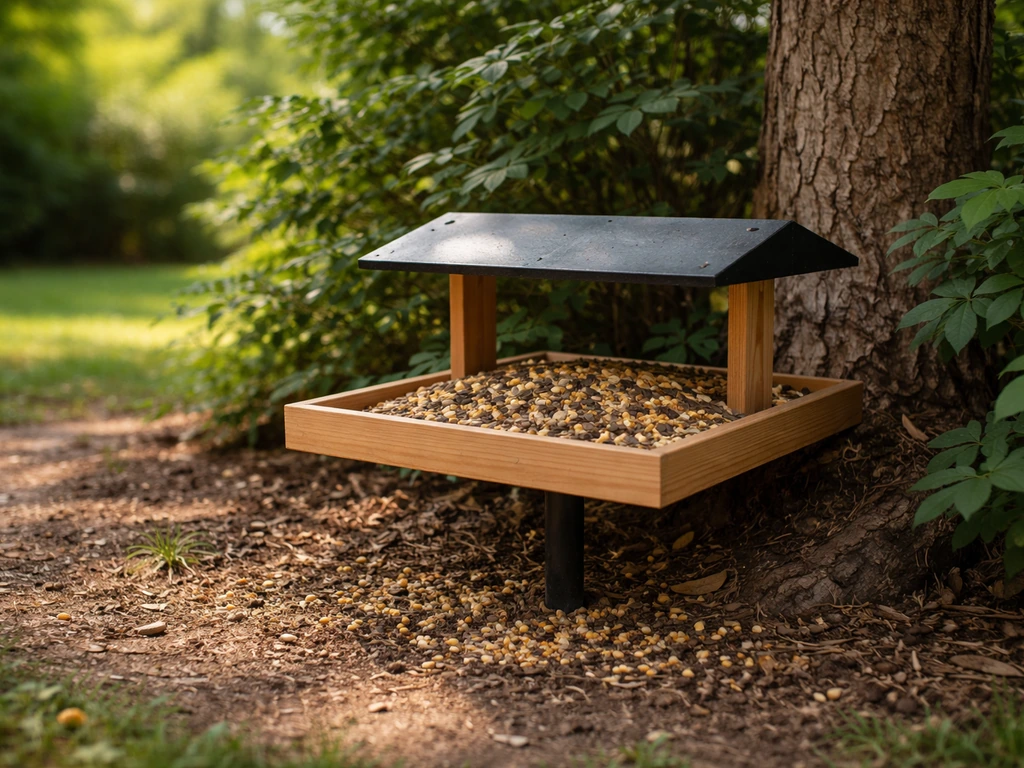
Set up a predictable feeding station
The single most effective thing you can do is make yourself a reliable, stress-free food source. Place a feeder or feeding platform in a spot where the birds already feel comfortable, with nearby cover like shrubs or trees so they have an escape route and feel safe. Species-appropriate food matters: black-oil sunflower seeds attract a wide range of songbirds, suet draws woodpeckers and chickadees, and millet is a go-to for sparrows and finches. Fresh water in a shallow dish or birdbath alongside the feeder dramatically increases traffic and trust.
Keep the feeder clean. The U.S. Fish and Wildlife Service, citing Cornell Lab guidance, recommends cleaning feeders at least once every two weeks to reduce disease risk for the birds. A dirty feeder full of moldy seed can harm the very birds you are trying to help, and sick birds will stop coming. Scrub with a dilute bleach solution (one part bleach to nine parts water), rinse thoroughly, and let it dry before refilling.
Introduce yourself gradually
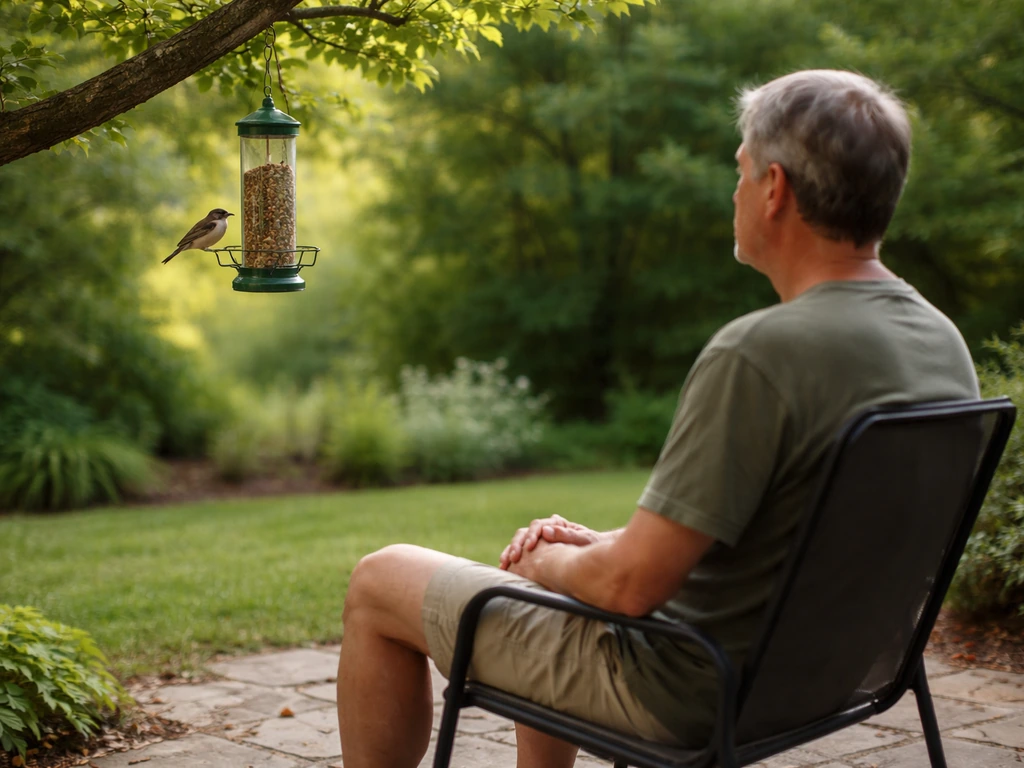
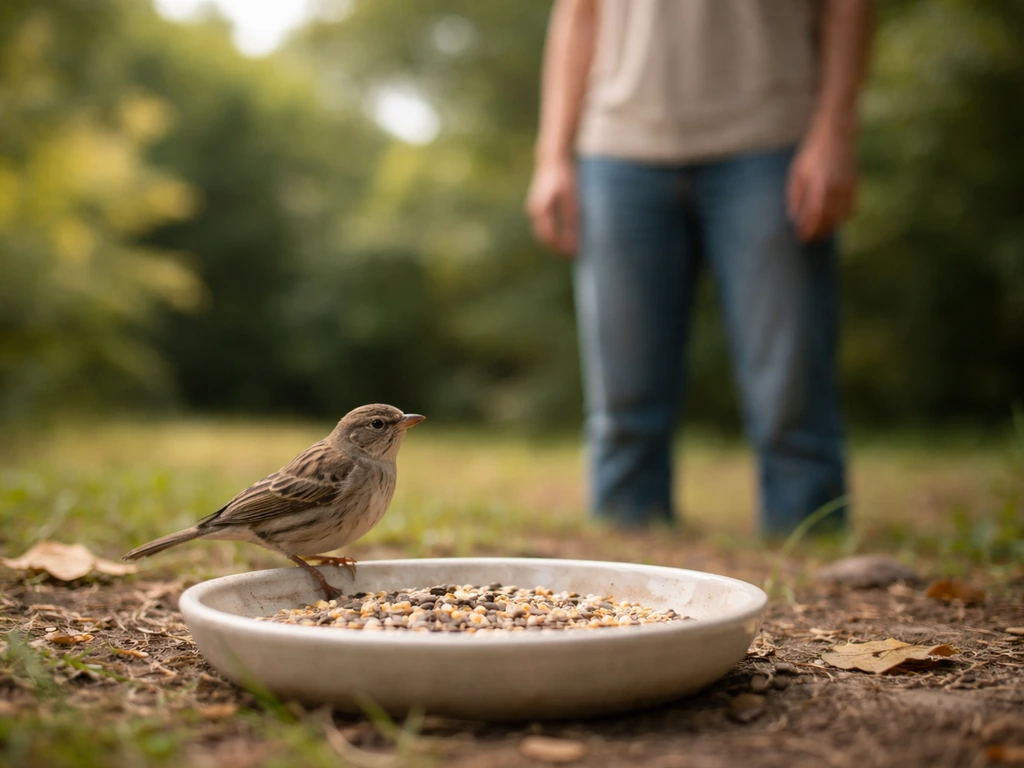
For the first one to two weeks, just be near the feeder without hovering over it. Sit in a chair about 10 to 15 feet away, move slowly, avoid direct eye contact (which many birds read as a predatory threat), and let the birds feed. Read a book, have a coffee, just exist calmly in their space. You are training them to associate your presence with the safe, good experience of eating, not with alarm.
Once birds are regularly feeding while you are seated nearby, begin moving your chair about a foot closer every few days, only when they are calm and feeding confidently. If they flush (fly away) when you move, you have moved too fast. Go back to the previous distance and hold it for another few days before trying again.
Introduce hand-feeding
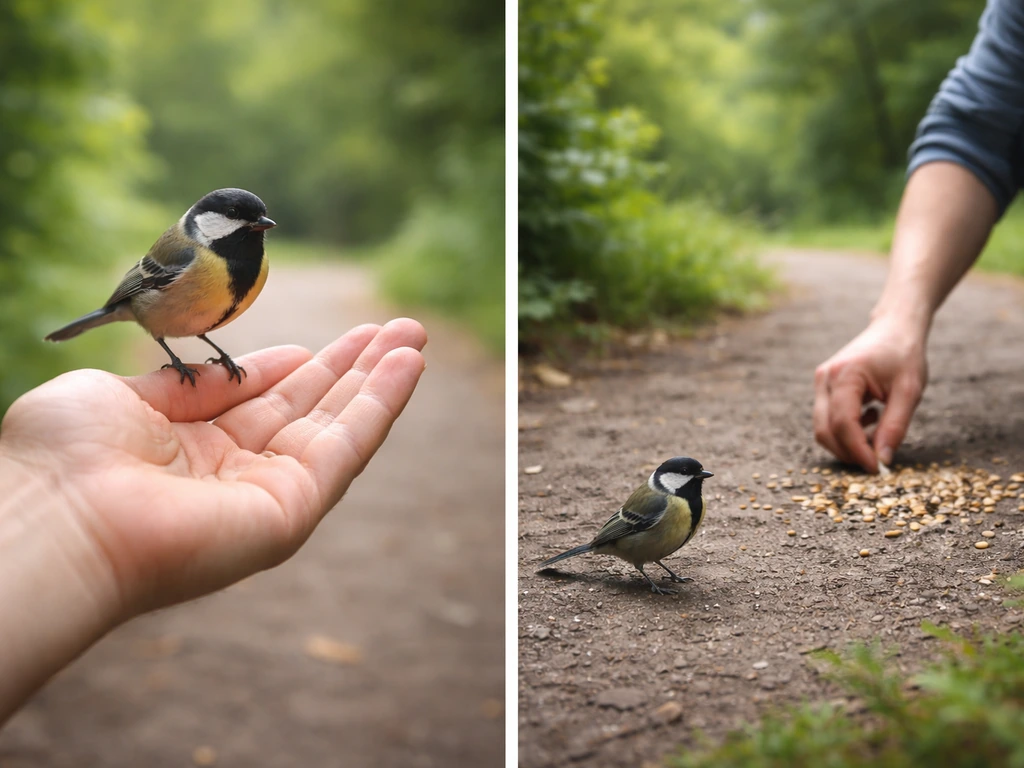
When birds are comfortable with you sitting about 3 to 4 feet from the feeder, try holding seed in your flat, open palm and resting your hand on or near the feeder edge. Keep absolutely still. Chickadees will often make the leap within a few sessions once they realize your hand is just another surface with food on it. Extend your arm slowly, palm up, fingers together and relaxed. Avoid sudden movements, avoid talking loudly, and stay patient. Some birds take days, some take weeks.
Training methods that actually work
The same principles that underpin how to tame a bird in a pet context apply here, just with lower intensity and different goals. Positive reinforcement is the core tool: the bird gets something good (food, safety) every time it does something that brings it closer to you. You are shaping behavior step by step, rewarding small increments of bravery rather than waiting for a big leap.
Desensitization is the other key technique. You expose the bird to the thing it is nervous about (you) at a level so low that it produces no fear response, and then very gradually increase that exposure over time. This is exactly the slow chair-moving process described above. Moving too fast breaks the desensitization and you have to rebuild from scratch, which is why patience pays dividends here.
Predictable cues help speed things up noticeably. If you always make the same soft sound, whistle, or quiet word when you approach the feeder or offer food, the bird learns that specific signal means "something good is coming." After a few weeks of consistency, that cue alone can make a bird fly toward you from a distance. Keep it simple and use it every single time.
Consistency in timing also matters. Birds have excellent internal clocks and will begin showing up at the same time each day if you feed reliably. Coming and going at random hours undermines the trust-building process because the bird never learns to predict you as a safe, stable presence.
When to approach and when to keep your hands to yourself
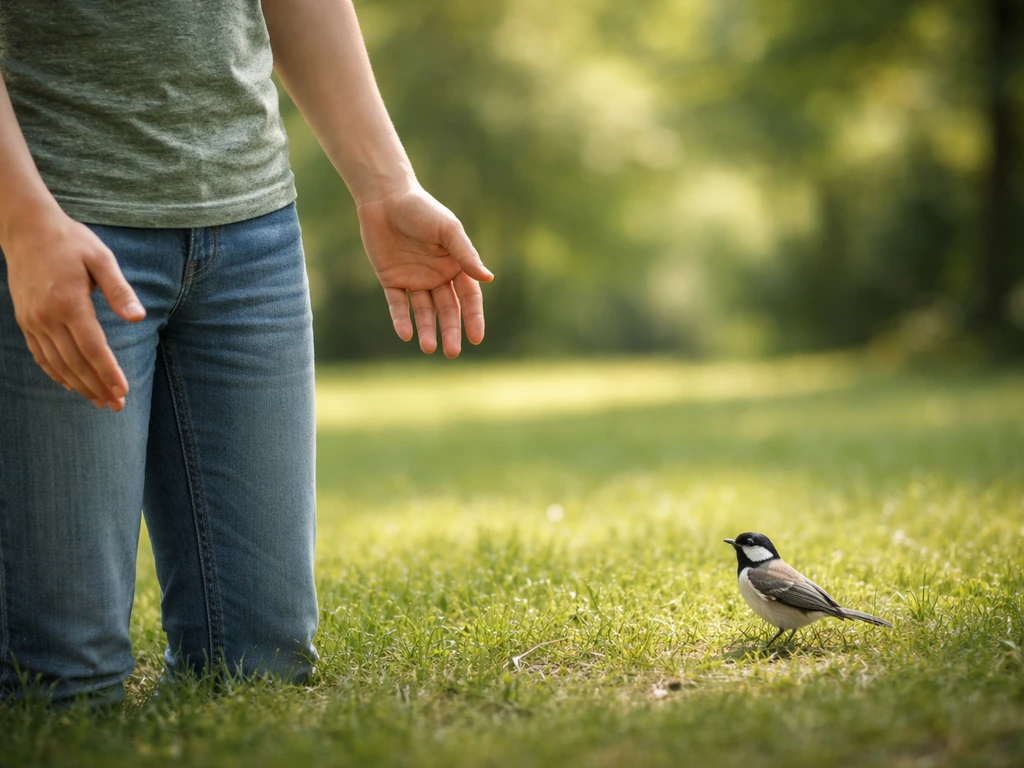
For most wild birds in a yard or park setting, the goal is trust at close range, not physical handling. A bird that is healthy, mobile, and choosing to be near you should be allowed to come and go on its own terms. Trying to catch or restrain a healthy wild bird causes acute stress, risks injury to the bird (and to you, from claws and beak), and undoes weeks of trust-building instantly.
If a bird lands on your hand voluntarily, stay still and calm. Let it leave when it wants to. That voluntary contact is the goal. Closing your hand around it, lifting it, or trying to hold it longer than it wants defeats the entire purpose and is likely to result in a bite or a scratch.
There are situations where you might need to handle a wild bird that cannot get away from you, such as one that is stunned after hitting a window, clearly injured, or trapped. In those cases, wear thin gloves if available, use a light towel to gently contain the bird, support its body without squeezing, and minimize the time it spends in your hands. Keep it in a quiet, dark, ventilated box while you arrange transfer to a rehabilitator. Do not squeeze, restrain the wings forcefully, or hold the bird on its back.
The legal and ethical side you need to know
This is not optional fine print. In the United States, [the Migratory Bird Treaty Act protects](https://www. law. cornell.
edu/uscode/text/16/chapter-7/subchapter-II) the vast majority of native wild bird species, including songbirds, raptors, shorebirds, and waterfowl. It is illegal to keep, cage, or possess these birds without a federal permit, regardless of your intentions. The CFR specifies that the scope of the regulations depends on the specific provisions, including circumstances such as lawful possession and whether a person has the required permits [posess these birds without a federal permit](https://www. law.
cornell. edu/cfr/text/50/21. 4). Even keeping a wild bird temporarily while you "nurse it back to health" can put you in legal jeopardy.
The U. S. Fish and Wildlife Service is explicit: do not keep the animal and try to nurse it yourself, because treating wild animals without proper training can be harmful to the bird and against the law.
If you find an injured or orphaned bird, the right move is to contact a licensed wildlife rehabilitator or your state wildlife agency immediately. Rehabilitators have the legal permits, proper nutrition knowledge, and release protocols to give the bird its best chance. Feeding a wild bird the wrong diet, imprinting a juvenile on humans, or preventing a bird from developing its natural fear of predators can all cause lasting harm even when the intentions are completely good.
Ethically, the goal should always be a bird that remains wild and capable of surviving without you. This is also why the approach used for a dove kept as a pet, like the process for how to tame a dove bird, does not translate directly to a wild mourning dove in your yard. The pet dove is legally yours, is not going to survive in the wild on its own, and benefits from deep habituation to humans. The wild dove does not need any of that, and providing it could actually hurt the bird's long-term survival.
Troubleshooting and realistic timelines
Progress with wild birds is rarely linear. Here is a practical breakdown of the most common problems and what to do about each one.
| Problem | Likely Cause | Fix |
|---|---|---|
| Bird won't approach the feeder at all | Location feels exposed or unsafe | Move feeder closer to cover (shrubs, fence) and reduce your proximity for another week |
| Bird flushes every time you appear | You are too close, moving too fast, or making eye contact | Increase your distance, slow down all movements, and avoid looking directly at the bird |
| Bird was coming regularly and suddenly stopped | Seasonal migration, molting stress, or a nearby predator | Wait two to three weeks; add a water source; check for cats or hawks in the area |
| Bird bites or claws when you try to get closer | You pushed into its personal space faster than it was ready for | Back off to a comfortable distance and rebuild trust over several more weeks |
| Wrong birds are using the feeder | Seed mix is too generic | Switch to species-specific food (e.g., safflower for cardinals, nyjer for finches, mealworms for bluebirds) |
| No progress after several weeks | Species may have a naturally high flight distance | Adjust expectations; some species simply will not approach humans closely regardless of effort |
For timeline expectations, here is a realistic framework. Bold, curious species like chickadees and titmice can progress from feeder visitors to hand-feeding in as little as two to four weeks with daily effort. Corvids may take a month or two to build individual recognition and comfort, but the relationship can deepen for years. Most songbirds that are not corvids will plateau at comfortable feeder visits within 3 to 8 weeks and are unlikely to progress to contact regardless of how long you try. Raptors and waterfowl may never show measurable progress toward human comfort, and you should not try to force it.
If you are also working with pet birds at home, you will notice that the timeline is much faster with domesticated species because of their breeding history. A pet budgie or finch can go from fearful to handleable in a fraction of the time it takes to earn the same trust from a wild bird. Understanding how to bond with a lovebird at home gives you good instincts for reading body language and using calm energy, skills that do transfer to wild bird interactions even if the pace and end goal are different.
The bottom line is this: you can absolutely build a genuine, rewarding relationship with wild birds in your yard or neighborhood, and some of those relationships are genuinely remarkable. What you cannot do is replicate a pet-bird experience with a wild animal, and trying to push beyond the natural limits of trust causes stress, injury, legal trouble, and harm to the bird. Work with the bird's nature, give it time, keep the pressure off, and let the relationship develop at its own pace. That approach works. The shortcut never does.
FAQ
Can you tame a wild bird by keeping it in a cage just until it trusts you?
No. Caging most native wild birds is illegal in the U.S. without the required permits, and confinement can also cause panic, injury, and long-term behavioral problems like chronic fear or failed release. The safer path is to build trust while the bird remains free, or transfer an injured bird to a licensed rehabilitator.
If a wild bird keeps coming to my feeder, does that mean it is safe to handle?
Not automatically. Even birds that eat nearby may still bite if startled or if you try to restrain them. Treat voluntary closeness as a sign of tolerance only, and advance to hand-feeding only if the bird stays calm while you extend your open palm slowly.
What should I do if the bird stops visiting after I start sitting near the feeder?
Back off and remove pressure. Increase distance again, resume quiet presence without hovering, and keep your routine consistent. Birds often “test” whether your behavior is predictable, and a sudden change (standing up quickly, loud noise, moving too fast) can reset trust-building.
Is it okay to use birdseed from pet stores, or does the food have to be exact?
Species-appropriate matters. Mixing random seed can attract the wrong birds and lead to poor nutrition, or it can increase waste and mold. Stick to common favorites for the target birds (for example, black-oil sunflower for many seed-eaters, suet for insect-leaning insectivores and woodpeckers) and remove spoiled food promptly.
How do I know if I am moving too fast during the chair-closer step?
If the bird flushes, throws repeated alarm calls, watches you intensely with a stiff posture, or stops feeding when you move, you are likely going too quickly or too close. Pause at the last distance where feeding continued normally for several sessions, then try again more gradually.
Can I speed things up by making eye contact or talking to the bird?
Usually, no. Direct eye contact can read as a threat for many wild birds, and loud or animated interaction increases stress. Use a consistent cue sound at the same volume and keep your body language calm and still.
What if the bird is already tame, like one that approaches people in a park?
It could be habituated, but it is still wild. Avoid grabbing, carrying, or “testing” tolerance by reaching quickly. If it already accepts proximity, focus on maintaining a predictable routine from a distance (food and water in the same place) and let the bird choose any voluntary contact.
Can I hand-feed a wild bird that is not eating yet?
Hand-feeding should only come after regular, confident feeding from the feeder while you are seated nearby. If the bird is hesitant to approach the feeder, start with placement, cover, and quiet presence first, then gradually work from open palm near the edge when feeding is steady.
What should I do if I find an injured or stunned bird that seems calm?
Do not assume calm means it is safe to handle or keep. Contact a licensed wildlife rehabilitator or your state wildlife agency immediately. While waiting, you can minimize stress using a dark, ventilated box and gentle support, but avoid prolonged restraint or feeding it yourself.
Will feeding wild birds make them dependent on humans?
It can, especially if you provide food in a way that replaces natural foraging or if juveniles become imprinted on people. The best practice is to support seasonal food needs without encouraging close handling, and for birds you are trying to help long-term, follow rehabilitator guidance on release readiness.
Is it ever legal to keep a wild bird temporarily in the U.S. if I intend to release it later?
In most cases, temporary possession still conflicts with protections under the Migratory Bird Treaty Act unless you have appropriate permits. Even “nursing it back to health” can be illegal and harmful if diet and procedures are wrong, so call a rehabilitator first.
How often should I clean the feeder, and what if I don’t have bleach?
Aim for at least every two weeks for typical yard feeders, and clean sooner if you see wet, moldy seed or heavy droppings. A dilute bleach solution is one common method, but if you do not have bleach, use an alternative cleaner that is specifically safe for bird-feeders and rinse thoroughly, then let the feeder fully dry before refilling.
What body language indicates stress or aggression, so I should stop trying to get closer?
Watch for signs like repeated alarm calls, rapid head bobbing that escalates, crouching or puffing with a tight posture, sudden darting movements, growling sounds (in some species), and any attempt to flee the moment you move. When you see those, stop advancing, return to the prior comfortable distance, and focus on quiet presence.
What is a realistic timeline, and when should I give up on hand contact?
Many non-corvid songbirds will plateau at close feeder comfort in about 3 to 8 weeks, and pushing beyond that can increase stress without changing outcomes. For chickadees, titmice, and some corvids, progress can continue longer, but if you never see calmer feeding while you are near the feeder, assume the ceiling may be limited for that individual.