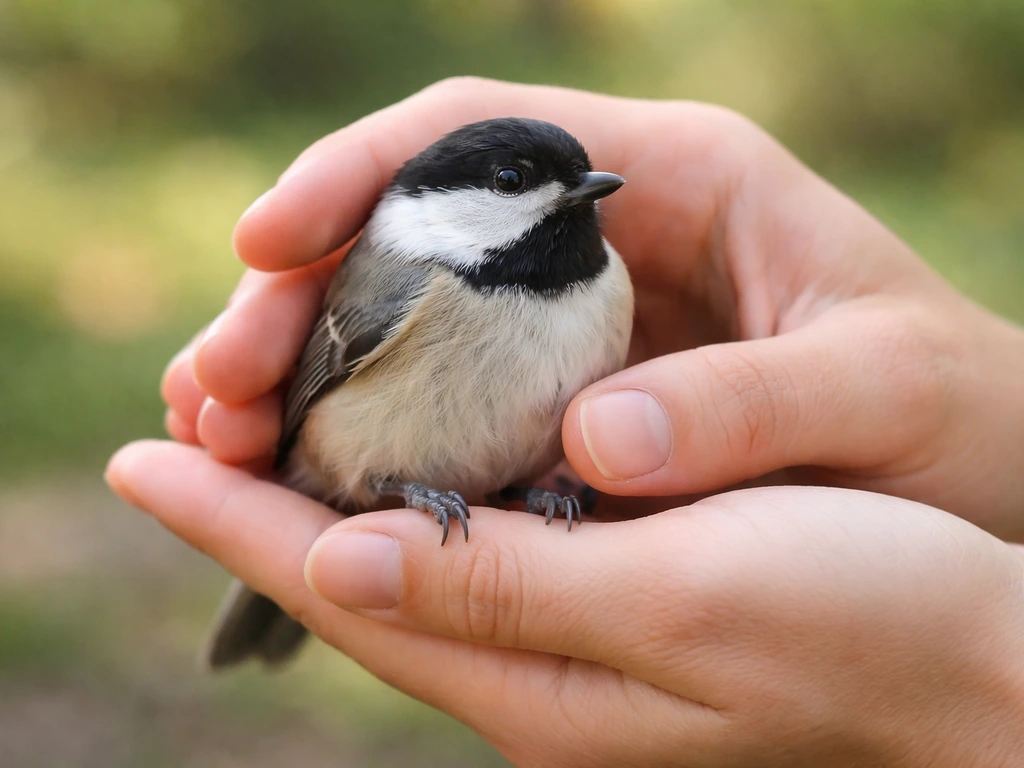
The most important thing to know before you touch a wild bird: in most cases, you shouldn't. That's not me being unhelpful. That's the honest, safety-first answer backed by wildlife agencies across the U.S. But sometimes a bird genuinely needs a human hand, and when that moment comes, knowing what to do in the next five minutes matters a lot. This guide walks you through exactly what to check first, how to avoid holding at all when possible, and how to handle a wild bird safely and legally if you truly have no other option.
How to Hold a Wild Bird Safely and Humanely Today
Clara Hayes
8 Apr 2026
Is it safe and legal for you to handle this bird?
Before you reach down, stop for thirty seconds and think about the legal side. The U.S. Migratory Bird Treaty Act (MBTA) makes it a federal offense to take, possess, or transport migratory birds without a valid permit. That covers almost every songbird, shorebird, and bird of prey you're likely to see in your yard. Pigeons, European starlings, and house sparrows are among the few common birds not protected under the MBTA, but they are the exception, not the rule. State law often adds another layer: in Florida, Washington, Massachusetts, Arizona, and most other states, you need a federal Migratory Bird Rehabilitation permit (and usually a matching state permit) to do anything beyond immediate emergency transport. What that means practically: a quick, gentle containment to move an obviously injured bird to a licensed rehabilitator is generally tolerated. Setting up a home rehab operation is not.
For your own safety, keep in mind that wild birds carry bacteria (Salmonella is common), and larger birds like hawks, owls, and herons can cause serious wounds with talons and beaks. Protective gear is not optional when you're dealing with a bird of any size. If you're unsure whether touching the bird is justified, call a wildlife rehabilitator or your state's fish and wildlife agency before you do anything else. That phone call costs nothing and could save you a legal headache.
Is the bird actually in trouble? What to check before you touch it
This is the most common mistake people make: seeing a bird on the ground and assuming something is wrong. Most of the time, the bird is fine. Here's how to read the situation quickly.
Fledgling vs. nestling vs. injured adult
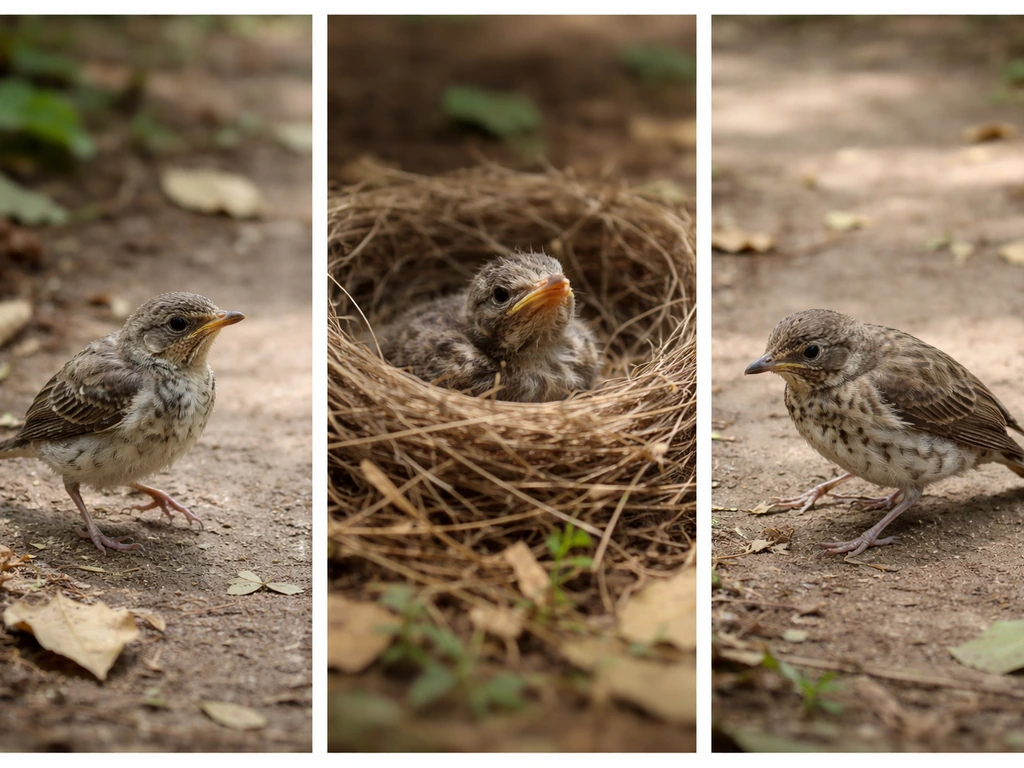
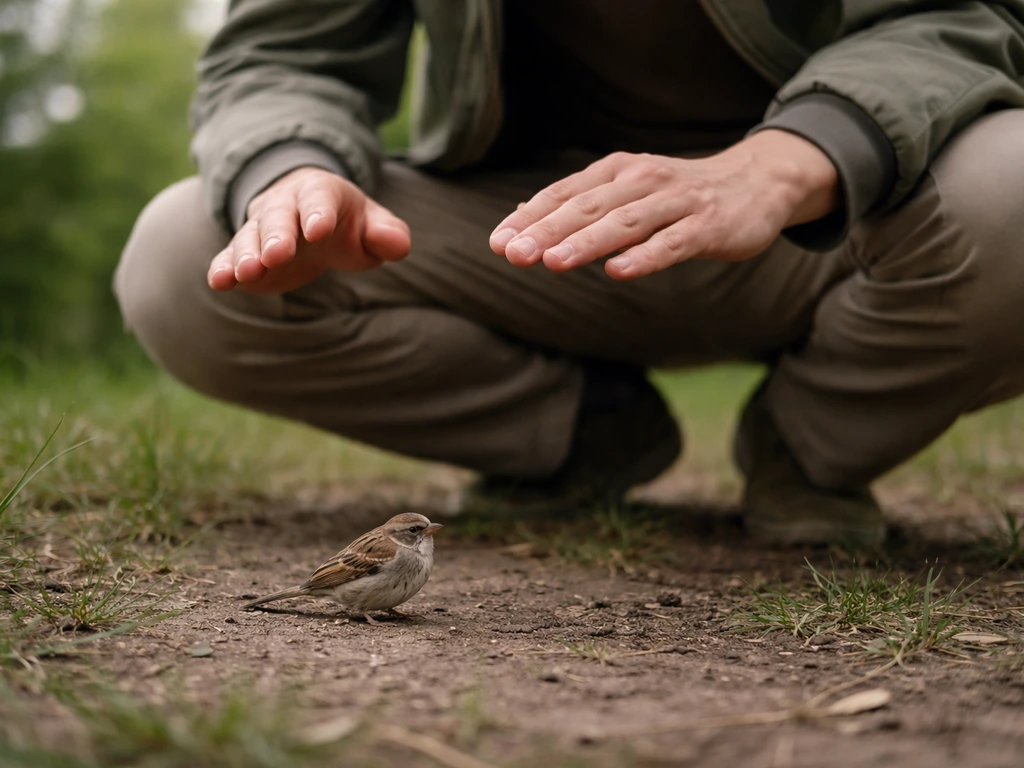
A fledgling (a young bird with most of its feathers, hopping around on the ground) has almost certainly left the nest on purpose. This is a totally normal life stage. The parents are almost always nearby, still feeding the bird and watching over it. Wildlife agencies including WDFW and Mass.gov are explicit: leave the fledgling alone unless it's injured or in immediate physical danger. Picking it up and bringing it inside is one of the most common ways well-meaning people accidentally orphan a healthy bird. If you're not sure whether you're looking at a fledgling or something younger and more vulnerable, look for feathers. A mostly-naked nestling that has clearly fallen from a nest is a different situation: you can gently place it back in the nest (the "touching a baby bird means the parents will reject it" myth is not true), or set it in a small container near the nest site so the parents can find it.
An injured bird, on the other hand, will usually show clear signs: it's unable to stand, one wing is drooping at an odd angle, it has visible blood or a wound, it's been caught by a cat (even with no obvious wound, cat bites cause serious internal infection), or it's lying on its side. A bird that hit a window and is sitting quietly but upright may just be stunned, not injured. Give it 15 to 30 minutes in a quiet, undisturbed spot before assuming it needs intervention. USFWS guidance for window-collision birds specifically recommends checking every 15 minutes to see if the bird can fly away on its own.
| Situation | What you're seeing | What to do |
|---|---|---|
| Fledgling on ground | Fully feathered, hopping, alert | Leave it alone; watch from a distance |
| Fallen nestling | Mostly naked or pin-feathered, helpless | Return to nest if reachable; call rehab if not |
| Window-stunned bird | Upright but dazed, no visible injury | Give 15-30 min in a quiet spot to recover |
| Clearly injured bird | Drooping wing, blood, can't stand, cat attack | Contain gently and call a wildlife rehabilitator |
| Dead parent nearby | Young bird with a dead adult | Contact a licensed rehabilitator immediately |
Try not to hold it at all: humane alternatives first
The least stressful outcome for any wild bird is one where a human hand never touches it. Before you pick the bird up, run through these options.
- Keep your distance and watch: If the bird is alert and moving, give it 20 to 30 minutes undisturbed. Keep pets and children away. In many cases, the bird will sort itself out.
- Shade and quiet: If the bird is stunned from a window strike, place a cardboard box over it (not sealed) to darken the area and reduce stress. This alone often speeds recovery.
- Guided containment without grabbing: For a bird trapped in a garage or shed, open one large exit, close all others, turn off lights so the open exit is the brightest point, and step back. Most birds will find their way out within minutes.
- Luring out of danger: If a bird is in a dangerous spot but not injured, you can sometimes use a long, soft object (like a broom held low, not waved) to gently guide it toward an exit or safer area without touching it.
- Box containment without handling: For an injured bird that is sitting still, you can often place a ventilated cardboard box over the bird and slide a piece of cardboard underneath to scoop it up, then flip the box upright. This skips direct handling entirely and is far less stressful for the bird.
This box-scoop method is honestly the first thing I reach for. It's quick, it keeps the bird in the dark (which calms it), and it gets you to the next step (calling a rehabilitator) without anyone getting bitten or scratched. The technique is also useful context if you've read about how to carry a bird safely, since the principle is the same: minimize movement, minimize exposure, minimize stress.
Step-by-step: how to safely hold a wild bird when you have no other option
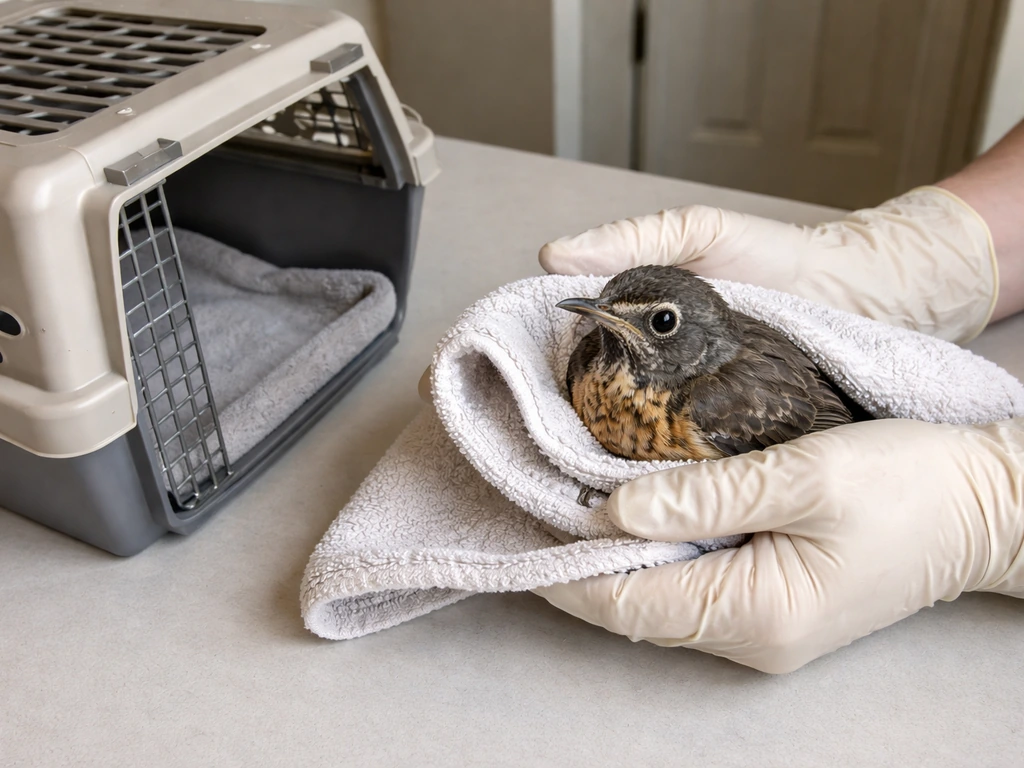
If you've ruled out the alternatives above and you genuinely need to pick the bird up (to move it out of immediate danger, or to place it in a transport container), here's how to do it with the least possible stress and risk to both of you. If you end up needing to pick up the bird, use the techniques from how to hold a bird without scaring it as a related approach to minimize stress and panicked thrashing.
- Gear up first. For any bird larger than a robin, put on thick gloves before you touch it. For raptors (hawks, owls, falcons), heavy leather gloves are non-negotiable. Welding gloves work well. For small songbirds, thin cotton or nitrile gloves offer some protection while keeping your touch light.
- Have your container ready. A ventilated cardboard box lined with a folded paper towel or thin cloth works for almost any bird. Have the lid open and within reach before you approach.
- Approach slowly and low. Crouch down to the bird's level. Move in a slow, calm arc rather than a straight rush. Rapid, upright approaches trigger a panic response.
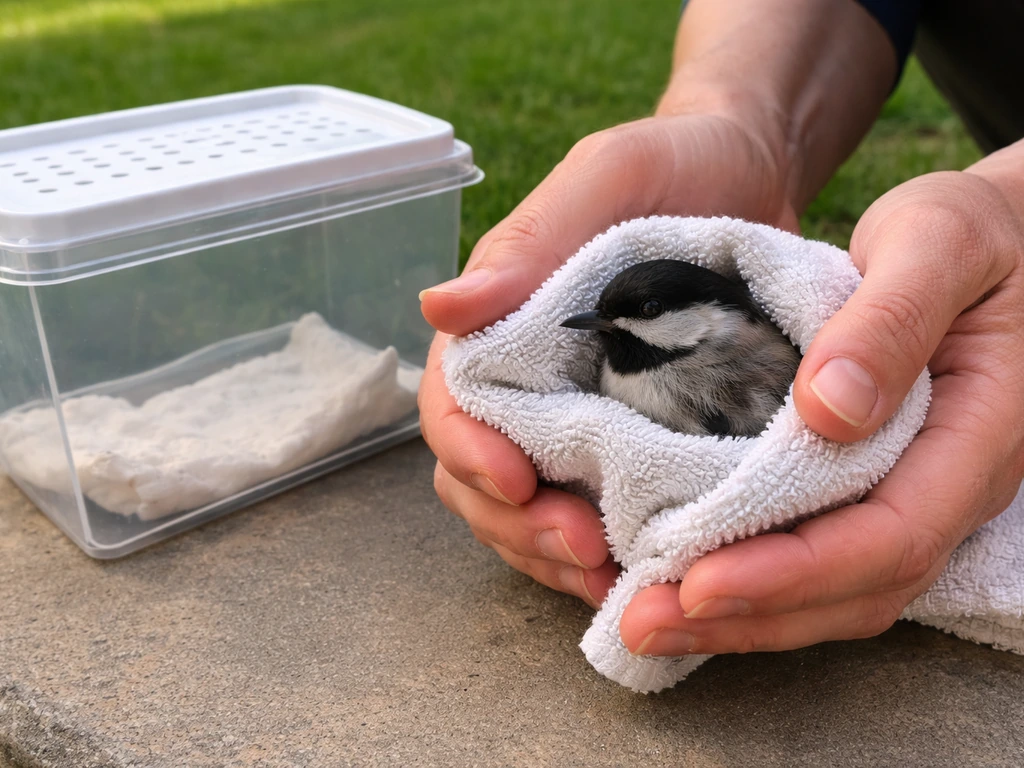
- Use a towel for the approach. Drape a light towel or cloth over the bird before you grab it. Covering the eyes and body dramatically reduces struggling. For raptors, this step is especially important: Alabama Wildlife Center specifically recommends covering a raptor's eyes with a towel or blanket to reduce stress during handling.
- Wrap and scoop with both hands. Once the towel is over the bird, place both hands firmly but gently over the body from above, wings tucked against the sides. You're not squeezing; you're creating a secure, calm enclosure with your palms. Lift in one smooth motion.
- Position the bird body-first into the container. Lower the bird into the box and let go of the towel inside with it. The towel gives the bird something to grip and keeps it calm. Close the lid immediately.
- Move to a quiet, dark, warm place and call for help. Set the box somewhere away from noise, pets, and children while you contact a wildlife rehabilitator.
Worth noting: the grip and body-wrapping technique here is related to, but different from, how you'd handle a tame pet bird. If you want a broader reference point, the general mechanics are similar to what's described in guides on how to hold a bird safely, though wild birds require much faster execution and far less tolerance for hesitation.
Avoiding injuries and stress during handling
The biggest risks during wild bird handling are injuries to the bird from struggling, injuries to you from talons and beaks, and stress-induced shock (which can be fatal for small birds). Here's what to watch for and avoid.
The parts you really can't afford to get wrong
- Wings: Never grab or pull on a wing. Wings are fragile. Keep them folded against the body at all times. If a wing is already injured, don't try to straighten it.
- Tail feathers: Don't grab a bird by the tail. Tail feathers are easily pulled out, and in some species they don't fully regrow. Use tail feathers only as a last resort to slow a bird that's about to escape, and even then, use the gentlest possible grip at the base.
- Feet and talons: Raptors grip with tremendous force and their talons are their primary weapon. Never let a hawk's or owl's foot wrap around your unprotected hand. Use gloves, and if a talon locks onto your glove, do not yank away sharply.
- Pressure on the chest: Birds breathe by expanding their chest. If you wrap too tightly around the body, you restrict breathing. Firm but not compressing is the goal.
- Time: Keep handling time as short as possible. Every second in a human hand is a stress event for the bird. Get it into the dark, quiet box as fast as you safely can.
Troubleshooting when things go sideways
If the bird is fighting hard, thrashing, or biting: don't let go in a panic. A sudden release often means the bird will crash into something and get hurt. Maintain your secure two-handed wrap and get it into the box. If you're bitten by a small songbird, it's going to sting but rarely breaks skin. Raptors and herons are a different story: a heron can strike at your eyes, and a red-tailed hawk can puncture skin through thin gloves. Keep your face turned slightly away from the bird's head and never bring it close to your face.
If the bird escapes mid-handling: stay calm, don't chase. Slow down, use the box-scoop approach again rather than grabbing. Chasing a panicked bird into a wall or window is exactly the kind of secondary injury you're trying to prevent. The guidance for how to hold a bird without scaring it is instructive here: slow movements and reduced visual stimulation (covering the bird's eyes or the room's brightness) are your best tools.
For small birds especially, the risks of over-handling are real and fast. If you want to understand how the dynamics differ across sizes, it's worth reading about how to hold a small bird, since songbirds and finches need an even lighter, quicker touch than larger species.
What not to do while the bird is in your care
This is short but critical. blank" rel="noopener noreferrer">Do not offer food or water. Audubon also advises that you should not offer food or water to an injured or orphaned bird and instead contain it appropriately and call a wildlife rehabilitator blank" rel="noopener noreferrer">Do not offer food or water.. This is one of the most consistent pieces of guidance from every wildlife rehabilitator organization I've encountered, and it comes up for good reason. Giving water to a stressed bird can cause aspiration (water in the lungs). Giving the wrong food can cause serious harm. Even offering food with good intentions can add stress. The Raptor Center at UMN, Audubon, Sea Biscuit Wildlife Shelter, Ohio Wildlife Center, and the USFWS all say the same thing: no food, no water, dark box, quiet room, call a professional. Don't open the lid repeatedly to check on the bird either. Every time that lid comes off, you reset the bird's stress level.
Aftercare, release, and when to call a wildlife rehabilitator
Releasing a stunned bird that's recovered
For a window-stunned bird that you've kept in a quiet, dark, ventilated box, check every 15 minutes by opening the box outdoors (not inside, where it can crash into things). If the bird is alert and scrambling, take it outside, open the box at ground level or hold it open at arm's length in a safe spot away from traffic and predators, and let it leave on its own terms. Don't toss it into the air. If after 1 to 2 hours it still can't fly, it needs professional help.
Temporary housing while you wait for a rehabilitator
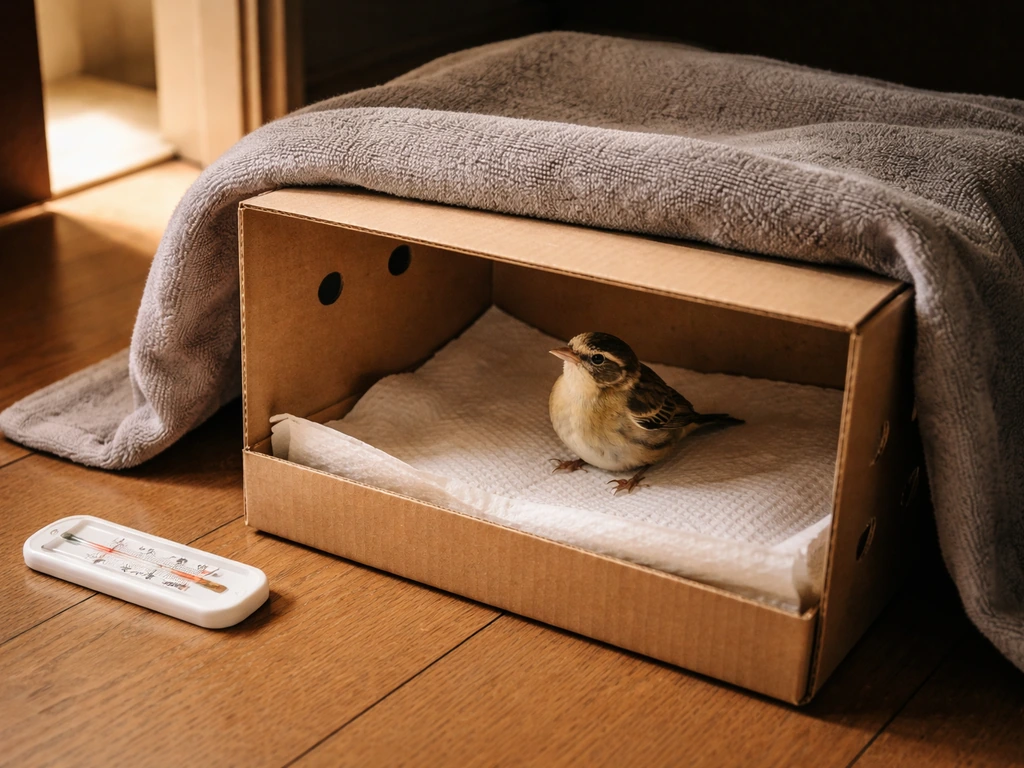
If you're waiting for a rehabilitator to respond or for transport, the box setup is your best tool. Ventilated cardboard box, paper towel lining, dark and quiet room, warm but not hot (room temperature is fine for most species). Do not put the bird under a heat lamp unless you've been specifically told to. Keep the lid closed. Keep the box away from pets, and away from your kids no matter how understandable the curiosity. The bird does not know you are helping it. Every disturbance extends the stress.
When to call a wildlife rehabilitator (and how to find one)
Call a licensed wildlife rehabilitator immediately in any of these situations: the bird has visible injuries, was caught by a cat or dog (even with no visible wounds), is a bird of prey of any kind, is a young bird whose nest is unreachable, or hasn't recovered from stunning after 30 minutes. You can find licensed rehabilitators through the USFWS website, your state fish and wildlife agency, or by searching the National Wildlife Rehabilitators Association (NWRA) or Wildlife Rehabilitators directory online. Give them the species if you know it, describe what you observed, and follow their instructions. Do not attempt to rehabilitate the bird yourself beyond temporary containment. Not only is it illegal in most states without a permit, it's also genuinely harder than it looks, especially for raptors and waterbirds.
Understanding the difference between this kind of emergency wild-bird handling and regular daily how to handle a bird situations is important: with a wild bird, you are not trying to build a relationship or train anything. You're doing the minimum necessary to keep the bird safe until a professional takes over. Keep that as your north star and you'll make good decisions under pressure.
A quick reference checklist before you act
- Is the bird actually in distress, or just a fledgling doing normal fledgling things? If it's hopping around with feathers, leave it alone.
- Can you contain it without touching it (box-scoop method)? Try that first.
- Do you have gloves and a ventilated container ready before you approach?
- Are you moving slowly, staying low, and using a towel to cover the bird's eyes?
- Are you keeping your hands around the body (not the wings, tail, or feet)?
- Is the box in a dark, quiet, warm room with the lid closed?
- Have you called or are you in the process of calling a wildlife rehabilitator?
- Are you NOT giving food or water until a professional instructs you to?
FAQ
What should I do if I am not sure what species the wild bird is?
If you cannot identify whether the bird is protected, treat it as protected and avoid keeping or transporting it. For common exceptions (pigeons, European starlings, house sparrows) and for species you are unsure about, the safest move is to place the bird in a ventilated box and call a wildlife rehabilitator or your state agency for instructions.
How can I tell whether a bird is actually injured versus just stressed?
Do not try to “test” whether it is injured by repeatedly holding it or by forcing it to stand. Look for clear injury signs first, and if the bird can sit upright and is alert, monitor in the quiet, dark box for 15 to 30 minutes, then reassess before deciding on further handling.
What if the bird looks young, but I cannot tell if it is a fledgling or a nestling?
Avoid removing it from a nest site if it is a fledgling that is not injured and not in immediate danger. If it is a nestling you know fell from a nest or a nest is reachable, you can gently place it back or near the nest area, then keep people and pets away while the parents resume care.
Do I still need to call for help if a cat caught the bird but there is no visible wound?
Yes. A bird caught by a cat or dog should still be treated as high risk even if it seems unhurt. Internal injuries and infections can develop after bites, so contain it safely in a ventilated box and contact a rehabilitator right away.
Can I give a wild bird water if it is hot or panting?
Do not water or feed it, even if it looks thirsty. If you are handling it only for transport to a box or outside, keep the time minimal, keep it dark and calm, and contact a professional promptly. Any aspiration risk comes from water or food entering the lungs.
How long is it okay to hold a bird in a box while I wait for a rehabilitator?
If you are waiting, place the bird in a ventilated box in a warm room (room temperature is fine for most species), keep the lid closed, and do not check repeatedly. If you must confirm breathing or condition, do it quickly with minimal light and keep the box off the floor away from drafts and household activity.
What if the bird seems to be getting worse while I am waiting?
If the bird stops moving normally, shows heavy bleeding, or becomes unresponsive, treat it as an emergency and call a rehabilitator immediately. Keep it contained in the dark and warm (not hot), avoid further handling, and follow their instructions on whether to bring it in.
What is the best way to prevent a bird escape if it comes loose in my hands?
If the bird escapes during handling, do not chase it. Use slow movements, reduce visual stimulation, and redirect it back into the box by creating a safe, calm path rather than running after it, which can cause wall or window collisions.
What kind of gloves or materials should I use, and what should I avoid?
Do not use towels or gloves that could snag feathers or restrict breathing, and avoid wrapping too tightly around the chest. Use a secure two-handed wrap and place it into a ventilated container lined with soft material, keeping the bird from rubbing its head against hard surfaces.
Can I keep the bird covered with a cloth to calm it, and does that affect ventilation?
Yes. If you have to move it, you can gently pick it up only as needed to reduce immediate danger, then get it into the box and place the box in a quiet, dark room. Covering the box is fine, but keep ventilation open and do not put it under lamps unless specifically told.
Is it legal to transport a wild bird to a rehabilitator after I find it?
For legal reasons, transporting wild birds without the required permits can be a problem. Even if you plan to bring it to a rehabilitator, minimize time and handling, and follow the rehabilitator’s instructions for where to take it and how to bring it safely.
What should I do if the bird is not injured but is in a dangerous location (road, sidewalk, cat area)?
If you find an adult bird that appears fine but is in a risky spot (for example, in the middle of a driveway), wait for immediate danger to pass if possible. If not, move it away from the hazard using minimal handling, then let it go at ground level in a safe area and keep pets indoors until it flies off.
Next Article
How to Hold a Bird Safely: Step-by-Step Guide
Learn humane, step-by-step how to hold pet or wild birds safely, with hand placement, stress control, and troubleshootin