If you searched 'smalland how to tame bird,' you probably want to tame a small bird in real life, not in the survival game Smalland: Survive the Wilds (where 'taming' means weakening a creature and feeding it a treat during gameplay). This guide is for the real thing: earning the trust of a small pet bird like a budgie, cockatiel, or finch, or gently encouraging wild birds in your yard to approach voluntarily. The process takes patience, consistency, and the right setup, but you can start making real progress today.
Small Bird Taming: How to Tame Smalland Safely
Clara Hayes
13 May 2026
First: Figure out what bird you're actually working with
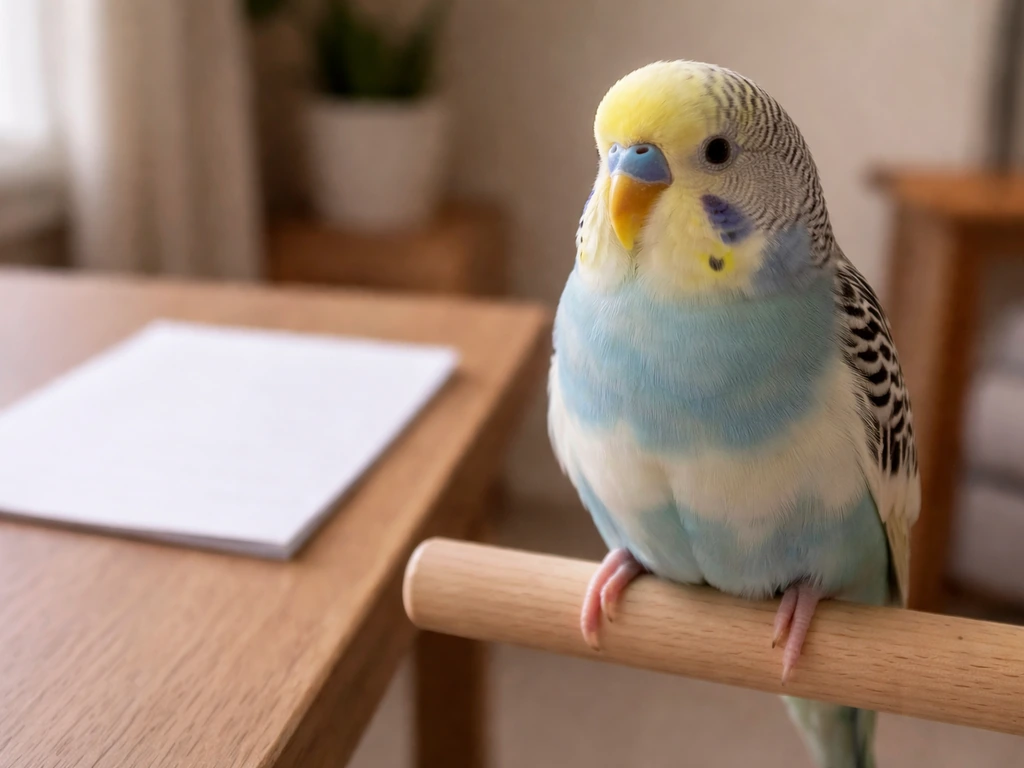
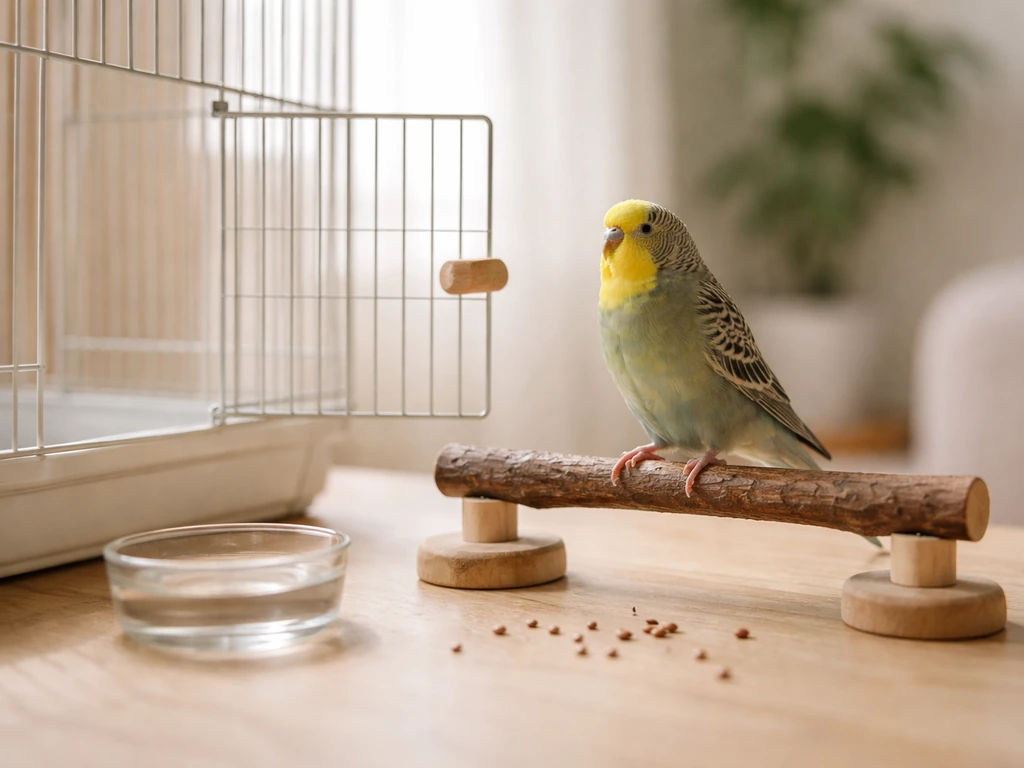
Before you do anything else, nail down three things: the species, the age, and whether it's a pet or a wild bird. Each of those answers changes your entire approach.
For pet birds, common small species include budgerigars (budgies/parakeets), cockatiels, lovebirds, small conures, and finches. Age matters a lot. A hand-fed baby bird raised by a breeder is already partly socialized and just needs continued gentle handling. A juvenile that was parent-raised but recently weaned, or an adult rescue bird with no handling history, will need a slower, more careful trust-building process from scratch.
For wild birds, you need to be honest with yourself about what you're actually looking at. If a small bird is sitting on the ground and hopping around, it is very likely a fledgling, and the parents are almost certainly nearby watching. Audubon is clear on this: if the bird has feathers and can hop, leave it alone. It does not need your help. A genuinely injured wild bird (broken wing, bleeding, unable to move, cat puncture wounds) is a different situation entirely, and that section is covered later in this article.
Set up a calm, safe environment before you touch anything
The environment you create before taming begins determines how fast you make progress. A stressed bird cannot learn. Your job in the first few days is simply to be a non-threatening presence.
Cage and room placement
- Put the cage at eye level or slightly below, never on the floor (that signals predator territory to a bird) and never up high where the bird feels untouchable.
- Place the cage in a room where you spend natural, quiet time, like a living room. Avoid kitchens (fumes from non-stick cookware are toxic to birds) and rooms with drafts.
- Cover three sides of the cage with a light cloth so the bird has a sense of security, but leave the front open so it can watch you.
- Keep the first few days low-traffic. Limit visitors, loud music, and sudden movements near the cage.
Food, perches, and rewards
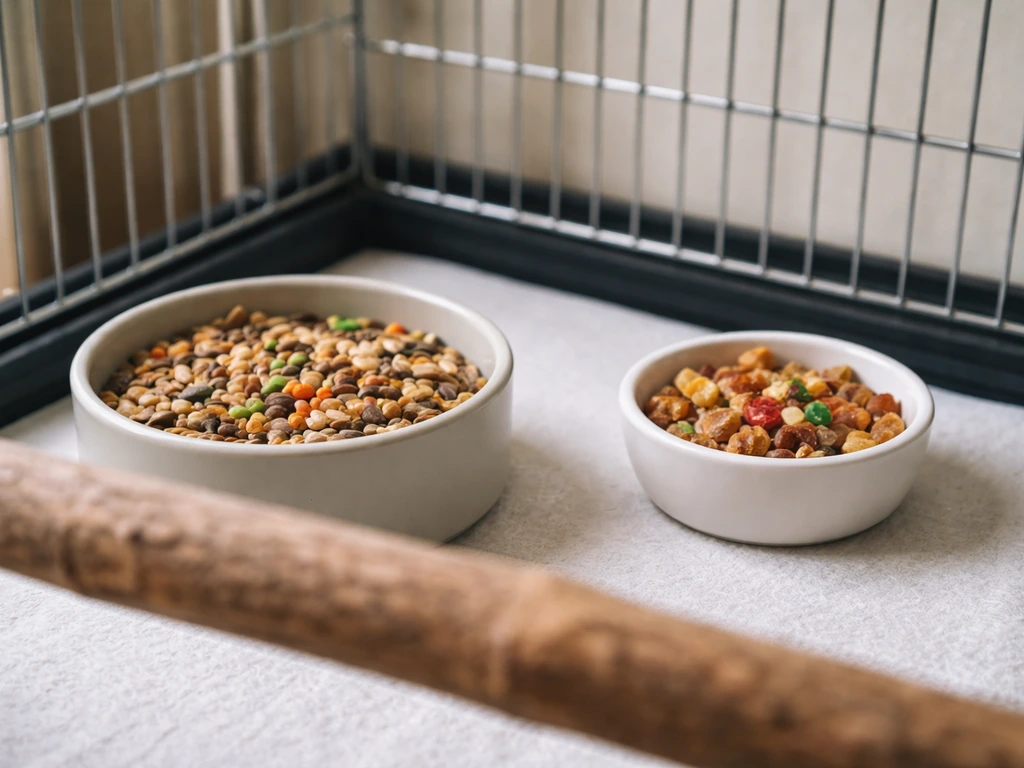
Use species-appropriate food as your baseline diet and keep a small supply of high-value treats separate for training sessions only. For budgies and cockatiels, a small piece of millet spray works brilliantly because you can hold it through the cage bars without putting your hand inside at first. For finches, tiny seeds held between your fingers or placed on your open palm work well. For small parrot species, a small piece of fruit or a nutrient-rich pellet crumble can motivate a bird that isn't food-motivated by seed alone.
Avoid offering treats through the bars constantly or the bird learns to expect food without engaging with you. Treats are a training tool, not a bribe to be given freely.
Step-by-step taming protocol you can start today
This protocol works for most small pet birds. Go at the bird's pace and stop each session the moment you see stress signals (more on those in the troubleshooting section below). RSPCA advises training at the bird’s pace, stopping when the bird seems distressed, and gradually teaching handling and training behaviors through step-up concepts step-up training concepts. Short daily sessions beat one long weekly attempt every single time.
- Days 1 to 3 (Presence only): Sit quietly near the cage for 10 to 15 minutes a day. Read, work on your phone, or just exist nearby. Talk softly in a calm, consistent tone. Don't stare directly at the bird; direct eye contact reads as a threat to small birds. Let the bird observe you without pressure.
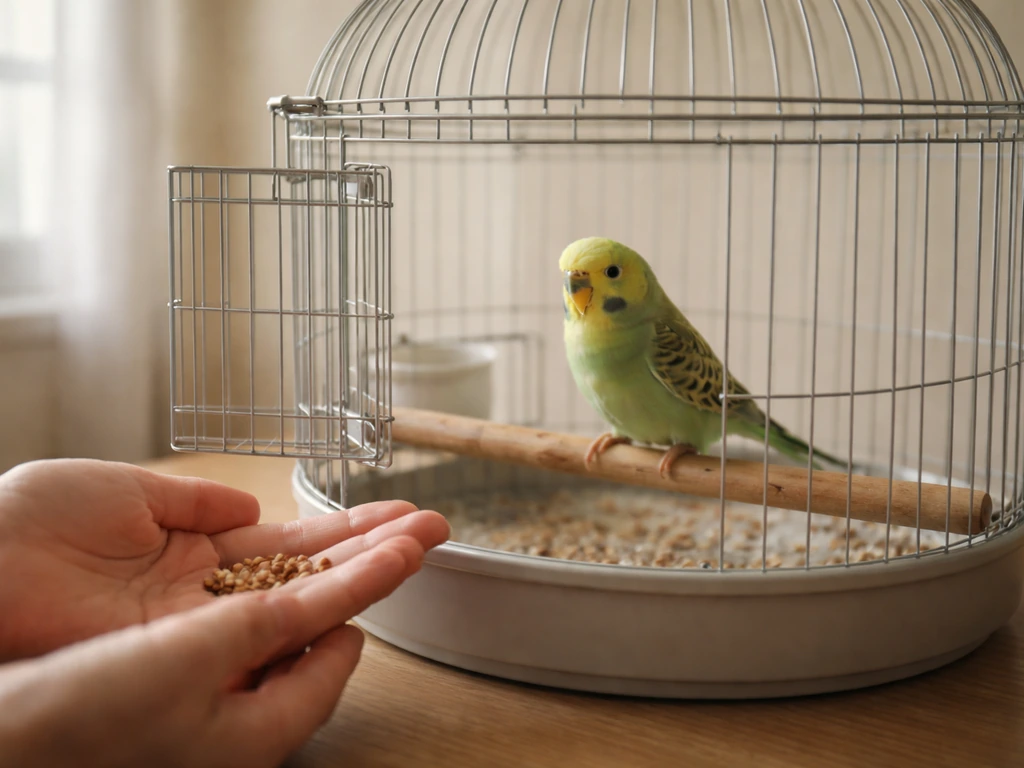
- Days 4 to 7 (Hand near the cage): Place your hand flat against the outside of the cage for a few minutes each session. Don't poke, tap, or move quickly. The goal is for the bird to approach the bars near your hand voluntarily. Reward any movement toward your hand with a soft verbal 'good' and eventually a treat held at the bars.
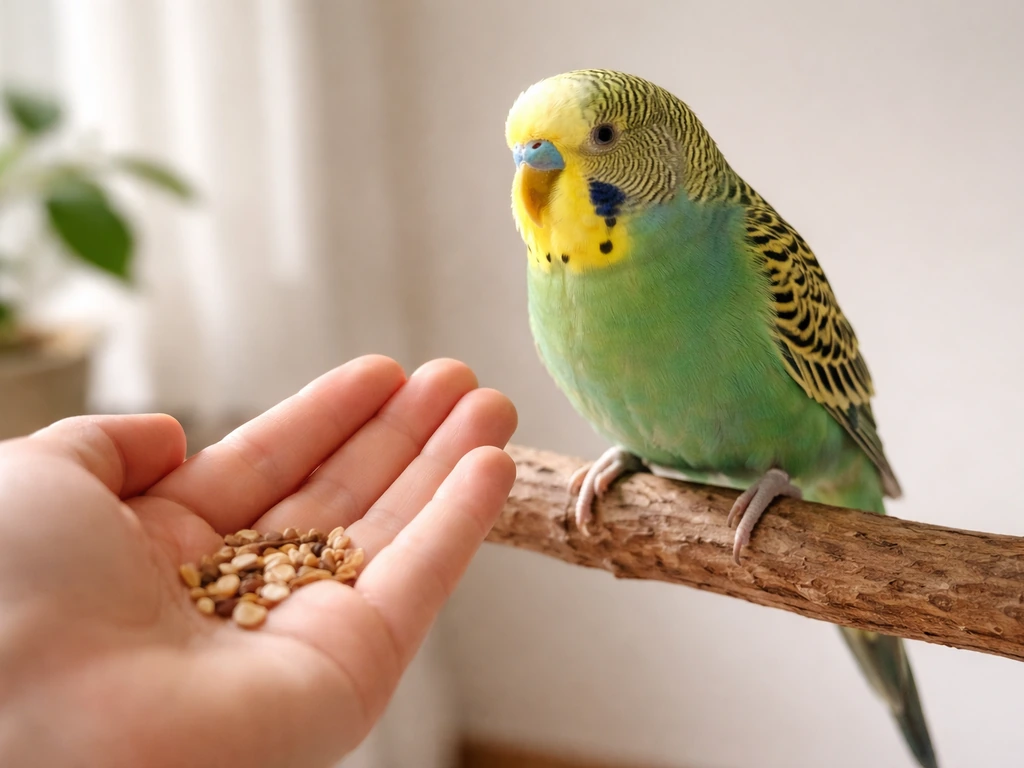
- Week 2 (Hand inside, no touching): Open the cage door and rest your hand just inside, palm up, staying very still. Hold a treat in your fingers. Don't reach for the bird. Wait. If the bird steps toward your hand or even looks at it without retreating, that's progress. Keep sessions under 5 minutes.
- Week 2 to 3 (Step-up introduction): Once the bird is comfortable eating from your hand, introduce the step-up command. Hold your finger or a short perch horizontally against the bird's lower chest, just above its feet, and say 'step up' in a consistent, gentle tone. Many birds will step up instinctively. Reward immediately with a treat and verbal praise. Practice this for just a few minutes daily as PetMD recommends, only when the bird seems relaxed.
- Week 3 onward (Out-of-cage handling): Begin short out-of-cage sessions in a small, bird-proofed room (windows covered or closed, mirrors covered, ceiling fans off). Let the bird explore from your hand or a portable perch. Gradually extend session length as confidence builds.
- Ongoing (Phase out food rewards): Once the bird anticipates step-up reliably, start offering praise and gentle head scratches as the reward instead of a treat every time, phasing treats to intermittent reinforcement.
Species-specific tips for small pet birds
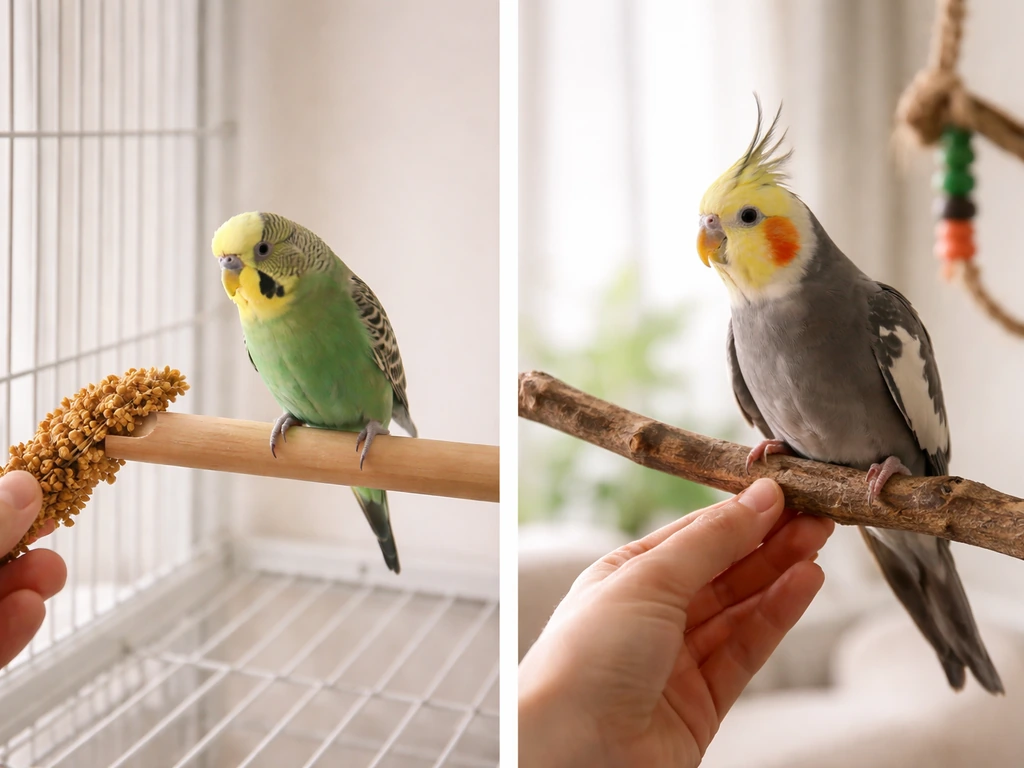
The general protocol above applies across the board, but each species has its own personality quirks worth knowing before you start.
| Species | Temperament | Best Reward | Key Tip | Typical Taming Timeline |
|---|---|---|---|---|
| Budgie (parakeet) | Curious but skittish, flock-oriented | Millet spray | Mirror toys can reduce motivation to interact with you; remove them during taming | 2 to 6 weeks for basic step-up |
| Cockatiel | Gentle, social, responds well to whistling | Millet, small seeds | Whistle or hum softly during sessions; cockatiels often respond faster to sound cues than visual ones | 1 to 4 weeks for step-up if young |
| Small conure / lovebird | Bold, energetic, can be nippy | Fruit piece, nut fragment | Expect more feistiness; consistent 'time-out' responses to nipping are essential from day one | 3 to 8 weeks depending on history |
| Finch / canary | Not typically handleable like parrots; fear-bites when grabbed | Small seeds on open palm | Focus on voluntary approach and hand-feeding rather than step-up; most finches are 'look but don't touch' birds | Weeks to months for hand-feeding comfort; full handling is rarely the goal |
Finches and canaries deserve a special note here: they are not naturally handling birds the way parrots are. Forcing step-up training on a finch causes chronic stress. The realistic, humane goal with finches is to get them comfortable eating from your hand, and to accept your presence near them without fleeing. That is a genuine achievement and is as tamed as most finches will comfortably get.
Wild birds in your yard: attraction, not capture
If your goal is to get wild birds to approach you in your yard, the entire approach is different. You are not training a pet. You are building a relationship of trust with a free animal on its own terms, and that distinction matters both ethically and legally.
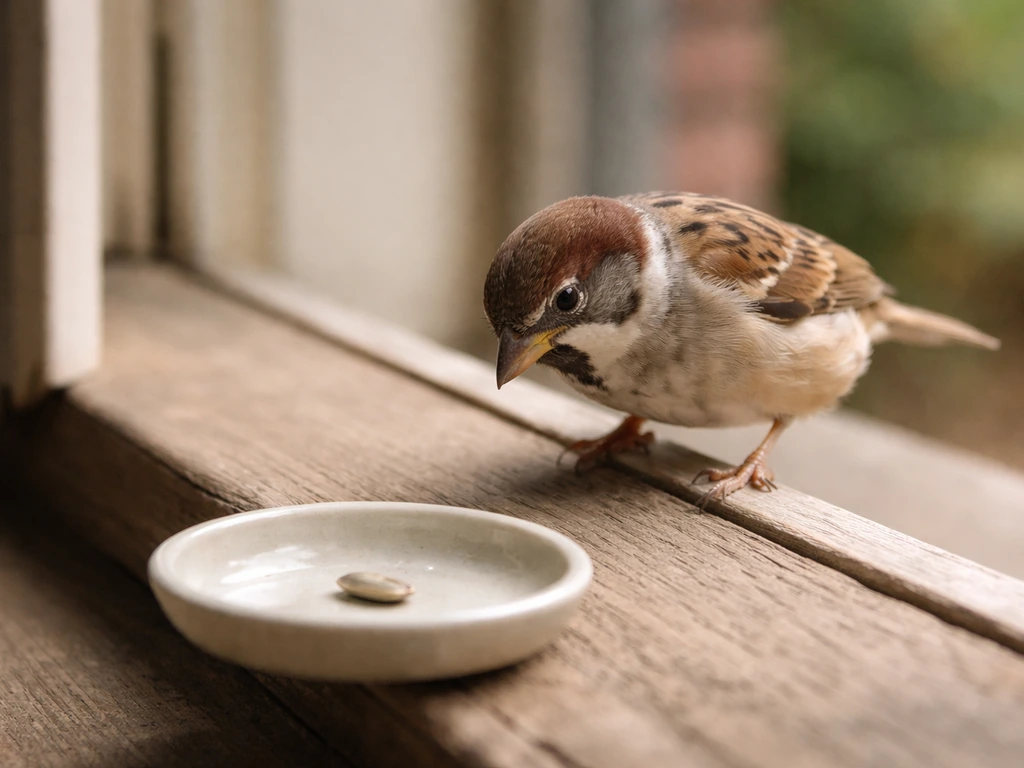
The most effective method is consistent, patient feeding. Place a feeder or scatter seed on the ground near where you sit regularly. Over days and weeks, sit quietly in the same spot, stay still, and let the birds habituate to you as part of the landscape. Some bold species like house sparrows, chickadees, and nuthatches may eventually feed from your open palm if you hold seed and stay perfectly still. This can take several weeks of daily sessions.
What you should never do is attempt to catch, net, or confine a wild bird to tame it. Beyond being inhumane and counterproductive, it is almost certainly illegal. Most small wild birds in the U.S. are migratory birds protected under federal law. You cannot legally keep one, even temporarily, without a federal rehabilitation permit under 50 CFR § 21.76. The goal with wild birds in your yard is always voluntary approach, never capture.
If a wild bird approaches you closely on its own, stay still, avoid sudden movements, and enjoy it without trying to grab or restrain it. Let it leave when it wants to. That voluntary interaction is the entire win.
Troubleshooting fear, bites, and setbacks
Every bird hits a rough patch during taming. Here's how to read what's happening and fix it without making things worse. If you are specifically trying to achieve a satisfactory tame with a hesitant bird, start by identifying what fear or stress signals are showing up and adjust your pacing satisfactory how to tame bird.
Reading body language
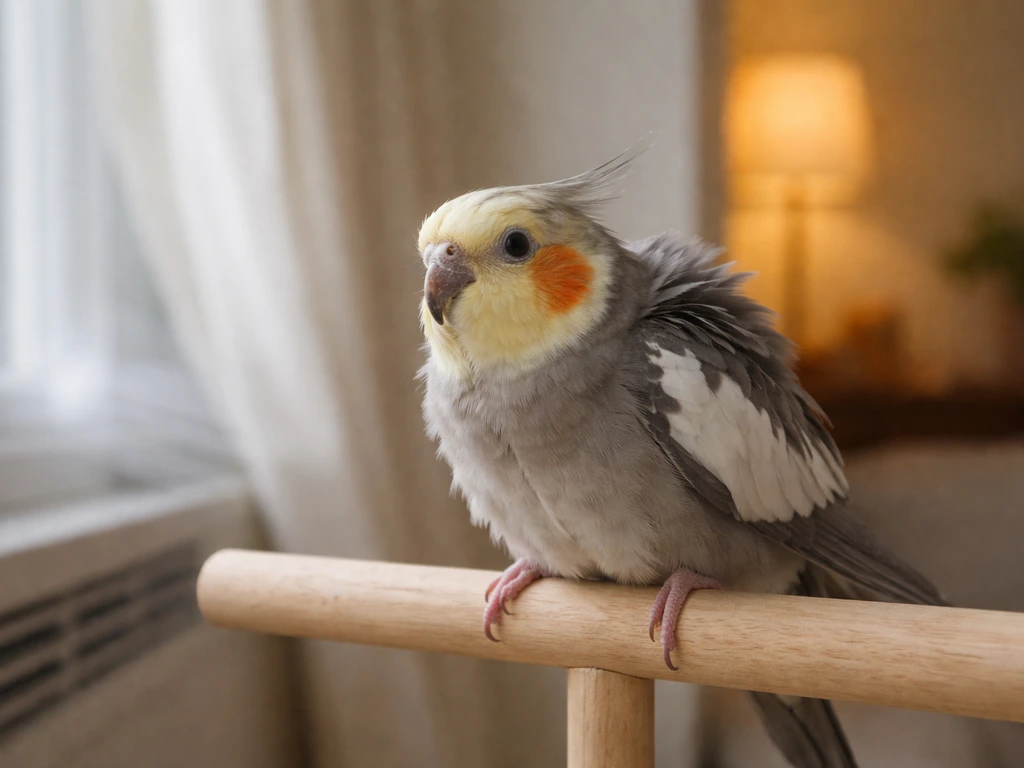
- Fluffed feathers, hunched posture, or wide eyes: the bird is stressed or cold. Back off and check room temperature (birds do best between 65 and 80°F).
- Tail bobbing rapidly: respiratory distress, see an avian vet.
- Feathers slicked flat, wings slightly raised: the bird feels threatened and may bite. Give it space immediately.
- Relaxed, slightly puffed feathers and one foot tucked up: the bird is calm and comfortable. This is your window for interaction.
- Regurgitating at you: this is affectionate bonding behavior in parrots, not illness (though true vomiting, which is forceful and involves head-swinging, is a vet matter).
- Feather plucking or barbering: a stress or health signal that needs an avian vet visit, as Purdue's veterinary guidance emphasizes.
When the bird bites
Bites are normal during taming, especially with birds that have no handling history. When a bird bites while on your hand, the VCA-recommended response is a calm, slow 'time-out': gently set the bird down and walk away for a minute or two, then return and try again. Do not yell, blow in the bird's face, or flick it. Those responses escalate aggression and destroy trust. Be aware that small birds will sometimes 'grasp' with their beak to balance, which is not the same as an aggressive bite. Learn to tell the difference: a balance grab is light and exploratory, while an aggressive bite involves intention and usually comes with a warning posture first.
When progress stalls
- If the bird was progressing and suddenly regresses, check for changes: new pet in the house, moved cage location, change in routine, illness.
- If the bird has never progressed past the 'flee from your hand' stage after two weeks, you may be moving too fast. Go back to stage one (presence only) and slow down by 50%.
- If sessions consistently end in biting or freezing, they are too long. Keep each session under 3 minutes until the bird is more comfortable.
- If the bird seems lethargic, stops eating, or has discharge from eyes or nostrils, stop training and see an avian vet before continuing.
What a realistic timeline looks like
There is no single timeline because every bird has a different history. A hand-fed budgie chick might step up reliably within a week. A rescue cockatiel that was neglected for years might take three to six months to accept hand contact without stress. What matters is that you measure progress in small, consistent wins, not a fixed deadline.
| Milestone | What it means | Rough timeframe (healthy, willing bird) |
|---|---|---|
| Bird doesn't flee when you approach the cage | Basic habituation to your presence | 3 to 7 days |
| Bird eats a treat from your hand through bars | Early trust established | 1 to 2 weeks |
| Bird accepts your hand inside the cage without fleeing | Significant trust milestone | 2 to 3 weeks |
| Bird steps up onto your finger on cue | Basic taming achieved | 2 to 6 weeks |
| Bird is calm out of cage, returns to hand, explores freely | Well-tamed and socially bonded | 1 to 3 months |
| Bird seeks out your company and initiates contact | Fully bonded companion | 3 to 6 months or more |
A 'tamed' bird, practically speaking, means one that accepts handling without chronic stress, steps up reliably, and shows relaxed body language during interaction. A bonded bird actively seeks you out and shows affection. Both are achievable with most small pet birds given consistent, patient effort. If you're also curious about working with birds that are especially fearful or that bite regularly, those topics get their own deep dives and build directly on this foundation. If you are wondering how to tame a scared bird, focus on slow trust-building and read stress signals before you try any handling fearful or that bite regularly.
Legal and ethical lines you need to know
For pet birds bought from a breeder or pet store, taming is entirely legal and encouraged. The only ethical line to watch is forcing interaction past the point where the bird is clearly distressed, which causes lasting psychological harm and is counterproductive. Always train at the bird's pace, as the RSPCA advises, and stop when the bird signals it's done.
For wild birds, the rules are strict and exist for good reason. Under federal law, most wild birds in the United States are protected under the Migratory Bird Treaty Act. You cannot legally capture, keep, or attempt to tame a wild bird without a federal rehabilitation permit. This includes seemingly common birds like sparrows, finches, and songbirds. The only legal exception is immediately transporting a sick, injured, or orphaned bird to a licensed wildlife rehabilitator or licensed veterinarian, per 50 CFR § 21.76.
If you find an injured wild bird, here is exactly what to do and what not to do: If you spot an injured bird, Virginia DWR advises you not to chase it and to contact a wildlife rehabilitator when you see red-flag injury signs.
- Do not attempt to feed it or give it water unless a wildlife rehabilitator specifically instructs you to.
- Do not chase it. Virginia DWR is explicit that chasing an injured bird causes additional harm.
- Do not assume a bird sitting on the ground is injured. If it has feathers and can hop, it is almost certainly a healthy fledgling with parents nearby.
- Do look for real injury signs: broken or dangling wing, visible bleeding, lacerations, inability to move legs, puncture wounds from a cat bite, or maggots.
- Do contact a licensed wildlife rehabilitator immediately. The CDC also warns that sick wild birds can carry diseases transmissible to pets and people, so avoid handling with bare hands.
- Do place a clearly injured bird in a cardboard box with ventilation holes, keep it warm and quiet, and get it to a rehab facility as quickly as possible.
The bottom line on wild birds: attracting them to your yard, building voluntary trust over time through feeding, and enjoying their presence is wonderful and fully legal. Attempting to capture or keep one, even with the best intentions, is not. If you're drawn to working more closely with wild birds, pursuing a volunteer role with a licensed wildlife rehabilitation center is the right path, and it's genuinely rewarding work.
FAQ
How can I tell if my small pet bird is stressed or just being cautious during taming?
Watch for changes like fluffed feathers, pinned eyes, rapid breathing, repeated lunging, or freezing when you approach. If the bird becomes still and avoids your hand, that is often fear rather than “normal fussing,” and the right move is to slow down, shorten sessions, and reduce how close your hand goes.
What should I do if my bird is biting at the same step every day, like when I try to step up?
Identify the trigger point and back up one stage. For example, if biting happens during step-up attempts, practice the non-contact phase longer (hand near cage, then hand near perch without lifting) and only progress when the bird can accept proximity without warning posture.
Is it okay to use toys or perches instead of treats to tame a small pet bird?
Yes, as long as the reward still builds positive association. Use toys or favorite surfaces as “secondary rewards,” but keep food as the anchor early on so you can shape behavior quickly. Avoid switching constantly between motivators, because inconsistent rewards can make progress slower.
How long can a taming session be for a small bird?
Start short, often 30 to 120 seconds for the first few days, then end on a calm note. If the bird is still engaged, you can repeat later the same day, but once stress signs appear you should stop immediately rather than pushing through.
My bird takes treats from my hand but won’t step up, what does that mean?
It usually means your bird tolerates your presence but feels unsafe about body contact or being lifted. Build “step-up readiness” by practicing with the hand as a neutral landing surface, keep the bird’s body level (no looming over it), and reward tiny attempts, such as leaning forward or placing one foot near your hand.
Can I tame a small wild bird by placing food near my house without sitting still for long periods?
You can, but habituation is slower if you move frequently. The key is predictability, sit quietly in the same spot, and minimize sudden gestures. If you change your routine, birds may learn to treat your yard as unsafe rather than normal.
What if a wild bird keeps showing up, but it never comes close enough to feed from my open palm?
That can be a normal outcome. For many species, “tamed equivalent” means voluntary feeding from the ground or a feeder placed near your consistent seating area. Focus on the closest voluntary behavior you can reliably achieve, instead of forcing hand-feeding expectations.
How should I adjust if my small pet bird refuses food during training?
Do not train through refusal. Reduce the time of the session, try a different high-value treat that matches species preferences, and ensure the bird is not already over-sated. Also consider health, if appetite drops suddenly or lasts more than a day or two, prioritize a vet check rather than changing training techniques.
Are there any safety rules for preventing bites when training small birds?
Wear sleeves that you do not mind getting pinched, keep sessions controlled, and avoid reaching quickly. Use a calm “time-out” by setting the bird down and stepping away briefly, then resume only when the bird is calmer. If you are unsure whether a bite is balance-grasp or aggression, slow down and reduce the intensity of the next attempt.
Can I tame a finch the same way as a budgie, like using step-up training?
Not reliably. Many finches show chronic stress with handling-focused training. A humane and practical goal is hand-tolerant eating and calm presence near the cage or their favorite feeding spot, progressing only as comfort increases.
Is it legal to keep a wild bird temporarily “until it’s better”?
In the U.S., typically no, unless you act under the immediate transport exception for sick, injured, or orphaned birds to a licensed wildlife rehabilitator or veterinarian. For anything else, capturing or keeping wild birds without the proper federal permit is not allowed.
What should I do if I suspect a wild bird is injured but it seems mobile?
Do not try to catch it. Observe from a distance and check for clear signs like inability to fly, bleeding, dragging an injured leg, or visible injury. Then contact a licensed wildlife rehabilitator or veterinarian for guidance, because “looks okay” can still mean an injury that needs professional care.