You can't truly hypnotize a bird the way stage magicians do it, but you absolutely can train one to become calm, still, and relaxed around you using slow movements, consistent eye contact cues, and positive reinforcement. Most people searching for how to hypnotize a bird are really asking: how do I get my bird to stop panicking, stay put, and let me get close? The answer is habituation and trust-building, done gradually and on the bird's terms. This guide walks you through exactly how to do that, species by species, from the first session to reliable calm handling.
How to Calm a Bird Like It’s Hypnotized Safely
Clara Hayes
27 Apr 2026
What 'Hypnotize' Actually Means for a Bird
When people say they want to hypnotize a bird, they usually mean one of a few things: getting a flighty bird to freeze and stay still, calming a stressed or aggressive bird before handling, or just making a skittish bird comfortable enough to approach. There is a real behavioral phenomenon called tonic immobility, where a bird goes limp and still under extreme restraint. You might have seen videos of birds lying motionless on their backs. That looks dramatic, but it is not hypnosis and it is not calm. It is a fear response, essentially the bird's nervous system shutting down under perceived threat. Triggering it deliberately is stressful for the bird and potentially dangerous.
What we are actually going for here is something far more useful: voluntary calm. A bird that chooses to stay near you, hold still, and accept touch or handling because it has learned that doing so is safe and sometimes rewarding. That state looks very similar to what people describe as 'hypnotized,' but it comes from trust rather than coercion. The techniques below are all built around that goal.
Safety and Legality Before You Start
The rules are different depending on whether you have a pet bird or a wild bird. For pet parrots, cockatiels, budgies, and finches, the methods in this guide are appropriate for daily home practice. You own these birds, and taming or training them is both legal and encouraged. The one hard rule: never use forceful restraint as a training tool. Old-school bird keeping relied on physically overpowering birds to 'make' them cooperate. Research and modern avian behavior science are clear that this approach causes fear conditioning and makes things worse over time. A restrained large parrot's heart rate can spike above 250 beats per minute. That level of stress is harmful, and it destroys trust.
For wild birds, the situation is different. In the US and most of Canada, wild native birds are protected under the Migratory Bird Treaty Act, which means capturing, restraining, or handling them without a federal permit is illegal, regardless of your intentions. USFWS policy guidance explains that the blank" rel="noopener noreferrer">Migratory Bird Treaty Act and its implementing regulations require federal authorization for activities such as capturing, restraining, or handling migratory birds, including actions like taking or possessing them. The Animal Legal & Historical Center’s plain-language summary explains that the MBTA’s baseline prohibition covers activities like pursuing, hunting, taking, capturing, or killing migratory birds without permitted authorization and describes key exceptions blank" rel="noopener noreferrer">Migratory Bird Treaty Act, which means capturing, restraining, or handling them without a federal permit is illegal. If you find an injured wild bird, contact a licensed wildlife rehabilitator rather than attempting handling yourself. What you can legally and effectively do with wild yard birds is condition them to your presence over time using feeders, consistent positioning, and slow approach. That process is covered in the section on wild bird techniques below.
- Never force a bird into tonic immobility (flipping on its back) as a training or handling technique
- Keep sessions short: 5 to 10 minutes maximum, especially early on
- Stop immediately if the bird pants, has labored breathing, or becomes limp
- Wear a light long-sleeved shirt when working with larger parrots until trust is established
- Do not attempt to handle injured or wild native birds without a rehabilitator permit
Set Up the Environment Before Your First Session
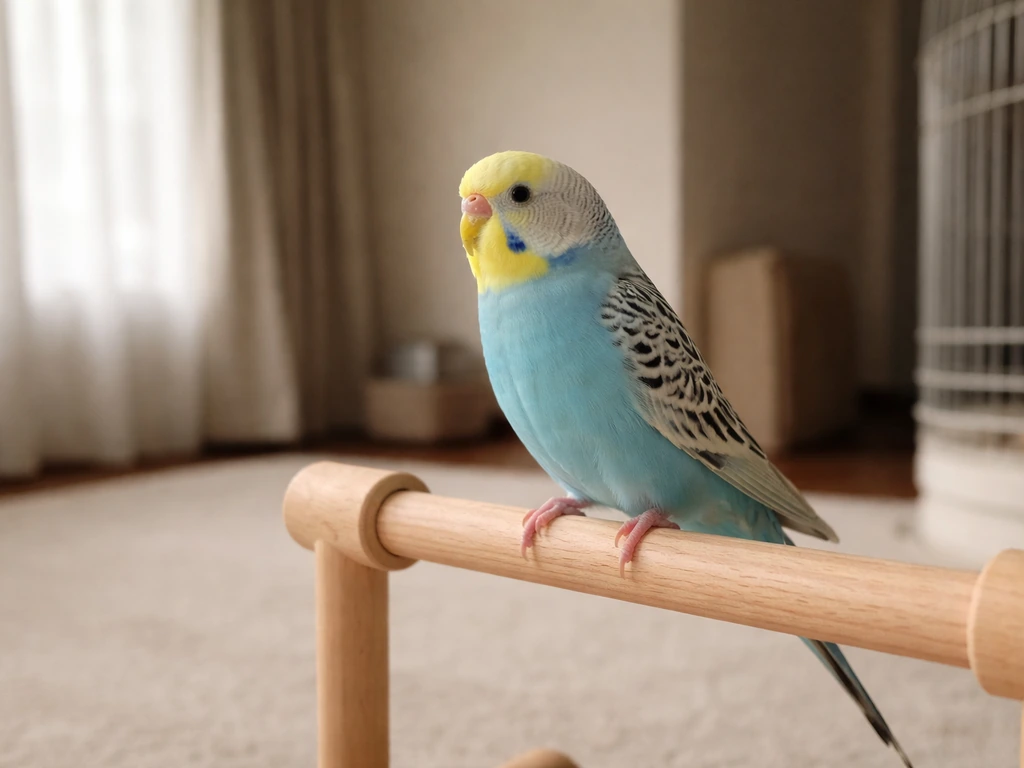
The environment does a lot of the work. A bird that feels safe in its space is already halfway to calm. Before you start any training, take 10 minutes to set up properly.
For pet birds, move the bird (in its cage or on a portable perch) to a quiet room with no TVs, radios, or foot traffic. Close windows to block outdoor sounds that could startle. Dim the lighting slightly if you have an anxious bird: lower light levels reduce alertness and reactivity in many species. Position yourself so you are sitting down or crouching to the bird's level rather than looming above it. Birds are prey animals, and height signals threat.
Decide on your goal for the session before you begin: simple stillness and proximity, a voluntary step-up onto your finger, or tolerating touch on the head. Pick one. Trying to do all three in a single session is the most common beginner mistake. Clear, single goals also make it much easier to read whether you are making progress.
For wild yard birds, set up a feeding station at a fixed location and sit at a consistent distance (start at about 10 feet or more) in a garden chair or on a low stool. Wear the same or similar clothing each time. Consistency signals safety to wild birds far more than any single technique you use in a session.
Step-by-Step Techniques by Bird Type
Parrots and Cockatiels
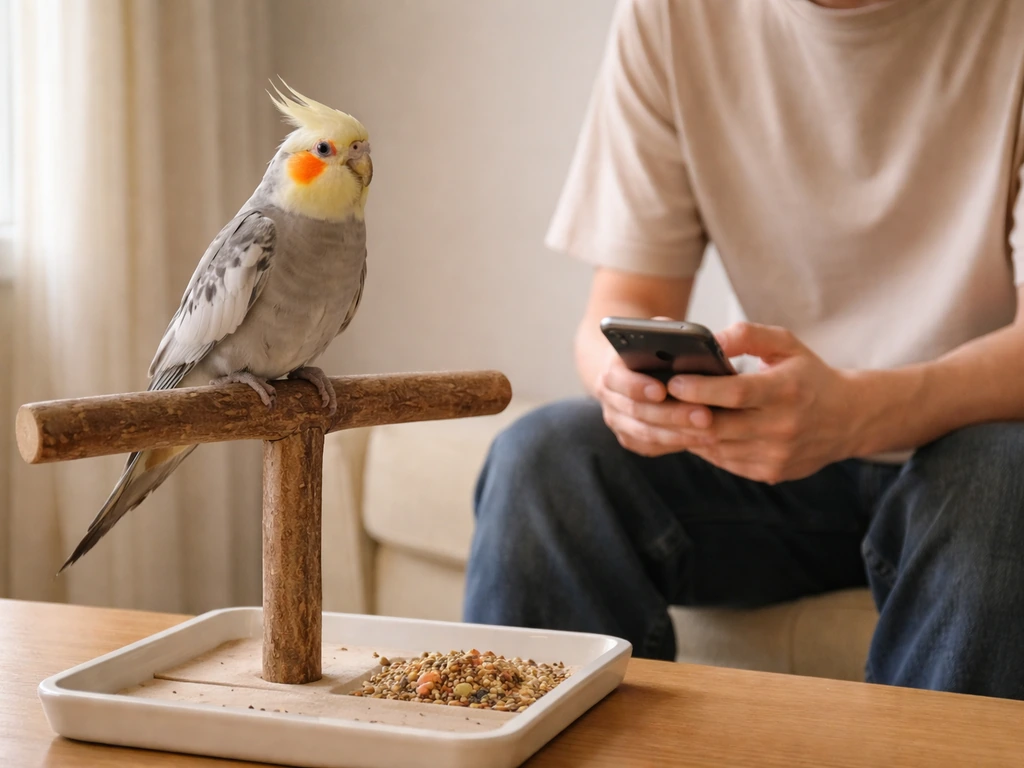
Larger, more social birds like African Greys, Amazon parrots, conures, and cockatiels are capable of complex trust relationships, which means they respond very well to structured desensitization. The process works like this: you expose the bird to something mildly uncomfortable (your presence at close range), pair it with something good (a treat, calm voice, or a favorite toy), and repeat until the mild discomfort becomes a neutral or positive signal. This is counter-conditioning, and it is the backbone of all calm-bird training.
- Sit near the cage or perch without interacting. Just be there, reading or looking at your phone, for 5 minutes. Do this daily for 3 to 5 days before attempting anything else.
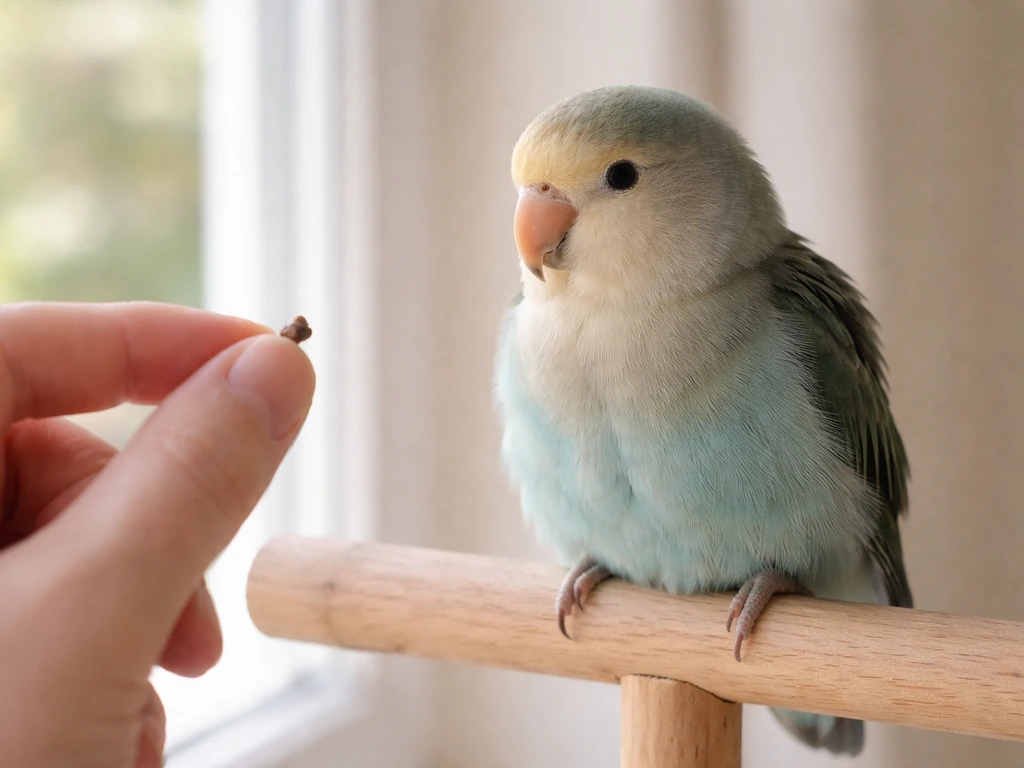
- Begin offering a small high-value treat (a tiny piece of almond, a sunflower seed, or a bit of mango) through the cage bars or at arm's length on a spoon. Don't push it. Set it near the bird and wait.
- Once the bird eats reliably with your hand at medium distance, very slowly move your hand 2 to 3 inches closer each session, always pairing with the treat.
- When the bird eats from your hand, introduce a perch or your finger just below its feet. Say 'step up' in a calm, even tone and apply the lightest upward pressure under its chest.
- Reward immediately the moment the bird shifts weight or lifts a foot, even if it doesn't fully step up.
- Build up step-up repetitions over multiple sessions before adding any handling.
Budgies
Budgies are small, quick, and highly reactive, so your movements need to be slower and your sessions even shorter. A newly acquired budgie should have at least one full week of cage-only adjustment before you attempt any hands-on contact. After that, start with the same proximity desensitization described above, but keep your hand lower and move it even more slowly. Budgies often train faster than people expect once they feel safe, but they also reset faster if they are startled. If a budgie flies in panic and thrashes against the cage, end the session and give it 30 minutes of quiet before trying anything again.
Finches and Other Small Cage Birds
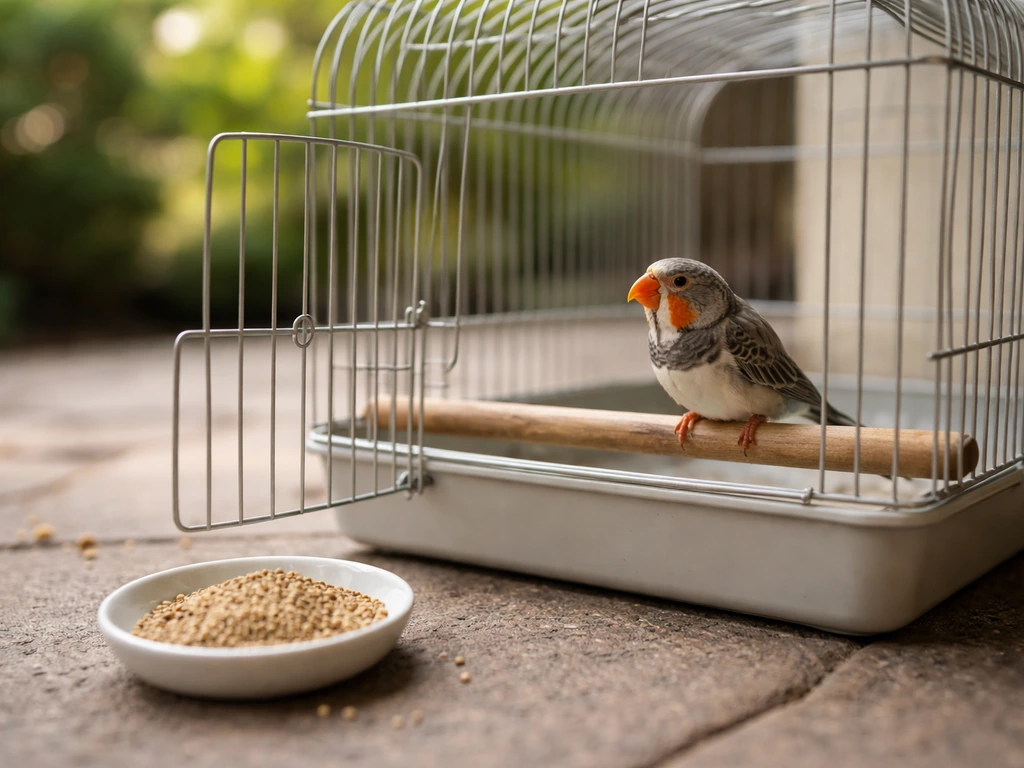
Finches are not typically hand-taming candidates, and chasing that goal with a finch will usually backfire. These birds are prey-oriented, flock-bonded, and not wired for the human-bond dynamic that parrots and budgies can develop. The realistic goal here is habituation: the bird tolerates your presence near the cage, does not panic when you change food or water, and maybe eats nearby while you sit still. To achieve this, do all cage maintenance with slow, predictable movements. Talk softly and consistently so your voice becomes a normal part of the environment. Never lunge or reach in quickly. Over time, many finches become genuinely comfortable with close human proximity even if they never become 'tame' in the traditional sense.
Wild Yard Birds
You can condition wild birds to stay calm and approach closer than they normally would, but it takes weeks of consistent, passive presence. Place a feeder at a set location. Sit near it at the same time each day, staying still and quiet. Each week, move your chair 1 to 2 feet closer. Most wild birds like sparrows, finches, and chickadees will eventually eat from a feeder while you sit within 4 to 5 feet if you have been patient and predictable. Black-capped chickadees are especially known for eventually taking seed from an open palm after weeks of this kind of conditioning. Never attempt to grab, chase, or corner a wild bird.
Using Focus Cues: Eye Contact, Gaze, and Slow Movement
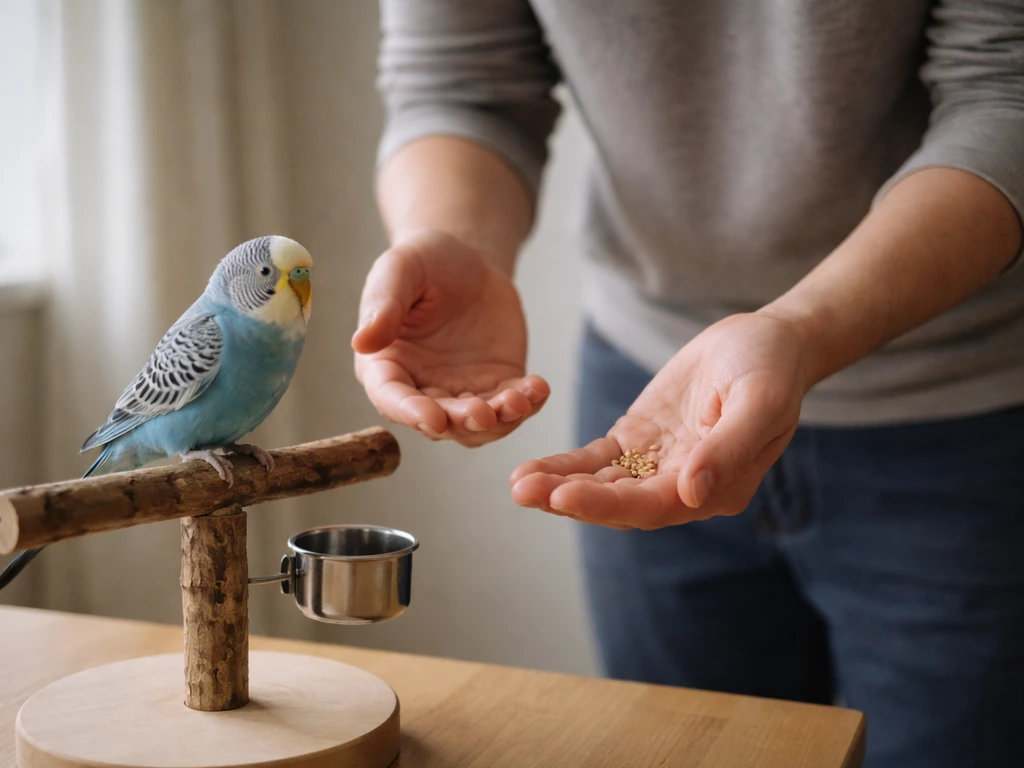
This is the part of bird training that most closely resembles what people picture when they think of 'hypnotizing' a bird. Calm, steady eye contact paired with slow, deliberate movement genuinely does have a settling effect on many birds, especially parrots. Here is how to use these cues without accidentally triggering a threat response.
- Use soft, slightly unfocused eye contact rather than a hard stare. A direct, unblinking stare signals predator behavior and will stress most birds.
- Blink slowly and deliberately while looking at your bird. Many experienced parrot owners report that slow blinking is returned by the bird and seems to communicate calm. This mirrors what cats do as a trust signal and appears to function similarly for some parrots.
- Move your hands and arms in arcing, fluid motions rather than straight-line approaches. Straight-line fast movement reads as a strike to a prey-wired bird.
- Bring your hand up from below rather than reaching over the top of the bird.
- Use a quiet, even-toned voice at the same volume throughout. Do not drop to a whisper when you get close, as the sudden change in volume or tone can startle.
- Time treat delivery within 2 to 3 seconds of any calm or stillness behavior. The faster the reward follows the behavior, the clearer the connection becomes.
Target training is one of the most efficient tools here. A target is a simple stick (a chopstick works fine) that you teach the bird to touch with its beak in exchange for a reward. Once the bird knows the target, you can use it to guide movement and attention, which keeps the bird focused on a task rather than on threat-scanning. A focused bird is a calmer bird, and over time that focused calmness becomes its default state around you.
Troubleshooting: Fear, Resistance, Aggression, and Flight
Even with good technique, birds will have bad sessions. The key is reading what is happening and adjusting rather than pushing through. Forcing a bird past its threshold does not speed up progress; it sets you back by reinforcing that your presence predicts something unpleasant.
| What You're Seeing | What It Means | What To Do |
|---|---|---|
| Bird moves to the far side of the cage or perch | You are too close, too fast | Back up 2 to 3 feet and slow your movements down |
| Feathers slicked flat against body, eyes wide | Active fear response | Stop all movement, stay still for 30 seconds, then slowly retreat |
| Hissing, lunging, or open-beak display | Threat/aggression: the bird feels cornered | End the session. Come back tomorrow with a smaller goal and more distance |
| Biting when you try step-up | Your hand approach is too fast or the bird is not ready | Return to treat-at-distance stage for several more sessions |
| Thrashing or flying into cage bars | Panic response: stop immediately | Cover three sides of the cage with a light cloth for 20 minutes, then leave the bird alone |
| Bird seems still but is panting | Stress, possibly overheating or fear | End the session, check room temperature, offer water |
If aggression is a consistent pattern rather than an occasional reaction, you may be dealing with a hormonal bird (parrots especially can become territorial during breeding season) or a bird that has had prior negative handling experiences. In those cases, a constructional approach works well: instead of pushing toward the behavior you want, you arrange the situation so the bird can offer a safe alternative behavior (moving toward you, staying on its perch) that you can then reinforce. You build the wanted behavior from below rather than pushing through the unwanted one from above.
Some readers may have looked at related topics like getting a bird to sleep or quieting a noisy bird. If your bird is struggling to settle down at night, the same calming cues and trust-building steps can help you figure out how to get your bird to sleep getting a bird to sleep. If you are also dealing with noise and constant alarm calls, the same calming, trust-based training steps can help you teach a quieter routine how to make a bird quiet. Those goals overlap with what we are doing here because a calm, trust-bonded bird sleeps better and screams less. The training foundation is the same: predictability, positive reinforcement, and reading the bird's signals carefully.
Realistic Timelines and How to Measure Progress
People often want a number, so here is the honest version: for a hand-raised parrot or cockatiel with no trauma history, reliable calm handling from a near-stranger can take 2 to 4 weeks of daily 5-to-10-minute sessions. For a bird that is wild-caught, neglected, or has had negative handling experiences, expect 2 to 6 months before you reach consistent voluntary calm. Budgies from reputable breeders often fall somewhere in the middle, around 3 to 6 weeks. Wild yard birds may habituate to your close presence in 4 to 8 weeks of daily consistent sessions, but that will never translate to handling.
Progress is not linear. Expect some days to feel like backsliding, especially after a stressful event (a vet visit, a loud noise, a new person in the house). That is normal. What you are looking for week over week is a trend, not a straight line.
Measure progress concretely: How close can you sit before the bird moves away? How quickly does it take a treat from your hand? Does it approach you voluntarily or wait for you to come to it? These are your real metrics. When a bird starts approaching you on its own, moving toward rather than away, you have crossed the most important threshold. From there, building toward full calm handling is mostly a matter of continued repetition and patience.
Your Next Steps Today
- Set up a quiet, low-distraction space for your next session before you do anything else.
- Choose a single, specific goal for today's session (proximity only, hand presence, or treat-from-hand).
- Gather 5 to 10 tiny high-value treats and keep them in a small cup nearby.
- Set a timer for 10 minutes. When it goes off, end the session regardless of how it is going.
- After the session, write down what you observed: distance achieved, bird body language, any retreat or approach. This log is how you spot the progress trend week to week.
- Repeat daily. Consistency is more important than any single technique.
FAQ
Is it ever safe to intentionally “freeze” a bird by restraining it so it goes still?
No. What looks like compliance in videos is usually fear-based tonic immobility, and deliberately triggering it can be stressful and risky. For training, use voluntary calm targets like staying near you, stepping up, or tolerating touch, and stop at the first sign of escalating fear.
How do I know when my bird is stressed versus just being calm and focused?
Watch for body signals, not just stillness. Stress often shows as wide eyes, puffed feathers, tail bobbing, panting, freezing followed by frantic escape attempts, or vocalizing that spikes, then drops suddenly. Calm usually looks like relaxed posture, steady breathing, soft or neutral alertness, and the bird choosing to come closer or accept a treat.
What should I do if my bird “backs off” right after we make progress?
Treat it as a cue to reduce intensity for the next sessions. Go back to the last distance or step where the bird stayed relaxed, shorten the session length, and increase the reward rate. Avoid pushing through the threshold, since it can reset trust back to an earlier stage.
How long should a training session be, and how often should I repeat it?
Use short sessions that end while the bird is still coping well, then stop. For most pet birds this is typically 5 to 10 minutes, once daily at first. If your bird gets overwhelmed quickly (common with budgies), do more frequent but shorter bursts and add a full quiet break after any panic episode.
Should I use treats for every step, or only when the bird does the right thing?
Start with frequent reinforcement for desired calm behaviors, then gradually taper as the behavior becomes reliable. If you only reward at the end, many birds will stay vigilant because the payoff seems uncertain. Also, choose small, fast-to-eat treats to avoid prolonged excitement.
Do I need to maintain eye contact the whole time to “hypnotize” a bird?
No, sustained staring can read as a threat for many birds. Use brief, calm looks and let your gaze soften or break naturally. Pair the eye contact with predictable movement and rewards so the bird learns your presence is safe, not confrontational.
Can I train more than one goal at a time, like step-up and head touch together?
It usually slows progress. Pick one clear session goal per training block, for example proximity first, then step-up on cue, then head touch. Birds learn faster when they know what you want right now and what earns the reward.
What’s the safest way to introduce a target stick if my bird is afraid of hands or objects?
Keep the target far enough away that the bird remains calm, then reward any brief approach or beak touch. Never wave it aggressively. Once the bird reliably touches it, you can move the target in controlled steps to guide attention, always stopping before the bird shows avoidance or agitation.
My bird bites when I try to step up. Should I keep trying during the same session?
Stop and reset. Biting often means the bird is past threshold, not “being difficult.” End the session, return to a less intense goal (like proximity for rewards), and resume later. If bites are consistent, consider breeding-season hormones or prior negative experiences and use a constructional approach that reinforces safer alternatives.
How do I handle training if the bird is bonded to someone else in the household?
Proceed slower and build your role as a consistent, non-threatening partner. Use your presence and rewards at the same location and time each day, ideally when the bird is already calm. Expect longer timelines, and don’t compete by reaching or hovering, let the bird choose to approach you for food or enrichment.
Are there specific situations where I should not train at all?
Yes. Skip sessions if the bird is already escalated (after loud events, travel, or a fight), if weather or household changes have increased stress, or if the bird is unwell. Training while the bird is highly reactive reinforces that your approach predicts pressure, not safety.
What about wild yard birds, can they ever become “handleable”?
Usually not safely or practically. Wild birds can become more tolerant of your presence enough to feed near you, but habituation does not mean you should attempt touching. Keep focus on passive presence, fixed feeding, and moving closer gradually, then stop moving forward if they show fear.
If a wild bird looks tame, can I still try to catch it gently for relocation?
Do not. Even “seeming tame” wild birds can panic, and cornering or chasing is both harmful and often illegal without permits. If relocation or injury is involved, contact a licensed wildlife rehabilitator and continue only with non-contact conditioning.
What should I do the day after a stressful training event, like a loud noise or vet visit?
Assume progress will temporarily drop. Return to earlier cues and rewards, increase distance, shorten the session, and avoid any new goals. The next sessions should prioritize trust rebuilding over advanced handling.