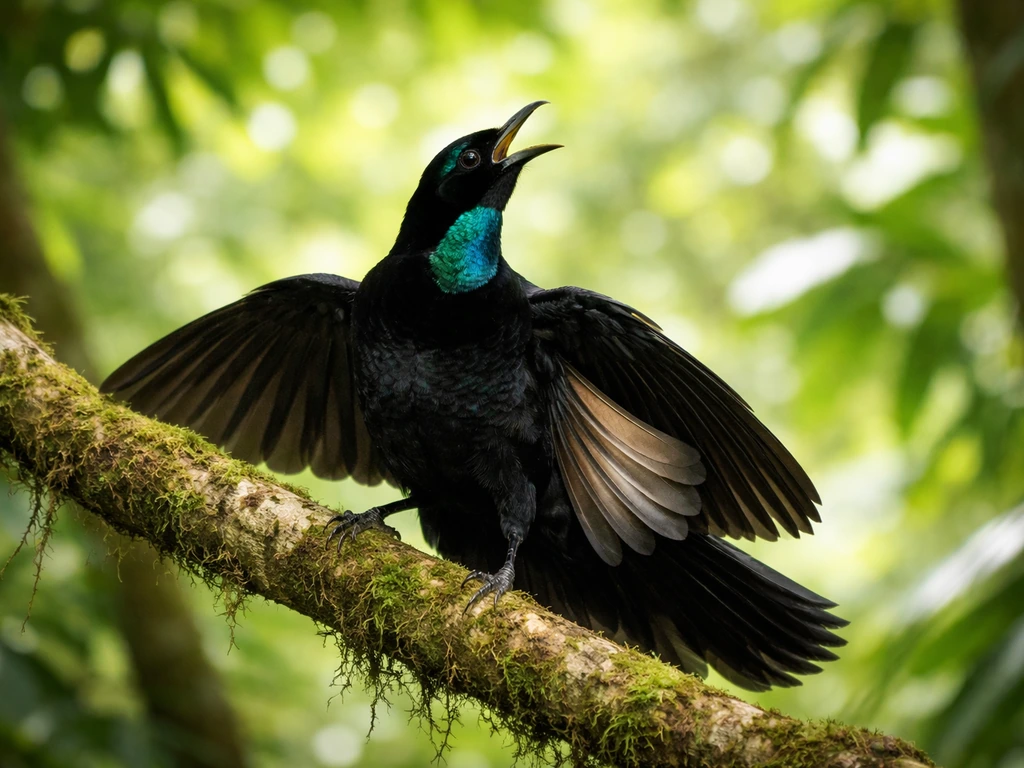
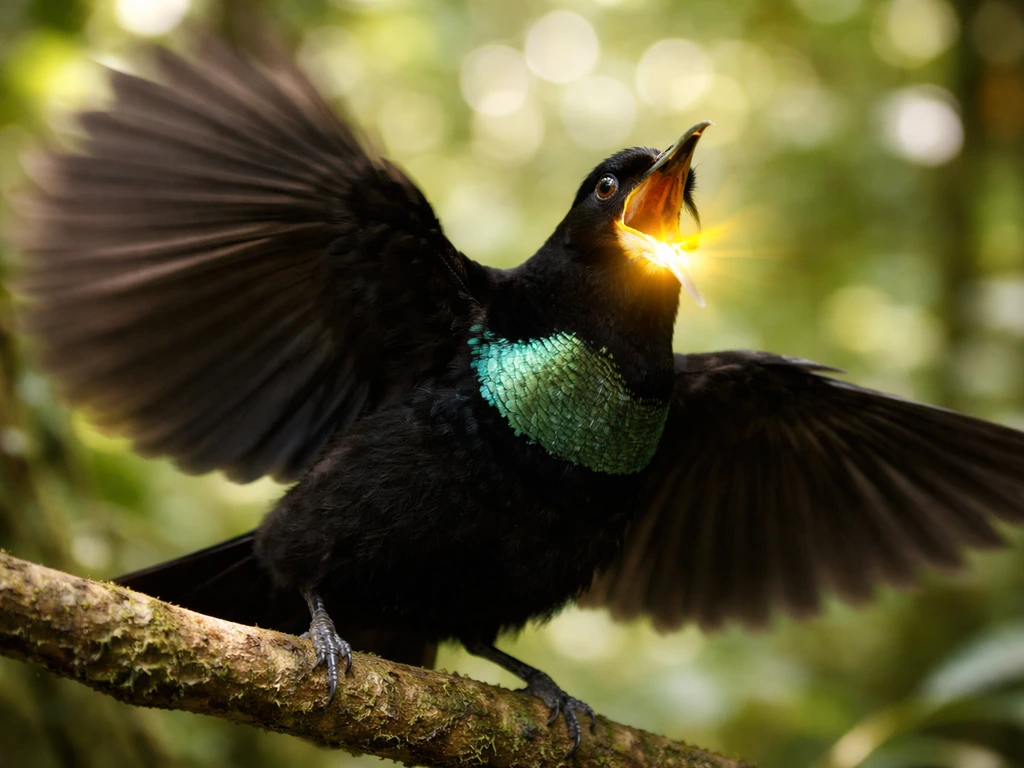
A male rifle bird of paradise attracts a mate through one of the most precisely choreographed courtship displays in the bird world. He claims a prominent exposed branch in the rainforest canopy, erects his iridescent throat and pectoral feathers to catch shafts of light, spreads both wings high above his head, and launches into a rhythmic side-to-side swaying dance that starts slowly and accelerates to a rapid tempo plateau. At the peak of that tempo, he flashes his bright yellow gape (mouth lining) directly at the watching female, all while producing loud wing-clap sonations that carry through the forest. It is the full package, movement, sound, color, and timing, working together as a coordinated sensory sequence that the female evaluates from her perch nearby.
How Does a Rifle Bird of Paradise Attract a Mate?
Male Courtship Behavior: What He Actually Does
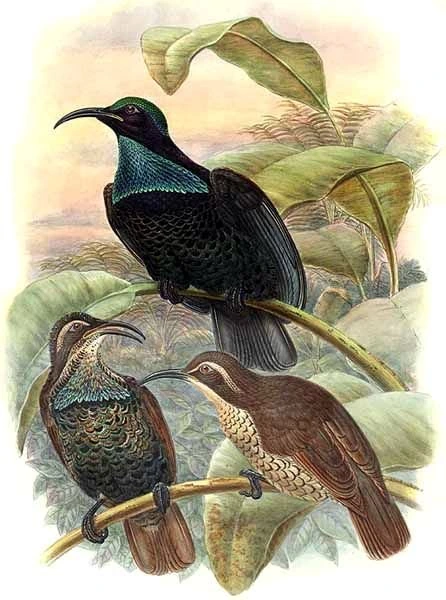
The male Paradise Riflebird (Ptiloris paradiseus) and his close relative Victoria's Riflebird (Ptiloris victoriae) share the same essential courtship logic. The male is a solitary displayer, meaning he does not gather with other males at a communal lek but instead holds his own display perch, typically a low-hanging, exposed branch where sunlight can penetrate the rainforest canopy and illuminate his plumage. During breeding season he becomes conspicuous and vocal, and can spend most of the day on these perches calling and displaying.
The display itself is structured and sequential. It is not a frantic burst of activity. The male begins in a static pose, then erects his throat and side feathers to maximize the iridescent sheen. He holds both wings high above his head, exposing the vivid metallic breast shield. Then the movement begins: rapid side-to-side wing sweeps combined with leg-driven swaying, and a wide-open gaping mouth that reveals a brilliant inner lining. He also produces a loud, explosive hiss or drawn-out 'yaassss' call that carries great distances through the canopy.
What makes this more than just flashy dancing is that the male actively adjusts his position relative to where the female is watching from. Researchers have noted that males orient themselves so the display is directed squarely at the receiver, not just performed into space. That intentionality is a key part of what females are assessing.
How the 'Rifle' Display Actually Works
The term 'rifle bird' is thought to reference the loud, sharp call, but the display mechanics are just as striking as the name. Research published in the Biological Journal of the Linnean Society (2025) and a detailed study summarized in Current Biology breaks the display down into measurable phases, and the timing is precise enough to predict mating success.
The slow start and the acceleration
The dance begins extremely slowly. In Victoria's Riflebird, the mean interval between the first and second wing claps is around 1.5 seconds. That is almost leisurely. Then the male gradually accelerates, compressing the intervals between each wing movement until he hits a fast tempo plateau where the mean interval between claps drops to around 300 milliseconds. Think of it like a conductor starting a piece adagio and building to presto.
The gape flash at peak tempo
The bright yellow gape flash, where the male turns his head forward and opens his bill wide between his outstretched wings, happens only during that tempo plateau. Each bout of gape flashing lasts roughly 1.82 seconds on average and includes around six to seven wing claps. The male positions his head carefully between his wings specifically to prevent his bill from catching flight feathers while he produces a high-amplitude bill-scraping sonation at the same time. The gape flash and the sound are synchronized, but interestingly the sound intensity drops slightly when the gape flash peaks, creating a kind of visual-auditory alternation that researchers describe as a 'sensory trajectory,' a structured sequence designed to capture, sustain, and focus female attention.
Why tempo matters so much
Studies confirm that faster maximal dance tempi strongly predict mating success. A male who can accelerate quickly and sustain the fast plateau is signaling genuine physical quality. It is not just about looking good, it is about being able to perform with precision under pressure while a female watches. Males who fumble the tempo, or who cannot hold the plateau long enough to deliver a clean gape flash sequence, are less successful.
What Females Are Actually Looking For
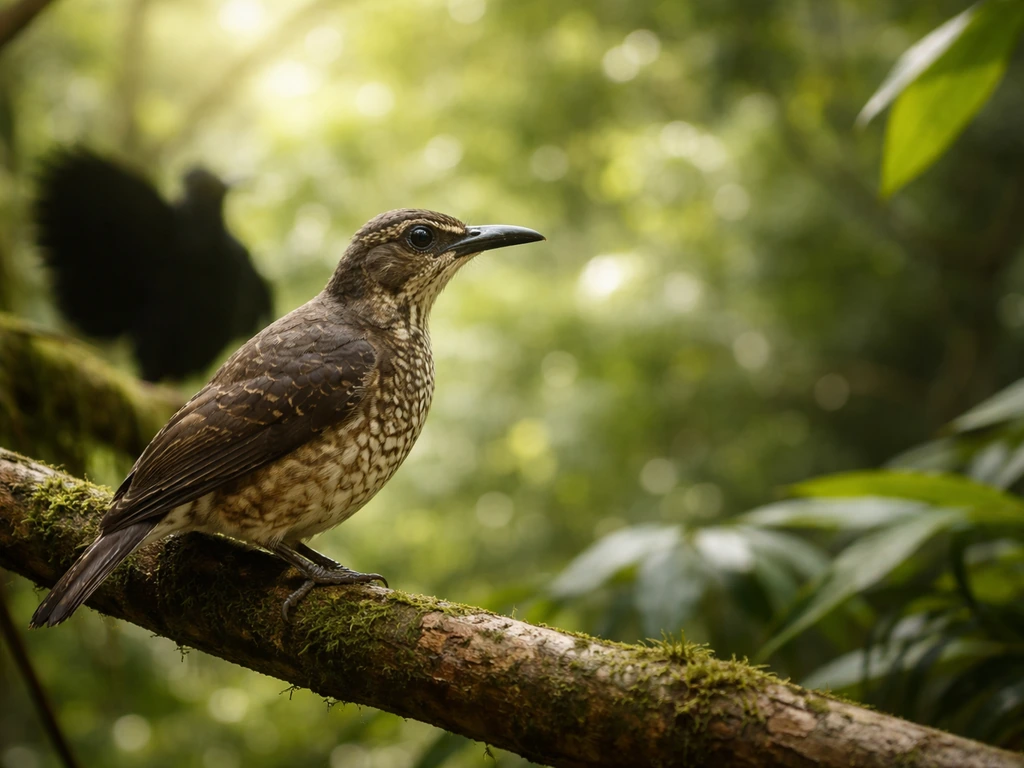
Female choice in riflebirds is not based on any single cue. The research is clear that females are integrating a whole sensory trajectory: the rhythm of the wing movements, the timing and brightness of the gape flash, and the synchronized sonations. No one element wins her over alone.
What a female appears to assess is whether the male can maintain her attention through the full arc of the display. The slow opening draws her in. The acceleration builds anticipation. The tempo plateau with its synchronized gape flash and sound is the climax of the sequence, and the male needs her to still be on the display perch, watching, when that moment arrives. If she leaves early, the display fails. So in a real sense, the male's ability to keep her engaged through each phase is itself the quality signal.
- Peak dance tempo: faster maximal tempi predict mating success directly
- Gape flash timing: only occurs at the tempo plateau, so early-departing females miss it
- Multimodal coordination: movement, gape color, and sound must all align correctly
- Iridescent plumage quality: erecting feathers in direct light maximizes the visual signal
- Display orientation: males position themselves to face the female squarely, not randomly
Habitat, Seasonal Timing, and the Role of Light
Rifle birds of paradise are rainforest specialists. The Paradise Riflebird is found in subtropical and tropical rainforests of eastern Australia, while Victoria's Riflebird inhabits the wet tropics of northeastern Queensland. Both species rely on specific environmental conditions for effective display.
Light is not a background detail, it is a functional part of the display. Males specifically position themselves on perches where blank" rel="noopener noreferrer">shafts of sunlight penetrate the canopy, because those shafts activate the iridescence in their throat and pectoral shield feathers. A male displaying in deep shade is essentially turning off half his signal. Early morning is a prime display window, anecdotal reports put males active on display perches as early as 5 a.m., and breeding season males are described as vocal and conspicuous throughout most of the day.
Seasonally, breeding for Ptiloris paradiseus victoriae runs from September through February, which means that is when you are most likely to encounter active courtship displays. Outside that window, male display behavior drops off significantly. If you are hoping to watch or document a display, plan your visit for the late austral spring through summer.
| Factor | What to Look For | Why It Matters |
|---|---|---|
| Season | September to February (breeding season) | Display frequency peaks during this window |
| Time of day | Early morning through mid-morning | Males are most active and vocal at dawn |
| Perch type | Exposed, prominent branch in canopy | Allows female visibility and sunlight access |
| Light conditions | Sunlight shafts penetrating canopy | Activates iridescent plumage for the display signal |
| Habitat | Subtropical or tropical rainforest edge or interior | Species-specific habitat requirement for territory and perch selection |
Watching Wild Displays: How to Position Yourself Without Interfering
If you are a backyard birder or wildlife watcher hoping to observe a rifle bird display in the wild, the approach is patience and stillness, not intervention. If you are wondering how to catch a myna bird instead, the key is to follow local wildlife rules and use humane, non-harmful methods rather than trying to lure birds during breeding activity.
If your goal is to attract a whippoorwill, focus on habitat cues like darkness, ground-friendly cover, and quiet conditions rather than loud sounds. Males in breeding season can spend most of the day on display perches, and their loud calls make them easier to locate than to see. The 'yaassss' or hissing call carries a long distance through the canopy, so follow your ears first.
Once you locate a display perch, the most useful thing you can do is stop moving, keep distance, and use binoculars or a zoom lens to observe. Any movement toward the bird risks interrupting the display or causing the female to leave the observation perch, which collapses the entire courtship sequence. The male needs the female's sustained attention; you do not want to be the reason that attention is broken.
- Listen for the loud 'yaassss' or explosive hiss call to locate a display perch from a distance
- Stop moving as soon as you spot the male or hear him close by
- Stay well back and use binoculars or a telephoto lens, no closer than necessary
- Do not use playback recordings or apps to attract or hold the male's attention
- Observe quietly and note the display phases: slow wing movements, acceleration, gape flash at peak
- If a female is present nearby, stay especially still so she can complete her assessment undisturbed
Captive and Aviary Settings: Supporting Natural Courtship Safely
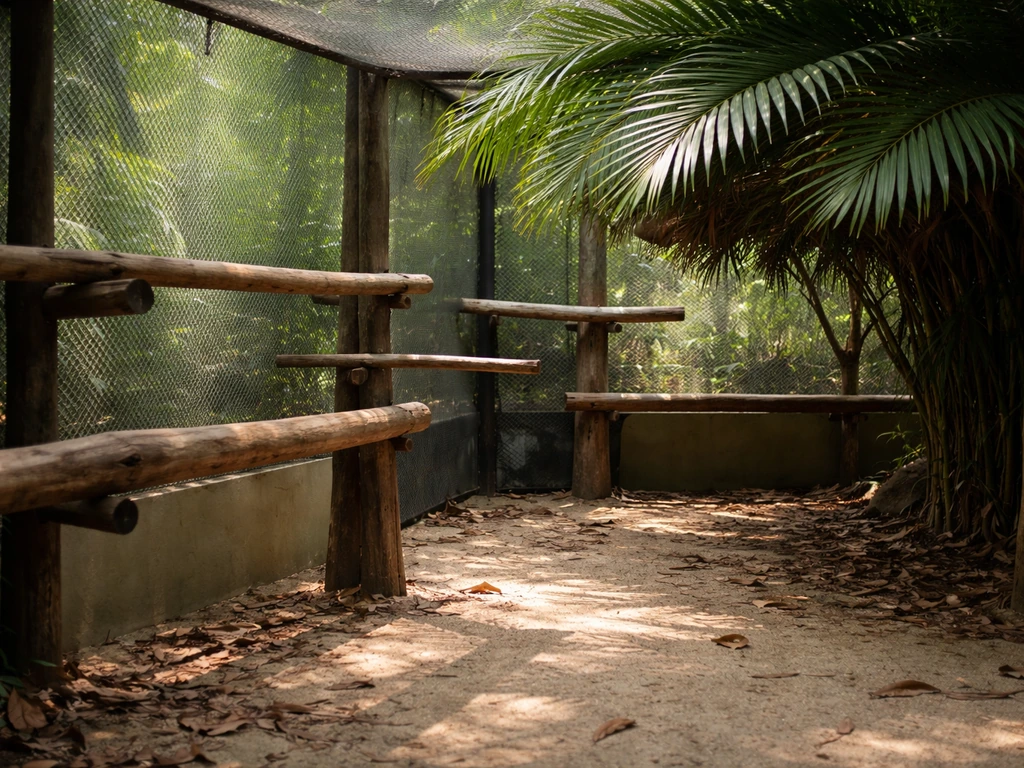
Rifle birds of paradise are rarely kept in captivity outside of specialized zoological collections, and managing them in private aviaries is legally complex in Australia. That said, for wildlife rehabilitators, registered keepers, or aviary specialists working with these birds, there are meaningful ways to support natural courtship behavior without forcing or stressing the birds.
The most important thing you can provide is a structural environment that mirrors what males use in the wild. That means prominent perches at varying heights with some exposure to natural light, ideally with sunlight access at specific times of day. The iridescent plumage signal depends on direct light, so an aviary that only offers filtered or diffuse light will suppress the display even if the male is otherwise healthy and willing.
Aviary design guidance from the Avian Scientific Advisory Group recommends that at least part of any aviary be sheltered, but for a displaying species like the riflebird, exposed open sections with perch height variation are equally important. Think about sightlines: the female needs to be able to watch the male from a perch at approximately the same level or slightly below, which is the natural geometry of riflebird courtship.
Do not place pairs in close confinement and expect courtship to happen on demand. Stress suppresses display behavior. Adequate space, appropriate food availability at all times (as required under South Australian captive bird codes and similar Australian regulations), and minimal human disturbance during breeding season are the baseline conditions. If the male is not displaying, the first troubleshooting questions are always about stress, light, space, and timing relative to breeding season.
| Setting | What You Can Do | What to Avoid |
|---|---|---|
| Wild observation | Use binoculars/zoom lens, stay still, find perch by ear | Playback recordings, approaching closely, disturbing the female |
| Backyard habitat | Plant native canopy trees, reduce disturbance near known perch sites | Feeding, using calls or decoys, trimming perch trees during breeding season |
| Captive/aviary | Provide prominent perches, natural light access, adequate space and food | Forced pairing, excessive handling during breeding season, poor lighting design |
| Rehabilitation | Support conditioning to natural behavior, consult wildlife vets for paired housing | Housing injured birds with potential mates without veterinary clearance |
If you are working in a rehabilitation context, displaying behavior in a male can actually be a useful indicator of recovery: a male who begins posturing, erecting feathers, and vocalizing is showing neurological and physiological readiness. Note the timing and whether his wing movements look symmetrical, asymmetry in wing display can indicate an underlying injury even when flight appears normal.
Ethical, Humane, and Legal Considerations
Watching rifle birds display is a privilege, not a right, and the ethics matter practically as well as morally. Courtship displays are energetically expensive for males and cognitively demanding for females. Any human action that disrupts the sequence, spooks the female, or pushes the male off his display perch is directly interfering with reproductive success.
Using playback recordings of rifle bird calls or display sounds to attract a male into view is ethically controversial and in some contexts illegal. The NPS explicitly advises against using bird call apps or recordings in national parks and wildlife refuges. Audubon's ethical guidance states playback should not be used to coax birds closer. The concern is real: playback can disrupt territorial behavior, interfere with natural pair formation, and cause birds to respond defensively rather than as part of genuine courtship. With a species whose mating success depends on a precisely timed sequence, injecting artificial sound cues into the environment is unpredictable and potentially damaging.
In Australia specifically, rifle birds of paradise are protected under national and state wildlife laws. Holding, handling, or keeping these birds without the appropriate permits is illegal. Captive breeding programs that involve wildlife trade or export require government-approved frameworks under the Australian Department of Climate Change, Energy, the Environment and Water (DCCEEW) regulations. If you are a keeper or rehabilitator, verify your permits are current and your housing practices meet state and territory codes before attempting to house a pair.
- Do not use playback recordings or birdcall apps to attract riflebirds, especially in protected areas
- Do not approach a displaying male or the watching female, the sequence requires uninterrupted attention
- Do not feed riflebirds or use decoys or food to attract them; this is considered harassment under wildlife viewing ethics and is illegal in many jurisdictions
- Do not handle wild birds without a permit and appropriate training
- Report distressed or apparently abandoned riflebirds to local wildlife authorities rather than attempting intervention yourself
- In captive or rehabilitation settings, comply fully with Australian captive bird codes and DCCEEW regulations before housing or pairing birds
- Check local ordinances before setting up any habitat modification aimed at attracting wildlife
One practical point worth keeping in mind: wildlife distress is not always obvious. NOAA's wildlife viewing guidance notes that animals do not always show visible behavioral changes when stressed. A riflebird that has not fled does not mean it is comfortable with your presence. When in doubt, increase your distance and err on the side of caution.
Your Practical Checklist for Today
Whether you are heading into Queensland rainforest this weekend, supporting birds in a wildlife aviary, or just trying to understand what you are looking at in a video of a riflebird display, here is what to do with this information right now.
- Check the calendar: breeding season runs September to February; plan observation trips within that window for the best chance of seeing active displays
- Arrive early: males can be active from around 5 a.m. and are most vocal in the morning hours
- Find the perch by sound first: listen for the loud, drawn-out 'yaassss' or explosive hiss call and navigate toward it from a distance
- Stop and stay still before you can see the bird: movement near the display site disrupts both the male and any attending female
- Watch for the display sequence: slow wing movements, gradual acceleration, then the gape flash at the fast tempo plateau with synchronized wing-clap sounds
- If in a captive or aviary setting, prioritize lighting (natural sunlight access), prominent perch height, adequate space, and minimal disturbance during breeding season
- Do not use playback, decoys, food, or any form of artificial attraction, in any context
- If something looks wrong (injured bird, obviously stressed bird), contact your local wildlife authority rather than intervening directly
Watching a riflebird display unfold in real time is genuinely extraordinary. The slow build, the acceleration, the sudden flash of yellow against that jet-black and iridescent body, it is one of the most sophisticated performances in nature. Understanding what the male is actually doing, and why each phase matters to the female, makes the experience even richer.
If you are also interested in attracting other wild birds to your yard or habitat, many of the same principles around timing, habitat quality, and ethical observation apply equally to species like bluebirds and bulbuls, though the display mechanics are very different. To learn more specifically about how to attract bulbul bird, focus on the right food, habitat features, and quiet presence that match how bulbuls feed and explore.
If you want to attract a bluebird, focus on creating the right habitat and timing so the area feels safe and inviting attracting other wild birds to your yard or habitat.
FAQ
If I see a male rifle bird posturing but not doing the full gape-flash sequence, does that mean he will not attract a mate?
Not necessarily. The full sequence depends on the male hitting the fast tempo plateau, and that timing can be disrupted by weather, noise, or the female’s position. If the bird repeatedly returns to the perch and resumes acceleration, he may be responding to light conditions or the receiver’s readiness rather than failing outright.
Where should I stand or position myself to avoid breaking the display?
Stay back and avoid moving toward the perch. Also consider your line of sight, if possible approach so the bird is not forced to look through your silhouette (blockage can act like an interruption). A common mistake is filming too close, which can cause the female to leave even if the male continues posturing.
Does playing recordings or imitating calls actually work for attracting a rifle bird?
It can backfire. The article already notes playback is ethically controversial and may be illegal in some places. Even when legal, artificial sound can trigger territorial or defensive responses, which means the male may stop performing the precise courtship rhythm you are trying to see.
How does the time of day affect the display, and what if I miss the morning window?
The display relies on direct shafts of sunlight to activate iridescence, so lighting matters as much as when the males are active. If you miss early morning, check later periods only if sunlight still reaches the canopy shafts on that specific perch, because diffuse or deep shade often reduces the visual component.
Are the courtship steps the same for Paradise Riflebird and Victoria’s Riflebird?
They share core logic, but timing details can differ. The article gives an interval example for Victoria’s Riflebird, so if you are comparing videos across species, expect differences in how quickly the wing-clap tempo ramps up and when the gape flash occurs.
What’s the biggest reason viewers fail to see the gape flash even when the male is performing?
Most often the female leaves early or never settles into an attentive viewing posture. Even if the male reaches a fast rhythm, the gape flash is most tightly synchronized with the climax moment of the sequence, which depends on the receiver staying on her perch.
Can a male display successfully if the environment has too much noise or disturbance?
He may still start, but sustained performance is harder. Because mating success correlates with reaching and holding the fast plateau, repeated disturbances can cause tempo “fumbles” or interruptions that reduce the probability of a clean gape-flash bout.
If I’m in a rehabilitation or aviary setting, what light setup best supports display?
Aim for a portion of the enclosure that provides direct, unfiltered sunlight at perch height, since iridescence depends on that direct illumination. Another practical detail is sightlines: provide an observation perch for the receiver that is at roughly the male’s level or slightly below to match natural viewing geometry.
Is it safe to assume that if a male is calling, he is ready to mate?
No. Vocalizing alone does not guarantee he will accelerate into the full timed sequence. The article notes display readiness can be a recovery indicator, so in rehabilitation contexts, track whether feathers erect symmetrically and whether wing motion and tempo transitions look coordinated before interpreting behavior as mating-ready.
What should I do if a bird seems stressed, but it is not obviously injured or fleeing?
Increase your distance immediately and minimize further disturbance. The article highlights that stress is not always visually obvious, so continuing to approach, reposition, or persist with closer filming can still interfere with reproductive behavior even if the bird remains perched.
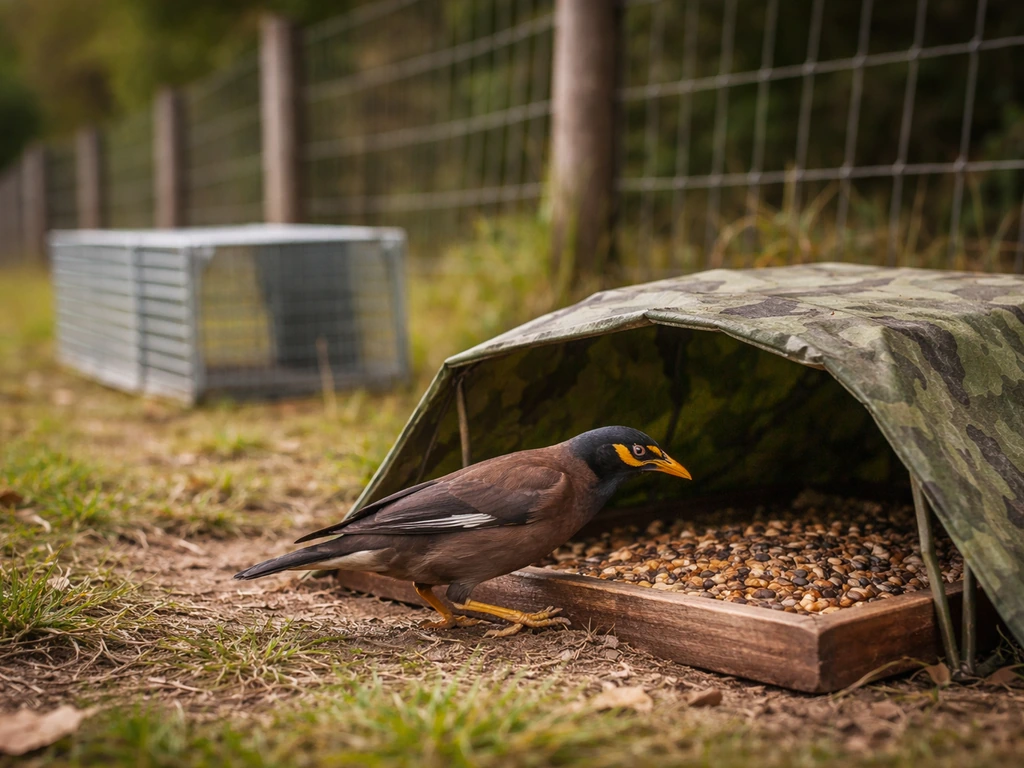
How to Catch a Myna Bird Safely and Humanely
Humane, step-by-step ways to catch or secure a myna using safe trapping, calm entry, and stress-minimizing handling.