Taming a finch is absolutely possible, but it looks different from taming a parrot or a budgie. Most finches will not become lap birds or step reliably onto your finger the way a cockatiel might. What you are really working toward is a bird that stays calm when you are nearby, recovers quickly from surprises, and ideally takes treats from your hand or tolerates gentle handling when necessary. That is a genuinely useful level of trust, and it is achievable with almost any pet finch if you are patient and consistent.
How to Tame a Finch Bird: Humane Step-by-Step Guide
Clara Hayes
18 Apr 2026
What 'taming' actually means for a finch
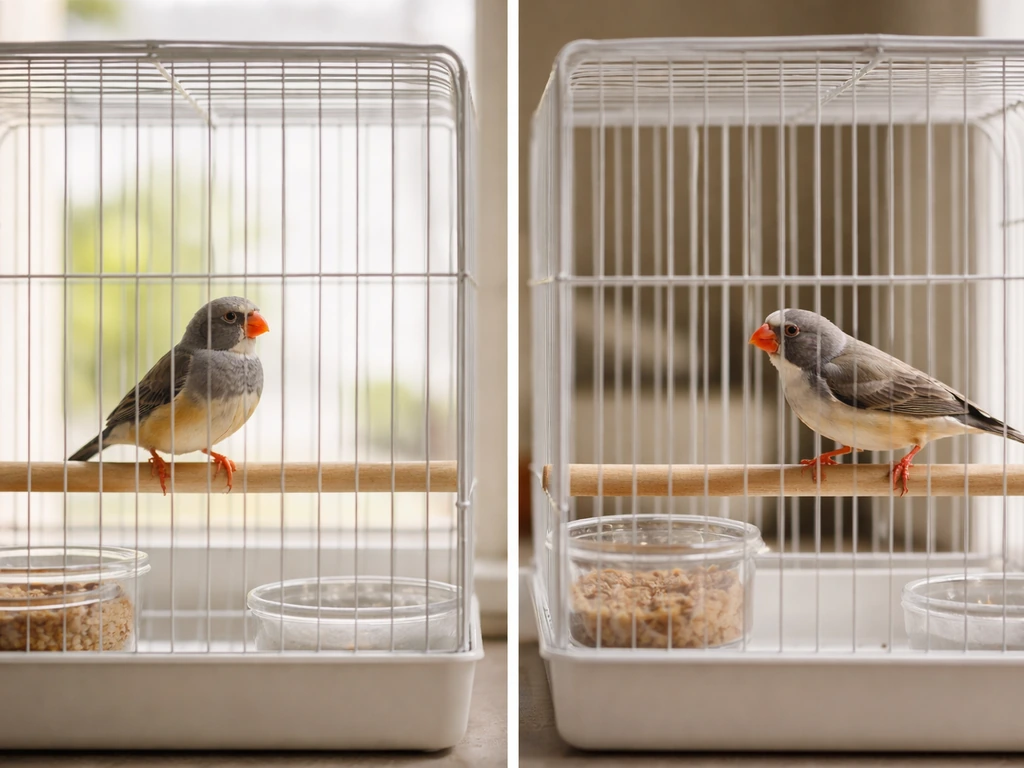
People use the word taming loosely, so let's be specific. For finches, taming exists on a spectrum: calm coexistence (the bird does not panic when you walk past the cage), treat acceptance (the bird takes millet or soft food from your fingers), hand perching (the bird briefly stands on your hand inside the cage), and routine handling (you can pick up, examine, or move the bird without a prolonged struggle). Most pet finches land somewhere in the first two categories. Full hand perching is realistic for some individuals, especially zebra finches and society finches raised with regular human contact. Routine handling on demand is rare and, honestly, not necessary for a happy, healthy finch.
The goal framing matters because it shapes your daily approach. You are building a learned association: your presence predicts safety, routine, and good things like food. You are not training compliance. The moment you start chasing, cornering, or forcing contact, you set the whole process back significantly. Think of it as a slow trust deposit rather than a training sprint.
Figure out your starting situation first
Your path forward depends heavily on where you are starting. A brand-new pet finch just brought home, an established but skittish bird you have had for two years, a hand-raised baby, and a wild finch visiting your yard are four completely different situations. Use the branching guide below to find your starting point.
Brand-new pet finch
The most important thing you can do in the first week is nothing. Let the bird settle. Place the cage in a calm room, maintain a predictable routine around feeding and lighting, and simply exist nearby without direct interaction. A zebra finch husbandry paper on PubMed Central notes that day-night lighting cycles of about 12:12 hours to 10:14 hours can be used in zebra finch housing protocols predictable routine around feeding and lighting. Avoid sudden movements, loud noises, and bringing strangers close to the cage. Your bird needs to learn that the new environment is safe before it can even begin to process you as a non-threat. Attempting handling or even treat offers in the first few days almost always backfires.
Established but skittish finch
If you have had the bird for months or years and it still flees to the far corner every time you approach, you are dealing with a trust deficit that has been reinforced over time. The process is the same as with a new bird, just slower. Start from the beginning of the desensitization steps below, be prepared for it to take longer, and look honestly at what in the current routine might be maintaining the fear (unpredictable handling, sudden noises, cage placement near a busy doorway, and so on).
Hand-raised or young finch
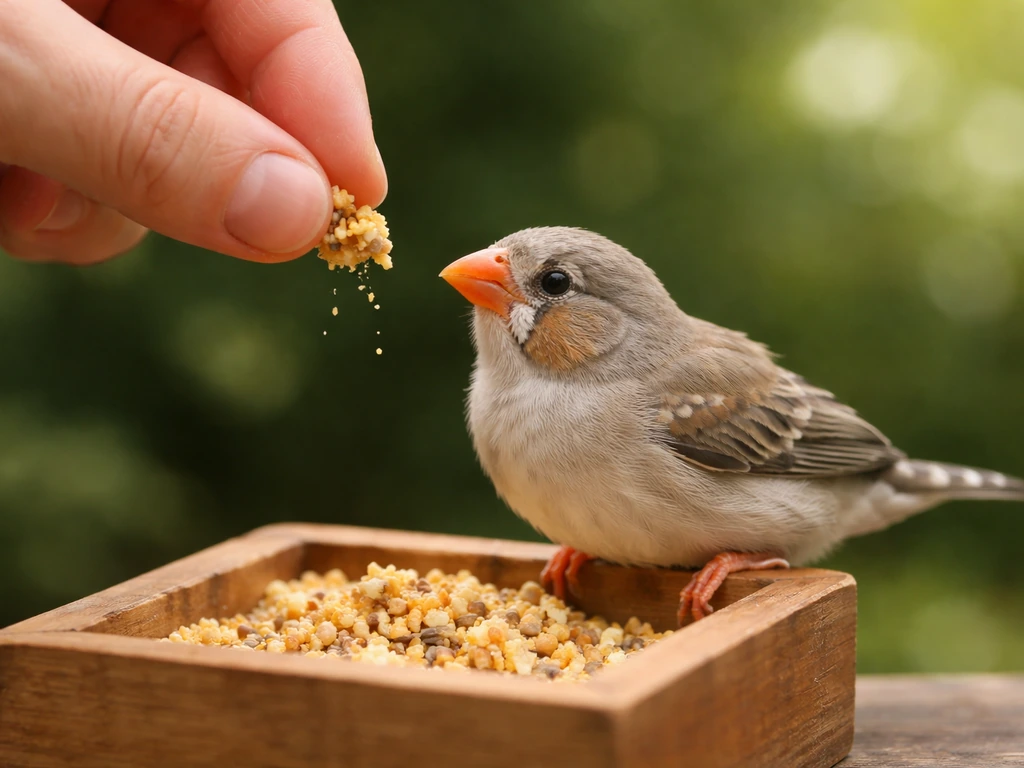
Hand-raised finches have a significant head start. They associate human hands with food and safety from day one. Your job is to maintain that association consistently. You can move more quickly through the early desensitization steps, but do not skip them entirely. Young birds still need routine and predictability to stay calm as they mature.
Wild or yard finch
If a finch is visiting your yard or feeder, "taming" it means encouraging it to become comfortable close to you, not capturing or keeping it. In the United States, most wild finches (house finches, goldfinches, purple finches, and others) are protected under the Migratory Bird Treaty Act. Trapping, possessing, or otherwise interfering with them is a federal offense that can carry civil penalties. In the UK, all wild birds are protected under the Wildlife and Countryside Act 1981, and intentionally disturbing certain species near active nests is also an offense. The approach for wild yard birds is purely about making your presence predictable and non-threatening near a feeding station. Do not attempt to catch or handle them.
Set up a calm, safe environment before you do anything else
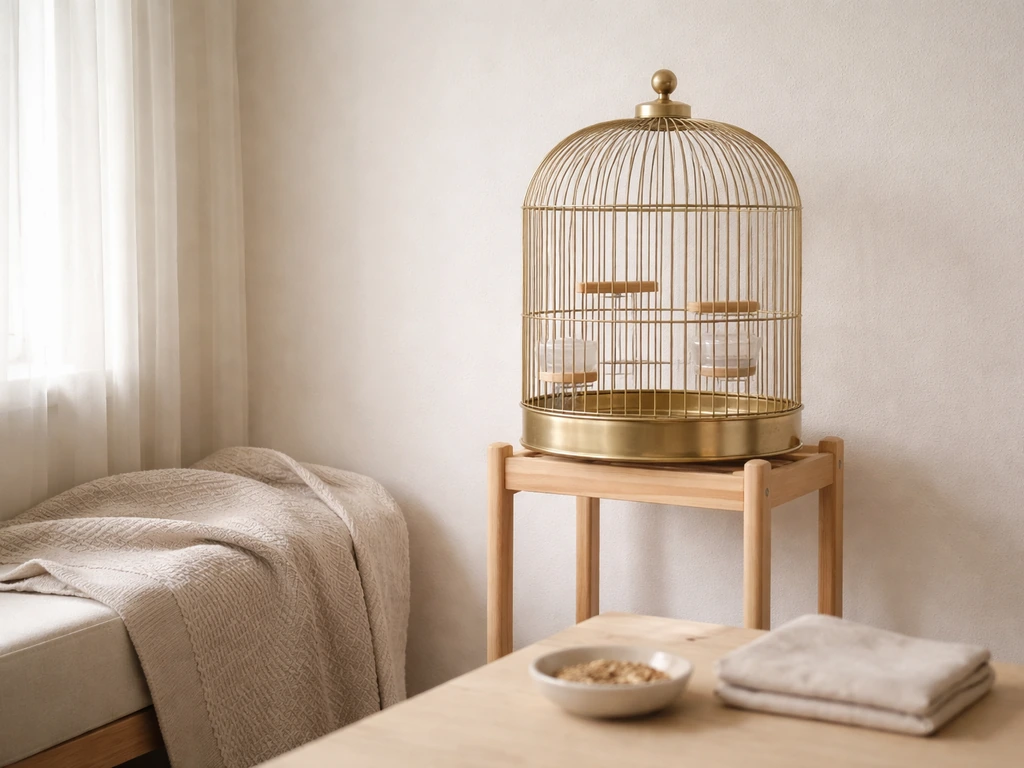
Environment is the foundation everything else is built on. A finch that is constantly stressed by its surroundings cannot focus on building trust with you. Get this right first and the training steps become much easier.
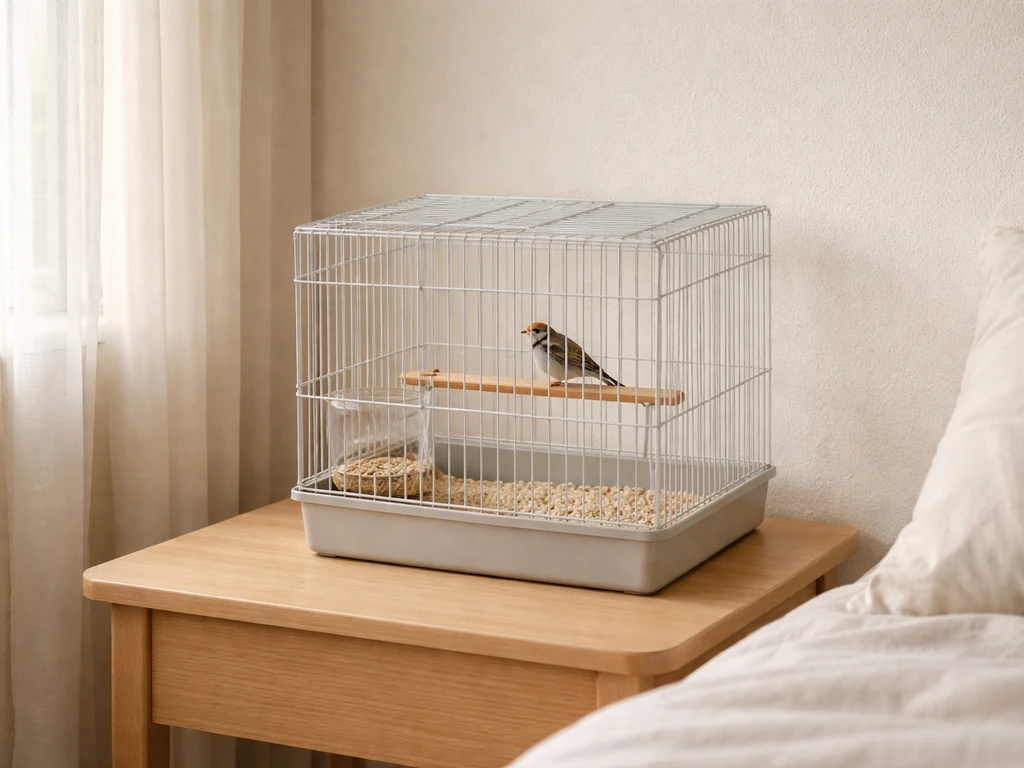
- Cage placement: Position the cage at roughly eye level or slightly below, against a wall so the bird has a sense of security at its back. Avoid drafty windows, high-traffic hallways, and spots next to speakers or televisions.
- Lighting and routine: Finches do well with 10 to 12 hours of light per day. Consistent light/dark cycles reduce stress significantly. Use a lamp on a timer if natural light is unreliable.
- Perch quality and variety: Offer perches of different diameters (6mm to 12mm is a useful range for most finch species) so the bird can choose what feels comfortable. Natural wood perches are ideal. Avoid smooth dowels exclusively, as they contribute to foot problems over time.
- Minimize hazards: Remove exposed wires, heavy swinging objects, and anything reflective that could cause startle responses. Keep the cage away from ceiling fans and other pets.
- Food and water placement: Keep these in predictable, easy-to-find locations. During early trust-building, place a secondary food dish near the side of the cage where you most often sit, so the bird begins associating your presence with food access.
- Avoid scented products: Before any interaction, do not use scented hand lotions, sanitizers, or perfumes. Birds have sensitive respiratory systems and strong scents can cause stress or avoidance responses.
Pairs and groups of finches are generally happier than solo birds, but a bonded pair will be harder to tame because the birds meet their social needs with each other rather than with you. If hand-taming is your priority, a single bird is more likely to bond to you out of necessity. That said, finches are highly social and a single bird kept without enough interaction can suffer. Be realistic about how much daily time you can commit.
Step-by-step desensitization: building trust without force
Work through these stages in order. Do not skip ahead because the bird seems fine. Each stage builds the neurological foundation for the next one.
Stage 1: Parallel presence (days 1 to 7)
Sit near the cage for 10 to 15 minutes once or twice a day. Do not look directly at the bird. Read a book, work on a laptop, or just sit quietly. Talk softly and at a low volume. The bird is learning that your presence is not followed by anything scary. You are not interacting yet, just existing. Success at this stage looks like the bird going back to eating or preening within a few minutes of you sitting down.
Stage 2: Slow approach and cage presence (days 5 to 14)
Begin moving slowly to the cage to refresh food and water. Narrate what you are doing in a soft, calm voice. Move in slow arcs rather than straight-line approaches, which birds read as predatory. Open the cage door and pause, let the bird react, and wait for it to settle before continuing. At this stage, introduce a consistent verbal cue (a soft whistle or a repeated word like "hello") so the bird starts to associate your voice with routine and safety.
Stage 3: Hand introduction and treat offering (days 10 to 30)
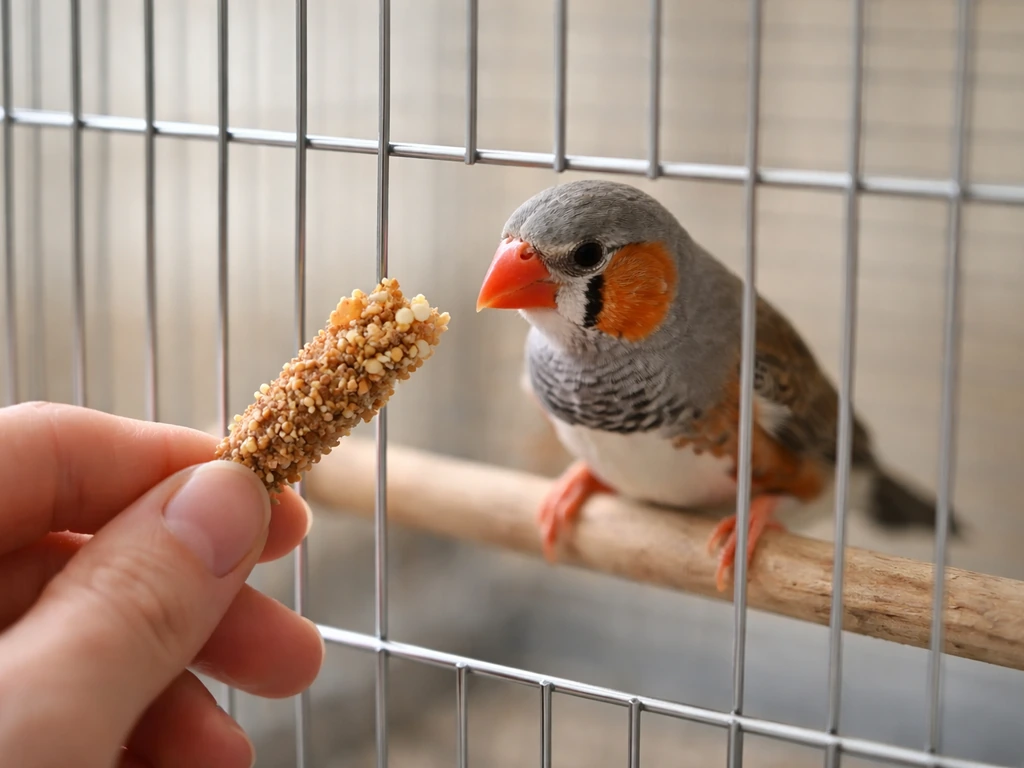
Offer a sprig of millet or a small piece of egg food by holding it against the cage bars first. Let the bird approach the treat at its own pace. Once it is reliably taking food from the outside of the bars, place the treat just inside the cage door and hold still. Do not push your hand further in than necessary. When the bird can eat from a treat held in your stationary hand inside the cage without fluttering away, you have cleared a major milestone. Keep sessions to 5 minutes at most to avoid fatigue and stress.
Stage 4: Still hand desensitization
Once treat acceptance is consistent, insert your hand into the cage and simply hold it still for several seconds before making any move toward a treat or the bird. You are teaching the bird that a hand inside the cage is not automatically a threat. This is an important step that many people rush past. The bird should be able to continue eating, preening, or moving around with your hand present before you progress further.
Moving into perching and gentle handling (only when the bird is ready)
This stage is not appropriate for every finch. If your bird is taking treats from your hand, staying calm with your hand inside the cage, and not showing alarm responses (wing flaring, tail fanning, rapid escape flights), you can gently test perching. Position a finger or a short perch stub horizontally just below the bird's feet while it is eating from your other hand. Do not lift or push. Let the bird step up voluntarily. Some finches will do this within a few weeks of consistent training. Others never will, and that is fine.
For the very small subset of finches that do become comfortable on your hand, you can use a marker-based approach to reinforce the behavior precisely. A short click sound (from a clicker or even a tongue click) timed to the exact moment the bird steps up, followed immediately by a food reward, communicates clearly which behavior earned the treat. Keep sessions under three minutes. This approach, adapted from marker training used with parrots and other species, works on the same principle regardless of bird size.
Routine handling, meaning picking the bird up for examination or moving it, should only happen when necessary (vet visits, health checks, cage cleaning) until the bird is genuinely comfortable. When you do need to catch a finch that is not yet hand-tame, a soft cloth net is far safer than grabbing with bare hands. Stressed finches can flutter violently, increasing the risk of injury to wings and legs. This is worth knowing ahead of time so you have the right tool before you need it.
Troubleshooting when progress stalls
Almost everyone hits a wall at some point. Here are the most common problems and how to address them.
| Problem | Likely cause | What to do |
|---|---|---|
| Refuses treats from your hand | Too much approach pressure; wrong treat type | Back up a stage. Try a different high-value food (millet spray, live or dried mealworms). Place the treat on the cage floor first rather than holding it. |
| Constant flighting and cage crashing | Environment is too stimulating or approach is too fast | Check cage placement, lighting, and nearby noise sources. Slow down all approach movements. Consider a temporary partial cover on three sides of the cage. |
| Fluffed feathers and lethargy (not fear) | Possible illness, not just stress | Distinguish fear from illness carefully. Persistent fluffing combined with lethargy, tail bobbing during rest, or open-mouth breathing are clinical illness signs, not training problems. See the health section below. |
| Wings held away from body and tail fanning during approach | Defensive threat display | You are moving too fast. Back off significantly. The bird is communicating it feels cornered. |
| Bird ignores you because of a cage mate | Social needs are met by the other bird | This is normal for bonded pairs. Progress will be slower. You can try separating birds briefly for training sessions, but only if the separated bird does not show distress. |
| Biting during handling | Fear-based defensive aggression | Do not jerk your hand away sharply, as this rewards the bite by removing the scary thing. Pause calmly, then slowly withdraw. Re-evaluate whether you have moved too quickly to the handling stage. |
| Bird was progressing well but suddenly regressed | Change in environment, routine disruption, or early illness | Identify what changed. New pet in the house, moved furniture, different schedule, new food. If nothing changed, monitor for illness signs. |
Realistic timelines
A new finch that is completely wild-caught or aviary-raised with no human contact may take two to four months before it reliably tolerates your hand near the cage. A young, socialized bird might accept treats from your hand within two to three weeks. Hand-raised birds can often progress through all stages in under a month. These are not guarantees. Individual birds vary enormously based on genetics, prior experience, and how consistent you are with the routine. The biggest mistake people make is rushing the timeline because the bird had one good session. One good session is a data point, not a new baseline.
The process for finches has some parallels to working with other small birds. If you have experience taming a budgie bird, you will recognize the same patience-first approach, though finches are generally less inclined toward hand perching than budgies are.
Health checks, safety, and when to get professional help
The single most important skill you can develop alongside taming is the ability to spot early illness. Birds instinctively hide weakness, so by the time a finch looks visibly sick, it has often been unwell for some time. Catching problems early is the difference between a straightforward vet visit and an emergency.
Signs that warrant an avian vet visit, not more training
- Persistently fluffed feathers combined with lethargy or reduced activity (not just brief post-fright fluffing)
- Open-mouth breathing, increased sternal motion (the chest heaving noticeably), or tail bobbing at rest
- Discharge or bubbles from the beak or nostrils, which can indicate respiratory infection
- Significant weight loss or a noticeably prominent keel bone
- Changes in droppings: very watery, discolored, or absent
- The bird sitting low on the perch or on the cage floor without obvious reason
A finch that is ill needs stabilization and veterinary care, not a training session. If you are seeing illness signs, keep the bird warm (around 85 to 90 degrees Fahrenheit if severely unwell), minimize handling and stress, and contact an avian vet promptly. Do not interpret fear responses and illness signs as the same thing. A bird that is frightened will typically recover its normal posture and activity within a few minutes once the stressor is removed. A bird that is sick will remain hunched and low-energy regardless of what is happening around it.
If you find an injured or weak wild finch
If a wild finch is on the ground and clearly injured or unable to fly, the correct response is not to begin taming it. Contain it gently in a ventilated box lined with a soft cloth, keep it in a quiet, warm place, and contact a licensed wildlife rehabilitator as soon as possible. Minimizing handling is the priority: the more you handle a stressed or weak wild bird, the greater the risk of making its condition worse. Do not offer food or water until you have spoken to a rehabilitator, as incorrect feeding can cause aspiration or other harm.
Legal and ethical do's and don'ts
- Do: Encourage wild finches to visit your yard with appropriate feeders and water sources. This is legal, ethical, and rewarding.
- Do: Report injured wild birds to a licensed wildlife rehabilitator rather than attempting home care beyond basic stabilization.
- Do: Make sure any pet finch you acquire comes from a reputable breeder or legitimate rescue, with proper documentation.
- Do not: Trap, net, possess, or attempt to keep wild finches. In the US, most wild finch species are protected under the Migratory Bird Treaty Act, and violations can result in significant civil penalties. In the UK, all wild birds are protected under the Wildlife and Countryside Act 1981.
- Do not: Remove wild finch eggs or chicks from nests, or disturb an active nesting site. This is an offense in both the US and the UK regardless of intent.
- Do not: Use decoys, traps, or call-playback to lure wild birds closer than they would naturally approach. Beyond legality, it causes genuine stress to the birds.
Your practical plan for the next seven days
Here is what to actually do this week, regardless of which starting situation you are in.
- Day 1 to 2: Audit the environment. Check cage placement, lighting routine, perch quality, hazards, and noise levels. Fix any obvious stress sources before doing anything else.
- Day 3 to 4: Establish your parallel presence routine. Sit near the cage for 10 to 15 minutes twice a day. Soft voice, no direct eye contact, no sudden movements. Note how quickly the bird resumes normal activity after you sit down.
- Day 5: Introduce your verbal cue consistently during feeding. Use the same soft word or whistle every time you approach to refresh food and water.
- Day 6: Offer millet or another high-value treat through the cage bars. Do not push. Let the bird come to you.
- Day 7: Assess where you are. Is the bird eating within two minutes of you sitting nearby? Is it approaching the bars when you offer a treat? Those are genuine signs of progress. If not, that is fine. Keep the parallel presence routine going for another week before trying treat offers.
Signs the process is actually working
- The bird resumes eating or preening within two to three minutes of you sitting nearby (instead of staying frozen at the far end of the cage).
- It approaches the side of the cage where you are sitting without being prompted by food.
- It vocalizes normally (singing, chirping) while you are present. A silent, tense bird is still stressed.
- It takes food from the cage bars and eventually from your fingers without fluttering away.
- After a brief startle, it recovers quickly rather than continuing to crash around the cage.
How finch taming compares to other small birds
Finches sit at the more independent end of the pet bird spectrum. Species like canaries are similar in temperament, and if you want a deeper look at that overlap, the guidance for taming a canary bird follows many of the same patience-first principles covered here. On the more interactive end, birds like parakeets and conures tend to be more naturally inclined toward human contact. The approach used for taming a parakeet bird involves a similar desensitization ladder but typically progresses more quickly to finger perching. If you are working with multiple species or considering adding a more interactive bird to your home, reading about taming a conure bird gives a useful sense of where the upper end of small-bird interaction looks like. And for birds with very different social structures, like mynahs, the trust-building fundamentals stay consistent even though the species specifics shift quite a bit, as you can see in guidance on taming a mynah bird.
The core truth across all of these species is the same: trust is built incrementally, through predictable positive experiences, and it cannot be forced or shortcut without cost. Finches are not the cuddliest birds you can keep, but a finch that sings confidently while you sit nearby, flies to the cage door when you appear, and eats millet from your fingers is a genuinely rewarding relationship. That is an achievable goal for most people willing to put in consistent, patient daily time.
FAQ
How do I know my finch is ready to move to the next taming step (instead of stalling or rushing)?
Use behavior as your checklist: the bird should keep normal posture and resume eating or preening within a few minutes after you approach, accept treats without repeated bursts of fluttering, and show brief curiosity rather than sustained avoidance. If the bird starts freezing, tail fanning repeatedly, or repeatedly relocates to the farthest corner for long periods, stay at the previous step for several sessions.
What if my finch takes millet from my fingers at the cage door, but still won’t tolerate my hand inside the cage?
That usually means your hand inside reads as a new, bigger “event” than the treat itself. Go back one stage and hold the treat at the doorway against the bars first, then just inside the open door while keeping your hand still for longer than usual. Only insert the hand when the bird is calm and actively feeding, and avoid moving your fingers toward the bird.
Should I offer treats every day during taming, and can I overdo millet or soft foods?
Treats help learning, but finches can get imbalanced diets if treats replace normal food. Offer treats in small portions during training sessions and keep the base diet consistent. If your bird’s droppings change, weight gain accelerates, or the bird becomes fixated on treats instead of maintaining normal foraging, reduce treat frequency and prioritize regular feeding time routines.
Can I tame a finch faster by handling it more, like picking it up to get it used to me?
For most finches, frequent grabbing or forced contact slows progress and can increase stress. Routine handling should only be done when necessary, and only when the bird is already calm with your hand inside the cage. If you need to move the bird, use a soft cloth net and do minimal, purposeful handling to reduce panic learning.
What’s the best time of day to work on taming, and does lighting matter?
Choose a predictable window when your finch is usually alert but not already stressed, often when the bird naturally settles around its normal feeding routine. Keep lighting and daily noise consistent in the room. Sudden light changes (for example, new bright lamps, TV glare, or moving the cage near windows that get sun flashes) can reset fear responses even if training steps are correct.
My finch panics when I approach, but settles when I sit still. Should I try to “desensitize” by approaching closer each day?
Yes, but do it indirectly. Start by reducing the intensity of movement, not the distance. Sit quietly first, then do slow refresh movements that stop before the bird is clearly alarmed. Move in gentle arcs, pause with the door open without reaching, and only progress when the bird returns to eating or preening quickly after you pause.
How do I avoid accidentally teaching fear when the bird flutters or escapes during sessions?
End the session on a calm note. If the bird performs intense escape flights or prolonged fluttering, stop introducing new steps, wait for normal behavior to resume, and resume later without increasing your reach or speed. Also keep sessions short so the bird associates your routine with safety rather than prolonged “chasing” pressure.
If I have a pair or small group, can I still tame a finch effectively, or will the other birds interfere?
It’s possible, but expect the tame bird to be less “motivated” by you when companions meet its social needs. If hand-taming is your priority, consider training one target bird at a time and keep others consistent in their environment so the target can focus on your presence predicting safety. Avoid separating bonded birds permanently unless a qualified avian professional advises it.
Should I use a clicker or tongue click for finches, and how exactly do I time it?
Marker sounds can work, but timing is everything. Use the click the instant the bird performs the desired action (for example, stepping onto a finger), then deliver the reward immediately. Keep marker sessions very brief, and only mark when the bird is already willing to try the behavior, otherwise you risk creating frustration or association with continued pressure.
What should I do if my finch shows signs of illness but I’m mid-taming?
Switch from training to health monitoring. Birds often hide illness, so if you notice persistent low energy, hunched posture, changes in breathing, or reduced activity that does not correct quickly when you stop interacting, contact an avian vet promptly. Consider that fear reactions usually resolve within minutes after the stressor ends, while sickness behavior often does not.
Is it okay to tame a wild finch that visits my feeder?
Don’t attempt capture or handling. For wild yard birds, your goal is predictability near the feeding station, not making it step onto your hand or removing it from the environment. Use consistent placement and quiet behavior, and prioritize wildlife-appropriate safety, since interfering with wild birds can be illegal and ethically risky.
What’s the safest way to catch a finch for a vet visit if it isn’t hand-tame yet?
Plan ahead. Use a soft cloth net rather than bare-hand grabbing, because finches can flutter violently and injure wings or legs. Have the transport setup ready before you approach, minimize handling time, and keep the process calm and efficient to reduce panic.